BRONCOFACTS Trail guide · 1966–present

Model year · Ford Bronco II

1990 Bronco II

The final Bronco II year

Bronco II production ended during the 1990 model year, with late four-wheel-drive trucks receiving the stronger Dana 35 front axle before the larger Explorer succeeded the line.
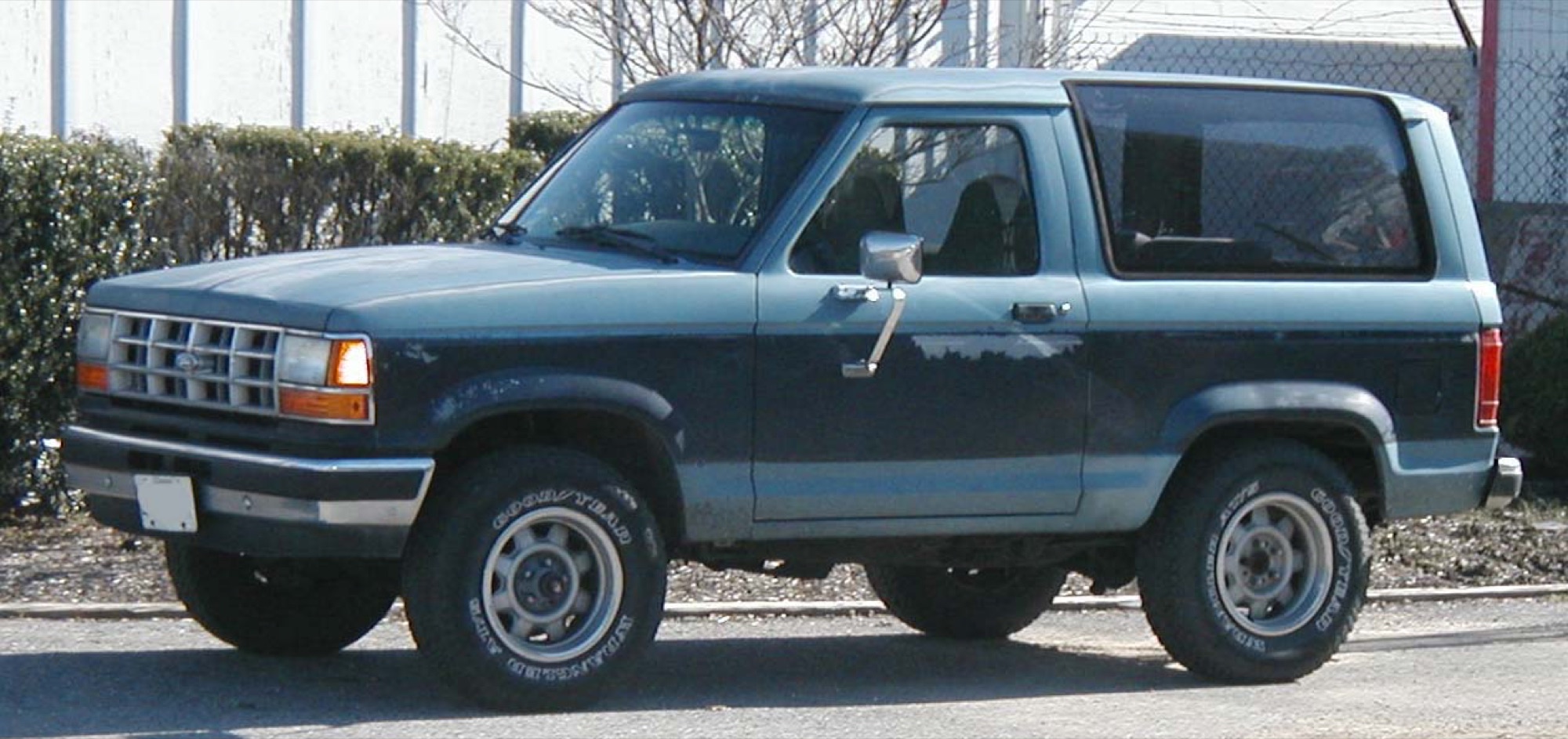
1989–1990 Ford Bronco II, post-restyle (new hood/fenders/bumper), teal/gray two-tone
1989–1990 Ford Bronco II, post-restyle (new hood/fenders/bumper), teal/gray two-tone Photo by IFCAR, public domain, via Wikimedia Commons

This page covers the U.S.-market Bronco II, distinct from the same-year full-size Bronco. Its final short model year retained the post-restyle three-door body and fuel-injected 2.9-liter V6. Specialist histories place a Dana 35 front-axle change after November 1989 and production's end early in 1990; the available sources disagree between January and February, so the exact month remains qualified.

Why it matters

1990 closed the seven-model-year Bronco II run and marked Ford's transition from the short-wheelbase compact SUV to the larger three- and five-door Explorer program.

What this page covers

Market: United States; Ford Bronco II peer family, distinct from the 1990 full-size Bronco.

Body styles: Three-door compact body-on-frame wagon in 4x2 or 4x4 form

What changed for this year

Final production year
Bronco II production ended early in calendar 1990. One specialist history says February, while a secondary overview says January; without a factory shutdown record, this page preserves the disagreement rather than selecting a month. [1] [2]
Late 4x4 front-axle change
Specialist histories report that four-wheel-drive Bronco IIs built after November 1989 received a Dana 35 front axle in place of the Dana 28. Build date and axle identification matter more than model year alone. [1] [2]

Models and trims

Base through XLT
Base, XL, XLS and XLT continued in the available secondary trim chronology, with Eddie Bauer as a premium XLT treatment. Exact final-year restrictions still need a factory order guide. [1] [3]

Engines and transmissions

2.9-liter fuel-injected V6
The electronically fuel-injected 2.9-liter Cologne V6 continued, reported by specialist sources at 140 hp and 170 lb-ft, with 4x2 and 4x4 configurations. [1] [2] [4]
No factory 4.0-liter Bronco II
The Bronco II ended with the 2.9-liter V6. The 4.0-liter V6 belongs to the succeeding 1991 Explorer program and should not be backfilled into a factory 1990 Bronco II specification. [1] [2] [6]

Capability and specifications

Published production split
Bronco II Corral reports 38,905 four-wheel-drive and 18,595 rear-wheel-drive units, totaling 57,500 for 1990. The table does not identify an original Ford production record, so the figures remain attributed. [5]
Short wheelbase retained
Bronco II retained its 94.0-inch wheelbase. The succeeding Explorer used longer 102.1-inch three-door and 111.9-inch five-door wheelbases, making it a related replacement rather than a simple rebadge. [2] [6]

Colors and interiors

Photo documents the shared late appearance
The approved teal-and-gray photograph is identified as a 1989-1990 Bronco II. It demonstrates the post-restyle form but cannot establish an exact model year, complete paint palette or interior code. [1] [7]

Options and packages

Final-year combinations need documents
Trim, 4x2 or 4x4 drivetrain, axle and option claims should be checked against build date, certification label and original paperwork. A 1990 model-year badge alone cannot establish whether a 4x4 has the late Dana 35. [1] [2] [3]

Safety and recalls

Safety controversy remained part of the final year
The federal investigation and Consumer Reports criticism that became public in 1989 remained important context as production ended. Investigation, recall and later disputed litigation figures are separate claims and are not collapsed into one finding. [2] [8]
Inspect chassis and axle identity
Check tires, steering, suspension, brakes, wheel bearings, ride height, corrosion and modifications, then identify the front axle and verify campaigns using the actual VIN. [1] [2]

Owner and buyer notes

Build date can change the axle answer
On a four-wheel-drive example, inspect the certification label and axle itself before ordering Dana 28 or Dana 35 parts. A later axle swap can also differ from the factory build. [1] [2]
Do not substitute Explorer specifications
Explorer succeeded Bronco II in Ford's lineup but added a longer platform, a five-door body and different powertrain availability. Parts and dimensions are not interchangeable merely because the programs share Ranger lineage. [2] [6]

Stories from this year

The last trucks carried a meaningful running change
Final-year does not mean mechanically frozen. The reported post-November Dana 35 change makes production timing unusually useful to restorers and parts buyers. [1] [2]
Succeeded, not rebadged
Explorer production followed quickly, but its longer wheelbases and new five-door body changed the product formula. Bronco II's end is best understood as a lineup succession, not a nameplate swap on the same vehicle. [2] [6]

Sources and footnotes

Bracketed references beside a fact lead to the document that supports it.

  1. Bronco II Corral model history Specialist model history
  2. Ford Bronco II overview Secondary chronology with cited references
  3. MotoGallery Bronco II trim history Specialist trim history
  4. The Ranger Station 2.9-liter V6 technical history Specialist technical reference
  5. Bronco II Corral production numbers Enthusiast production table; sourcing method unstated
  6. Ford Explorer model history Secondary successor chronology and dimensions
  7. Wikimedia Commons 1989-1990 Bronco II image Public-domain vehicle photograph
  8. Washington Post: Consumer Reports criticizes Bronco II handling Contemporary news archive

See something missing or wrong? Send a correction or source.