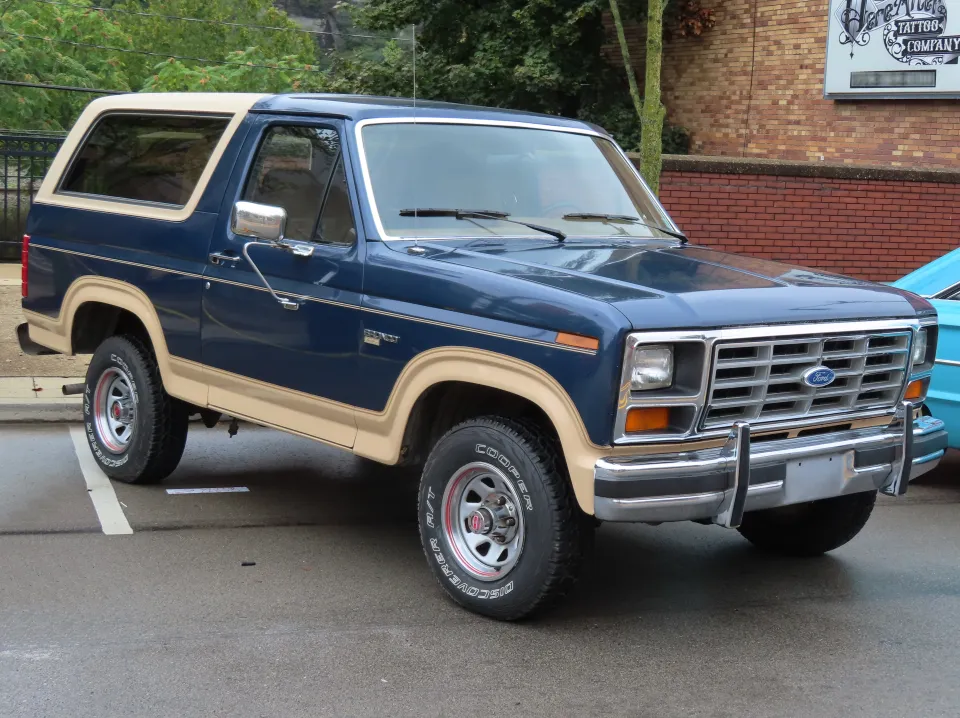
Generation 3 · F-150 based · 1980–1986
Third Generation
Lighter, more aerodynamic and independently sprung up front.
Photo by MercurySable99, CC BY-SA 4.0, via Wikimedia Commons · Source: Wikimedia Commons
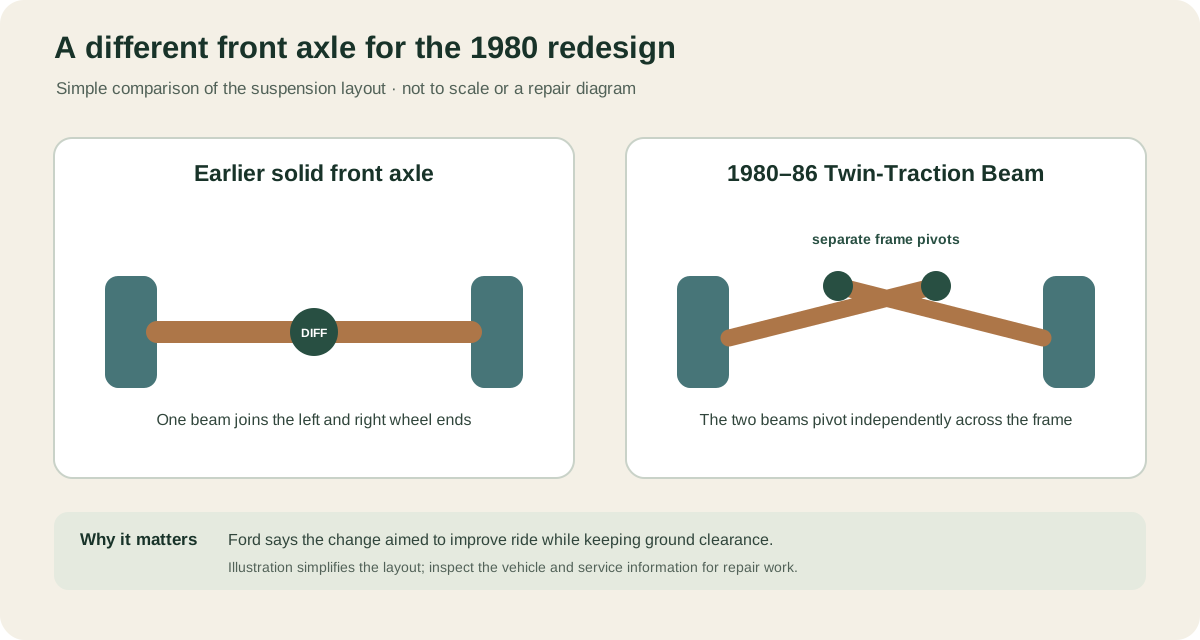
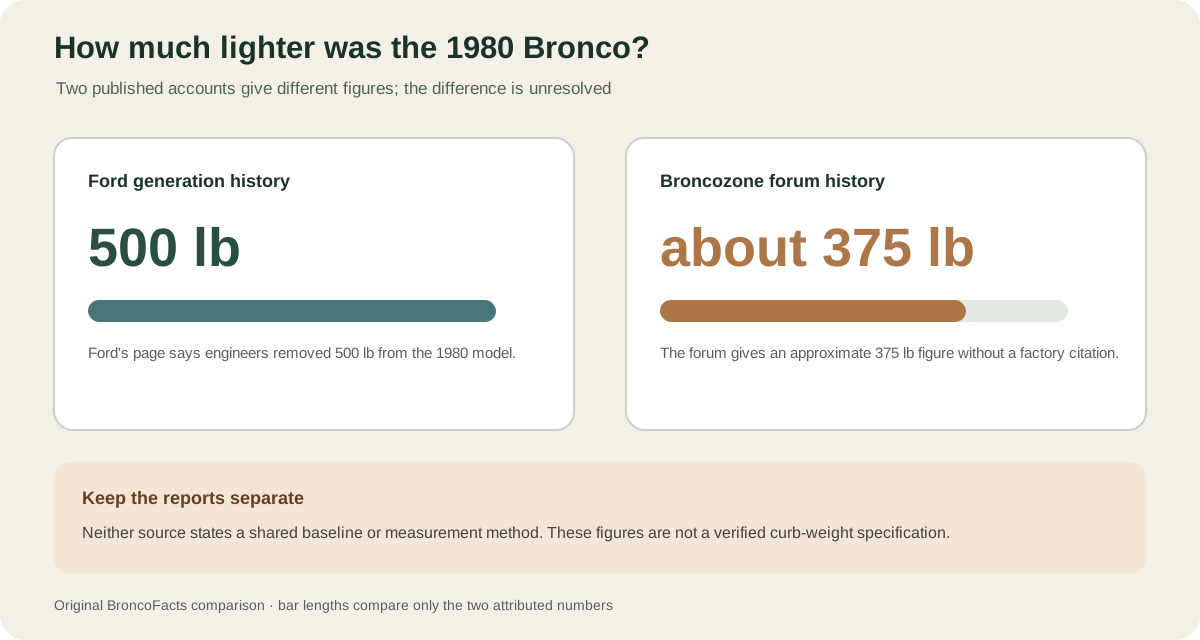
For 1980 the Bronco moved to the new F-150's shortened frame and got independent front suspension. Ford's Twin-Traction Beam replaced the solid front axle with a Dana 44-based independent setup, meant to ride better and keep the ground clearance. Wheelbase was 104.7 inches and length 177.6. The body stayed a two-door wagon with a removable fiberglass rear roof, built in Wayne, Michigan. Ford's history page says the new truck weighed 500 pounds less; a forum history puts the cut at about 375. Owners call this generation the bullnose.
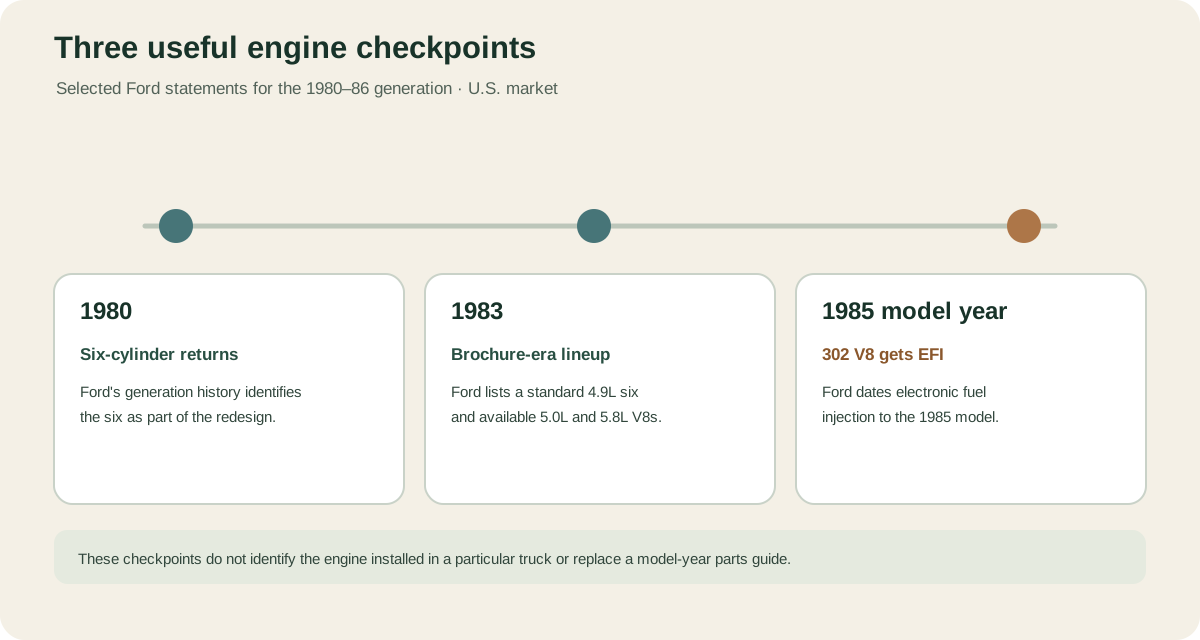
The 300 cu in (4.9L) six was the standard engine, with the 302 and 351 V8s optional. The six came only with a manual until 1983, when Ford added the automatic. For 1981 an overdrive four-speed and automatic locking hubs were optional. The 351M gave way to the 351 Windsor for 1982, the year the XLS appearance package arrived. Late in 1983 the four-barrel 351 H.O. came in at 210 hp. For 1985 the 302 got fuel injection, the four-speed Automatic Overdrive joined the list, and the Eddie Bauer trim topped the range. Published output for the injected 302 runs from 150 to 190 hp. The 8.8-inch rear axle came in from 1983 and ran alongside the 9-inch until 1986.
Blue Oval Trucks and Wikipedia agree on 44,353 for 1980, 39,853 for 1981, 40,782 for 1982 and 62,127 for 1986, the best year of the generation. They split on 1983, 38,963 or 40,376, and on 1984, 47,423 or 40,376; Wikipedia uses the same figure both years. For 1985 Blue Oval lists 54,562 built and Eighties Cars gives 52,316 sold.
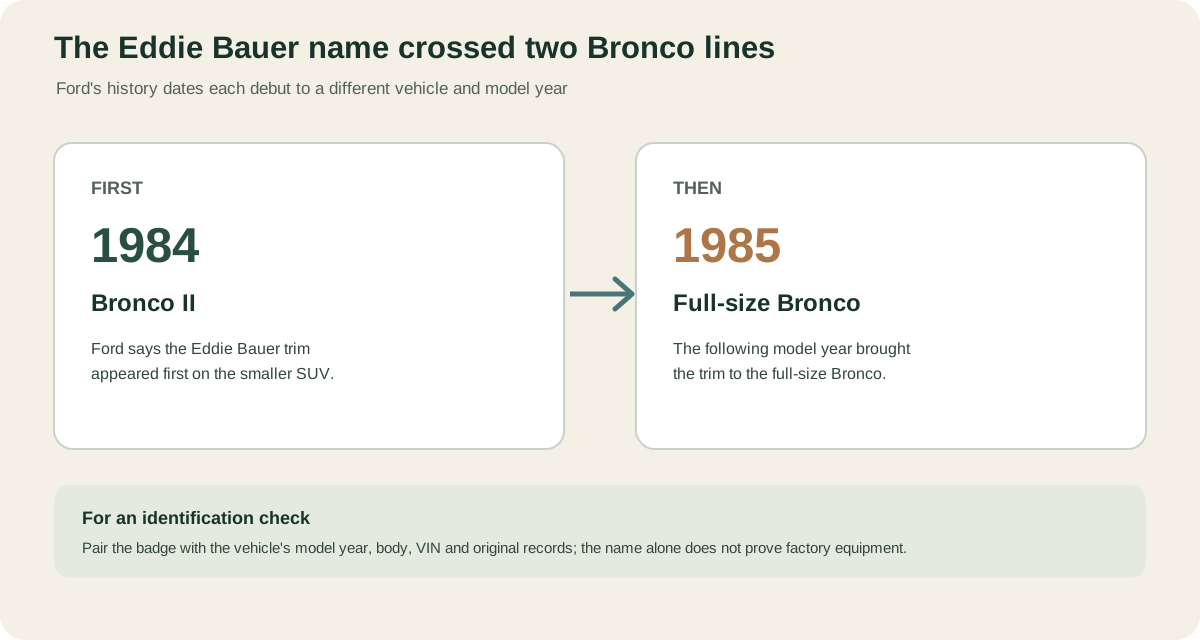
On one today, start with the front end. Check the beam pivots and bushings, read the front tires for alignment wear, and buy parts listed for Twin-Traction Beam trucks. A 1982-on 351 should be a Windsor, but engines get swapped, so check the casting numbers. Look at the rear housing and tag before ordering axle parts: the 9-inch has a removable carrier and the 8.8 is an integral-carrier axle. A real Eddie Bauer has tan cloth captain's chairs, privacy glass and argent wheels with its two-tone paint, and two-tone repaints are common. The compact Bronco II had its own Eddie Bauer package from 1984.
Highlights
-
Twin-Traction Beam independent front suspension replaced the solid front axle for 1980, built around a Dana 44.
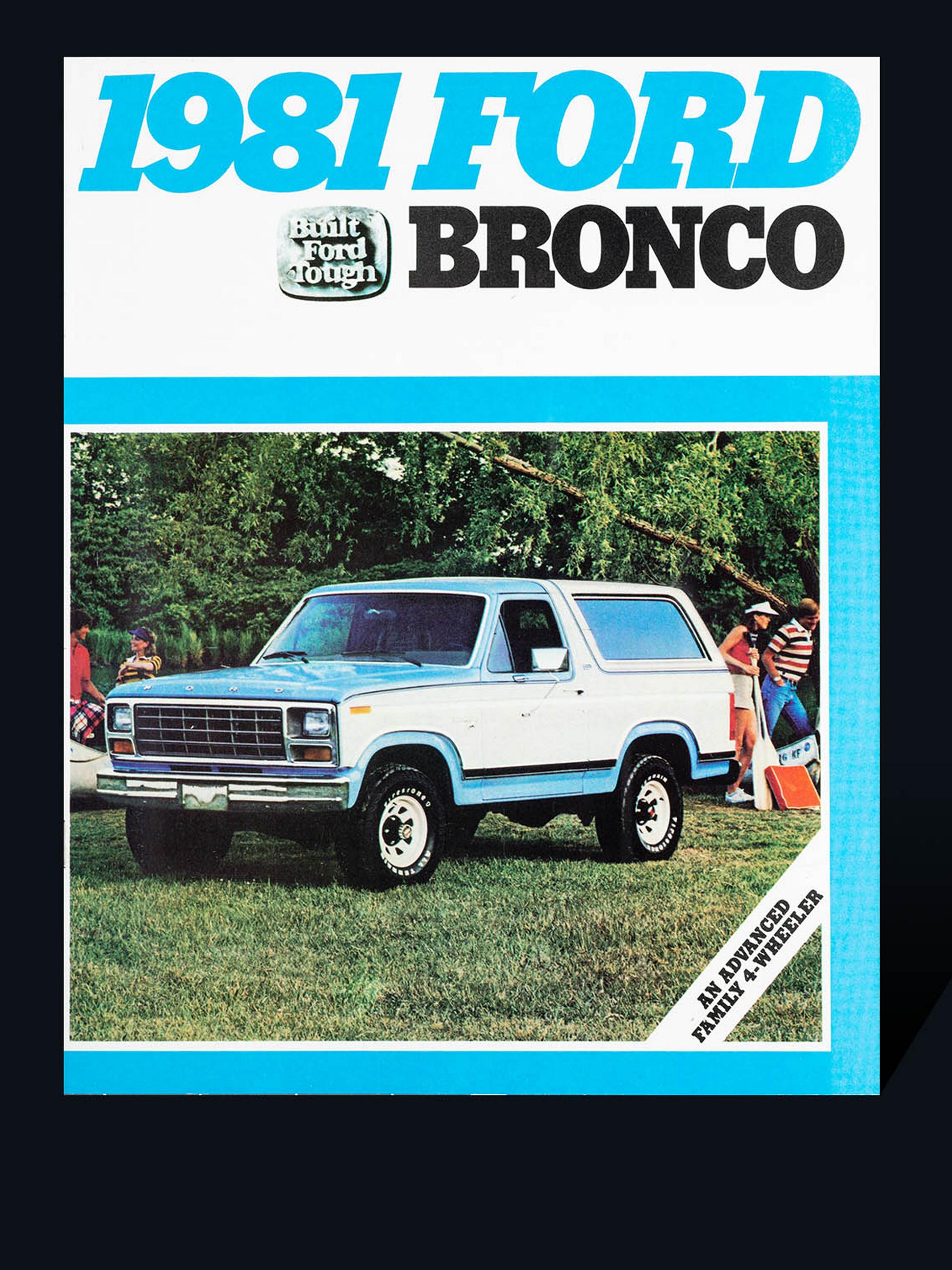
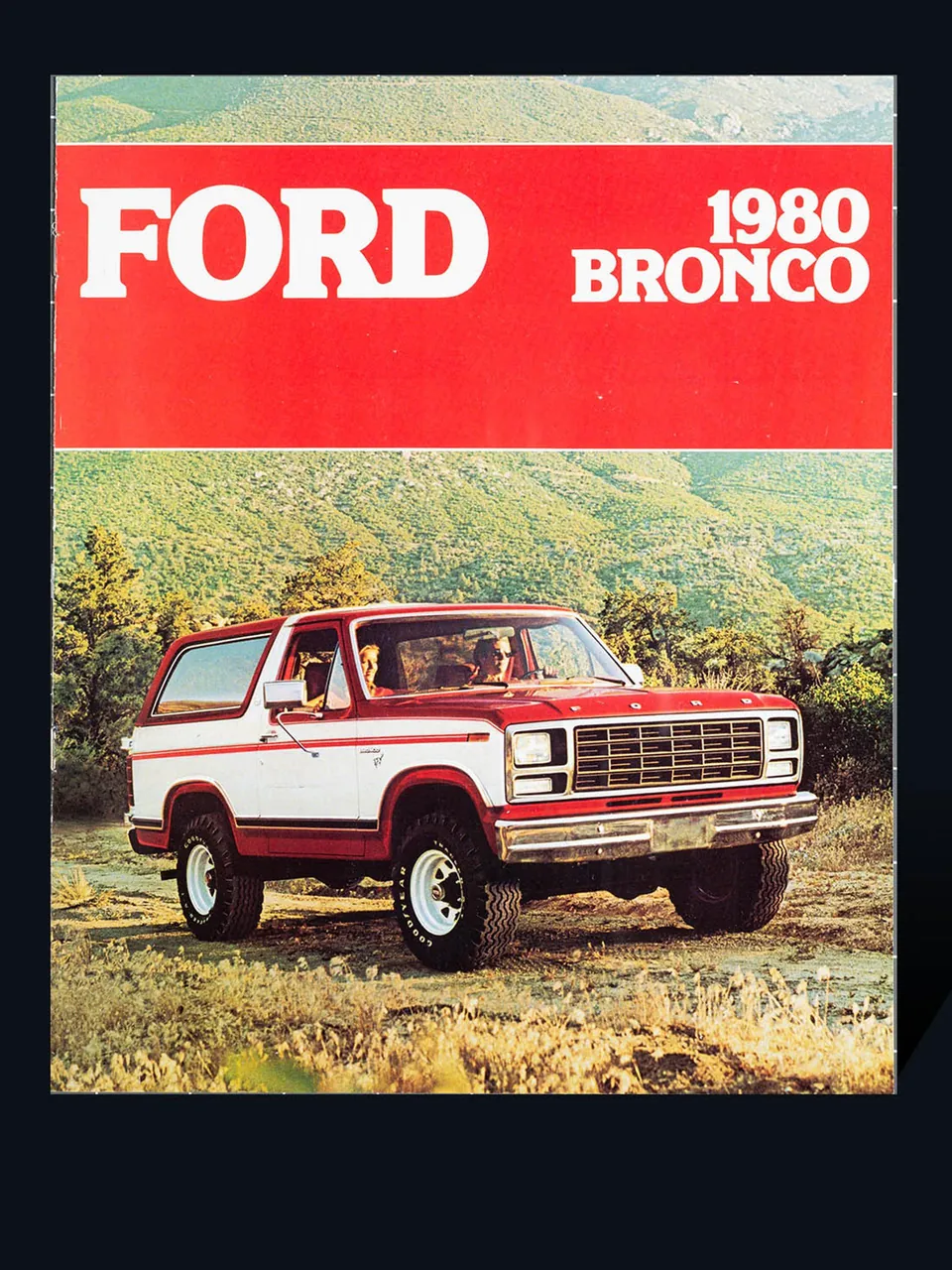
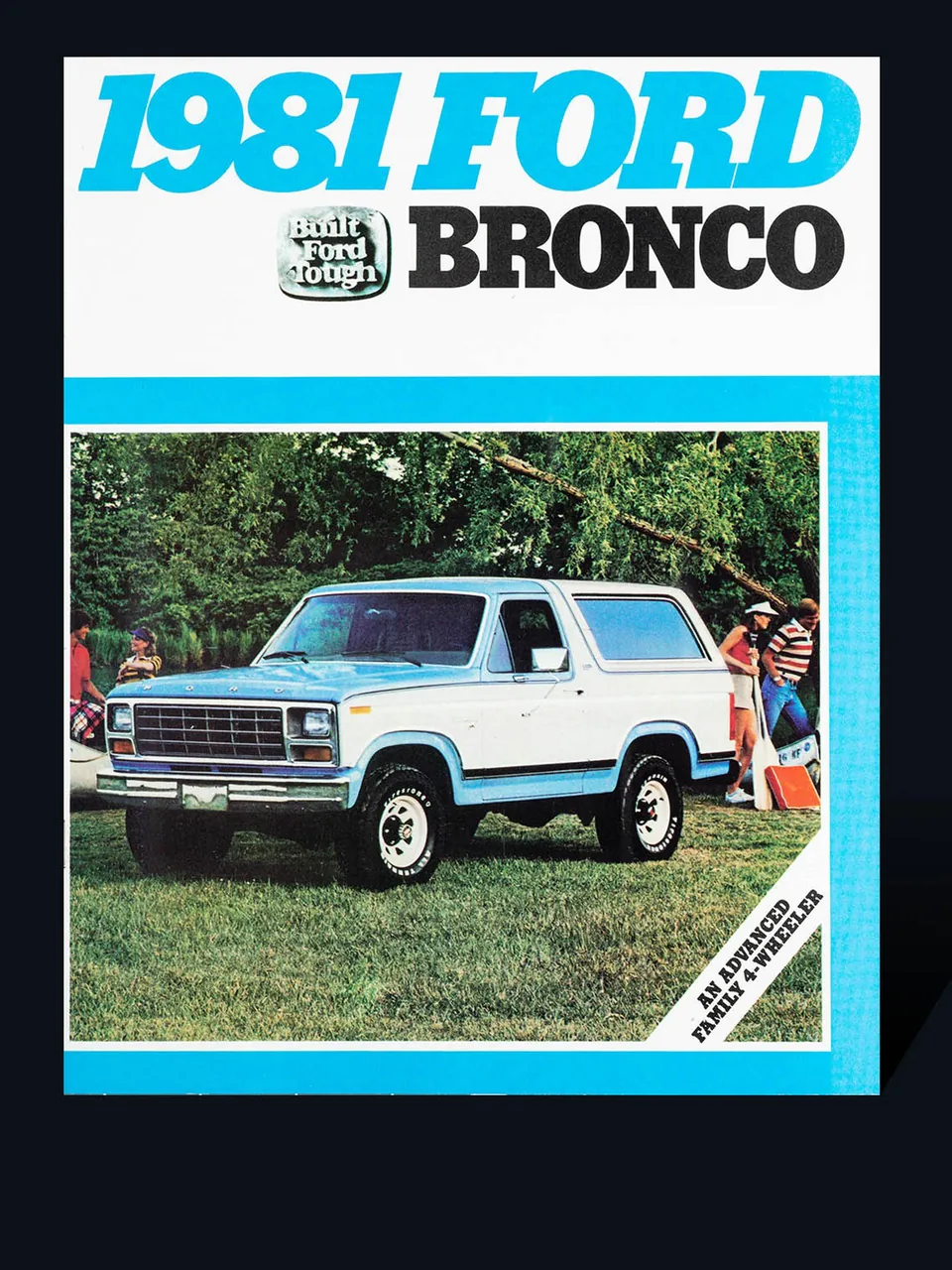
Ford's 1981 brochure cover shows the Bronco early in the generation. Image courtesy Ford Motor Company Source: Ford -
Inline-six returned as the standard engine: the 300 cu in (4.9L) six, manual only until an automatic joined it for 1983.
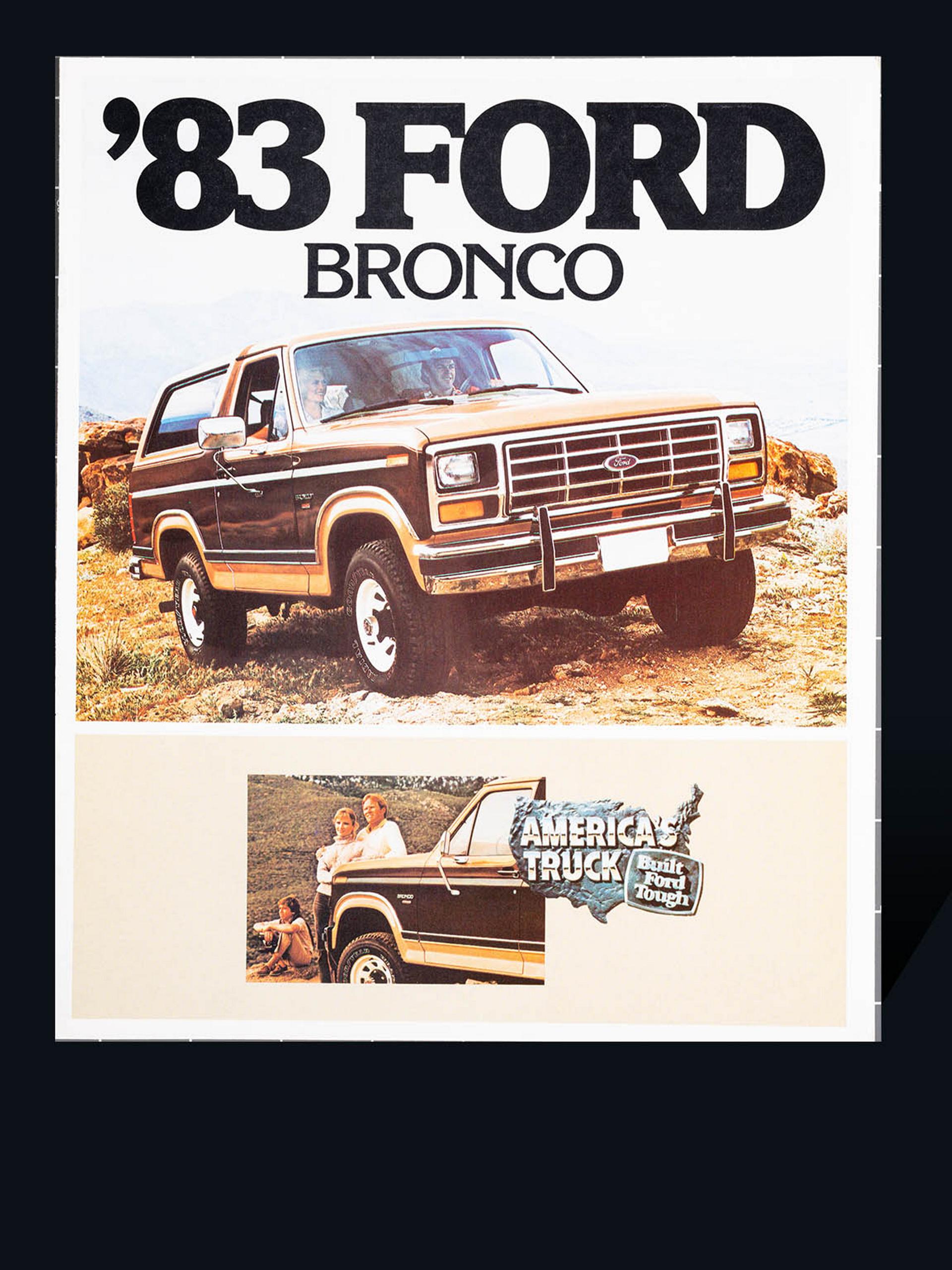
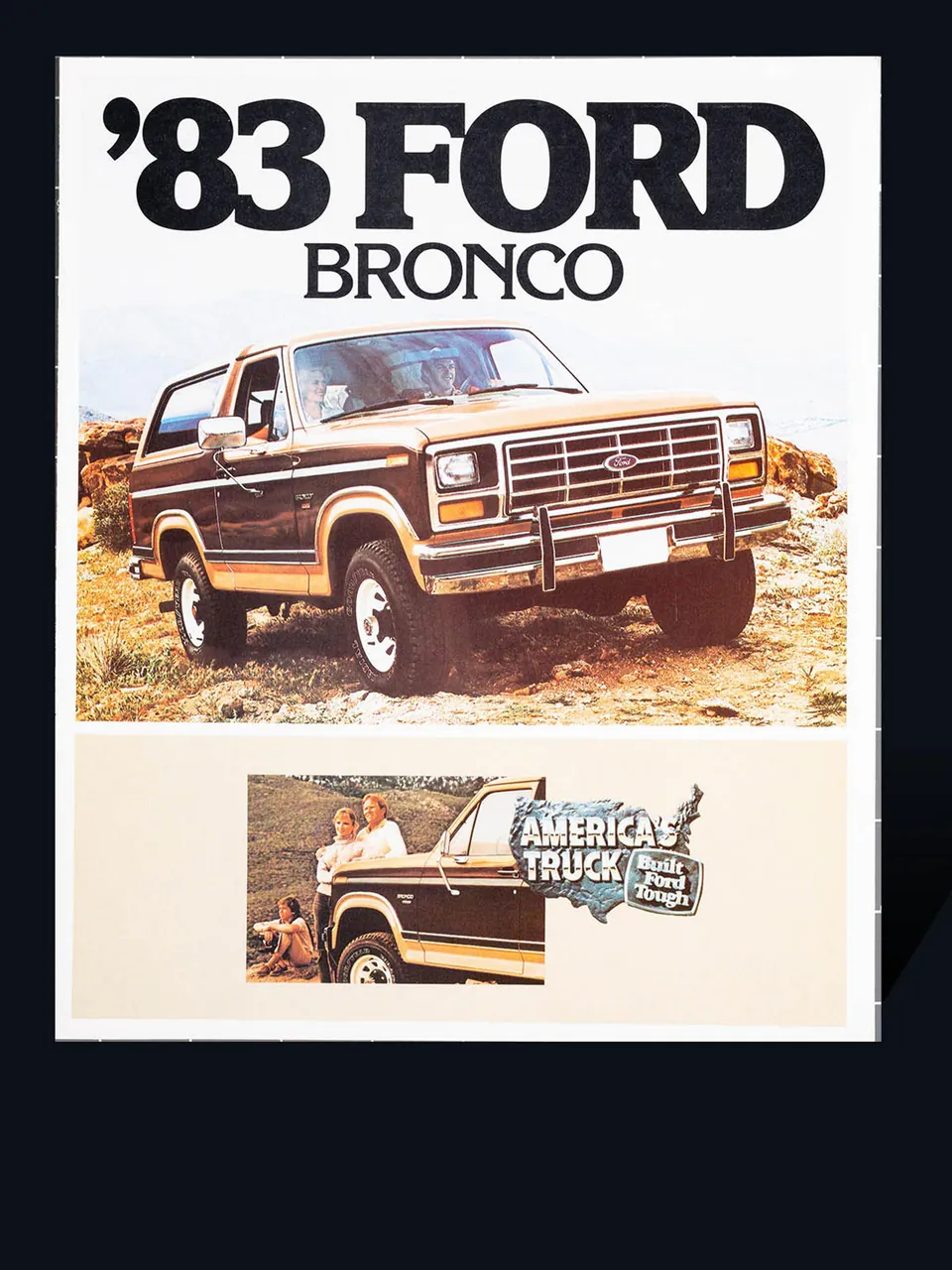
Ford's 1983 brochure cover shows the Bronco later in the generation. Image courtesy Ford Motor Company Source: Ford 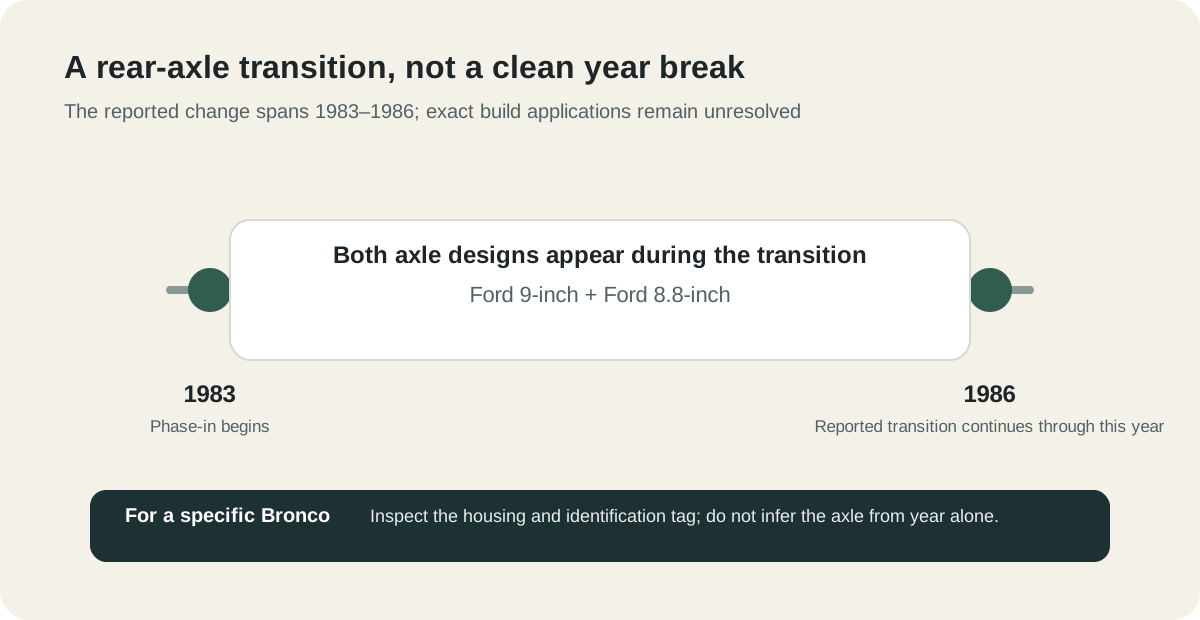
The 9-inch and 8.8-inch rear axles overlapped during a reported 1983–1986 transition, without a serial-number cutoff. Original BroncoFacts timeline based on the linked Ford and specialist axle references. Sources: Ford · cjponyparts.com -
Eddie Bauer package arrived for 1985 as the top trim, with two-tone paint, tan cloth captain's chairs and privacy glass.
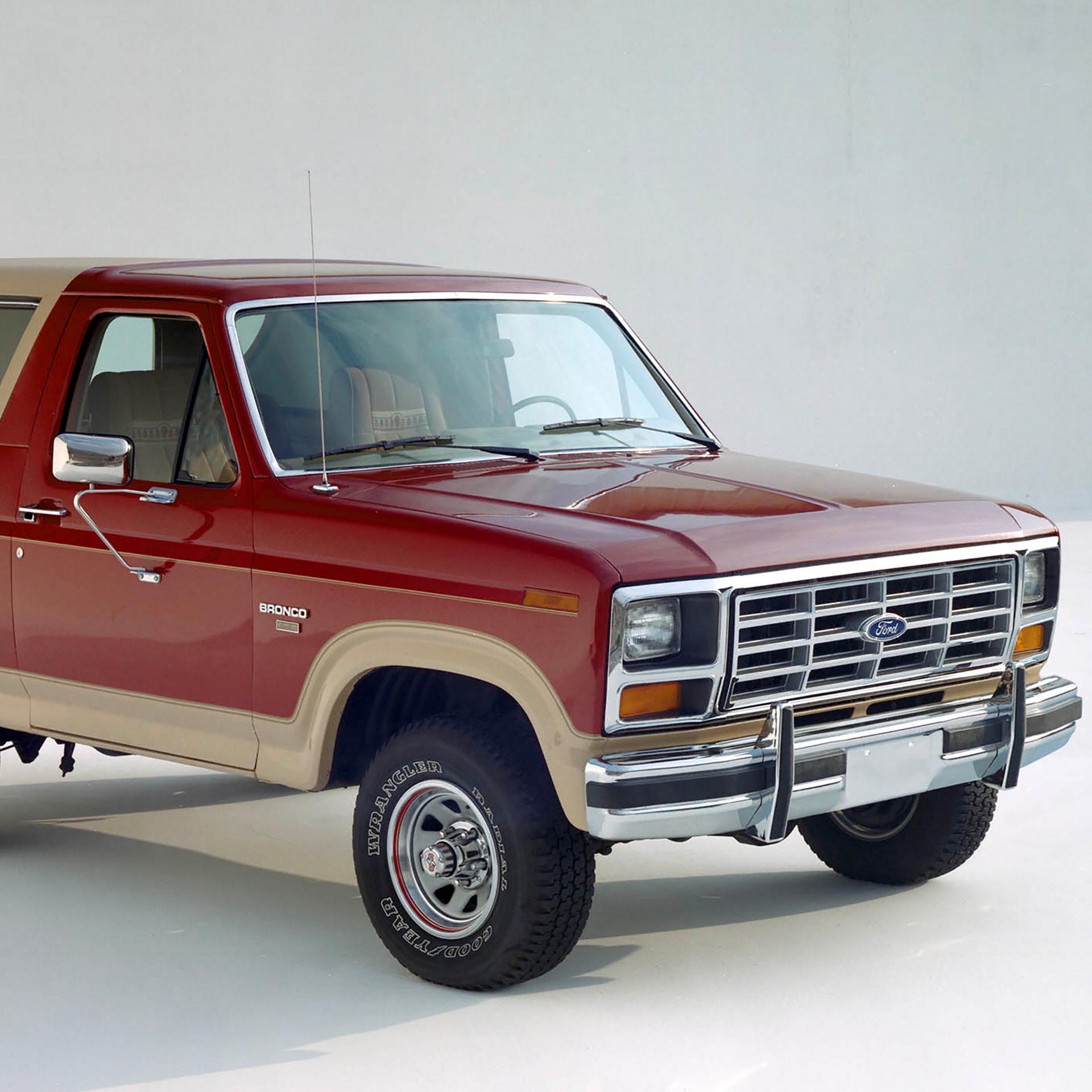
Ford's 1985 studio photo shows the late-generation look. Image courtesy Ford Motor Company Source: Ford 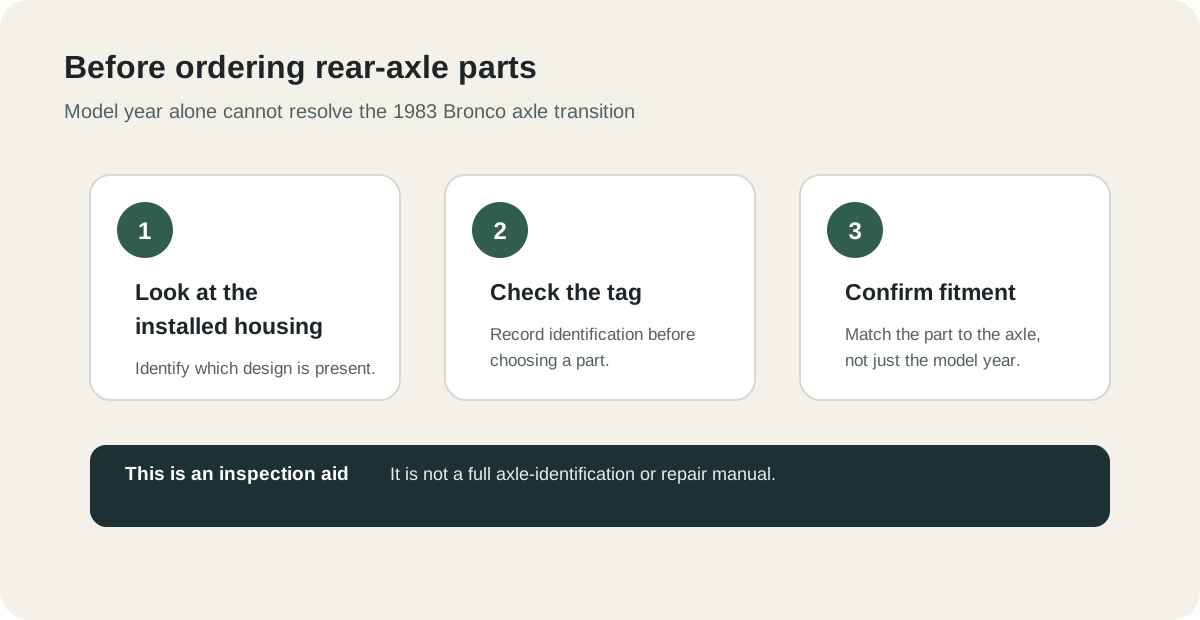
Model year alone won't settle the reported 9-inch/8.8-inch overlap. The housing, tag and installed components identify the rear axle. Original BroncoFacts axle-check guide based on the linked Bronco history and axle references. Sources: Ford · cjponyparts.com - The 351 H.O. arrived late in 1983 with a four-barrel and 210 hp, and fuel injection reached the 302 for 1985.
- 1986 was the best year of the generation at 62,127 built.


Generation sources
- Ford — Third Generation Bronco historyManufacturer history and factory brochures
- Ford Motor Company — The Ford BroncoManufacturer archive history
- Wikipedia — Ford BroncoEncyclopedia entry with production table
- Blue Oval Trucks — Bronco production figuresEnthusiast production table
- Eighties Cars — 1985 Ford Eddie Bauer Bronco SUVEnthusiast history article
- Broncozone forum — Basic 1978–1996 Bronco historyOwner forum history
Year by year
| Year | Production | Engines | Output | Trims |
|---|---|---|---|---|
| 1980 | 44,353 1 | 300 cu in (4.9L) six; 302 (5.0L) and 351 (5.8L) V8s optional | 5.8L V8: 138 hp at 3,400 rpm, 263 lb-ft at 2,000 rpm 2 | Custom; Ranger XLT |
| 1981 | 39,853 1 | 300 cu in (4.9L) six; 302 (5.0L) and 351 (5.8L) V8s optional | Custom; Ranger XLT | |
| 1982 | 40,782 1 | 300 cu in (4.9L) six; 302 (5.0L) and 351 (5.8L) V8s optional | Bronco; XLT Lariat; XLS | |
| 1983 | 38,963 or 40,376 3 | 4.9L six; 5.0L and 5.8L V8s optional | 4.9L six: 122 hp, 255 lb-ft net 4 | Standard Bronco; XLT; XLS |
| 1984 | 47,423 or 40,376 5 | 4.9L six; 5.0L V8 and 5.8L V8 optional, the 5.8 becoming the four-barrel H.O. in late 1983 | 5.8L H.O.: 210 hp, 304 lb-ft | Bronco; XLT |
| 1985 | 54,562 or 52,316 6 | 4.9L six; 5.0L EFI V8, 5.8L V8 and 5.8L H.O. V8 optional | 5.0L EFI: 150 hp, 270 lb-ft or 190 hp, 285 lb-ft; 5.8L H.O.: 210 hp 7 | Bronco; XLT; Eddie Bauer |
| 1986 | 62,127 8 | 4.9L six; 5.0L EFI V8 and 5.8L H.O. V8 optional | 4.9L six: about 120 hp, 250 lb-ft; 5.0L EFI: 150 hp, 270 lb-ft or 190 hp, 285 lb-ft; 5.8L H.O.: 210 hp 9 | Bronco; XLT; Eddie Bauer |
- Blue Oval Trucks and Wikipedia give the same count; neither names the Ford document behind it.
- Car and Driver's figures from its March 1980 test.
- Blue Oval Trucks lists 38,963. Wikipedia shows 40,376, the same figure it gives for 1984.
- Automobile Catalog's figures, not a Ford rating sheet.
- Blue Oval Trucks lists 47,423. Wikipedia shows 40,376, the same figure it gives for 1983.
- Blue Oval Trucks lists 54,562 built. Eighties Cars gives 52,316 as model-year sales.
- Automobile Catalog lists the injected 5.0 at 150 hp; It Still Runs gives 190 hp, which may belong to a different application.
- Blue Oval Trucks and Wikipedia give the same count, the largest in Blue Oval's 1980–1986 table. Neither names the Ford document behind it.
- Automobile Catalog's figures, except the 190 hp and 285 lb-ft that It Still Runs gives the Bronco's injected 5.0.
More for these years: dimensions and gearboxes, factory colors, recalls, or compare two years.
Model years
Each produced model year has its own page with cited facts and context.