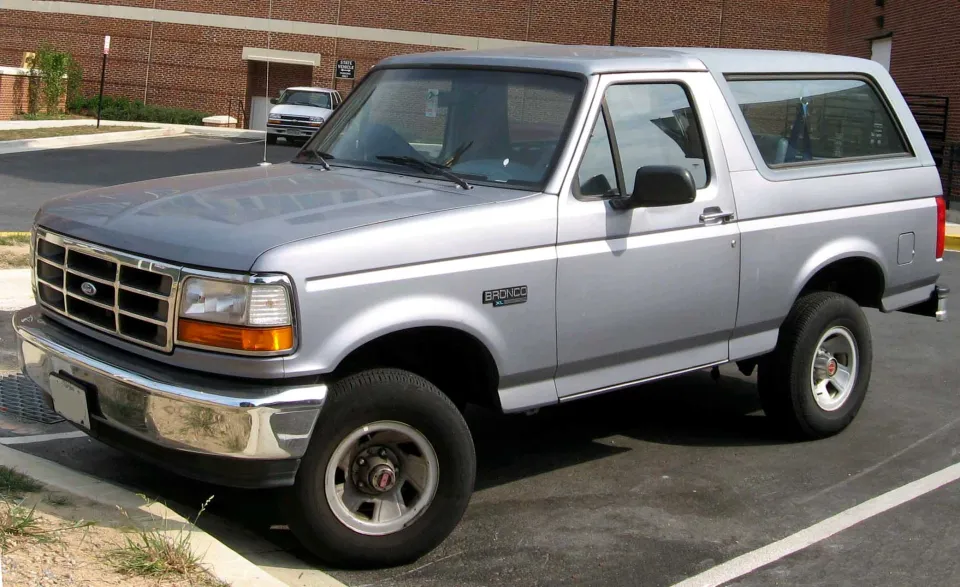
Generation 5 · OBS F-Series based · 1992–1996
Fifth Generation
The final classic full-size Bronco.
Photo by IFCAR, public domain, via Wikimedia Commons · Source: Wikimedia Commons

The 1992 Bronco took the ninth-generation F-150's rounder nose, with a bigger grille and new headlamps, on the same chassis. Owners call it the OBS, for Original Body Style. Wheelbase stayed at 104.7 inches, and the body was a two-door wagon with a rear hardtop. All of them came from the Michigan Truck Plant in Wayne, and the last was built June 12, 1996.
This generation added safety gear year by year. Ford dates rear three-point belts to 1992, four-wheel ABS to 1993 and a driver airbag to 1994. A center high-mounted stop lamp and a front crumple zone in the frame followed in the last years. Comfort grew too. Leather and remote keyless entry were available from 1992, and the 1996 mirrors had turn signals built in, a first for Ford.
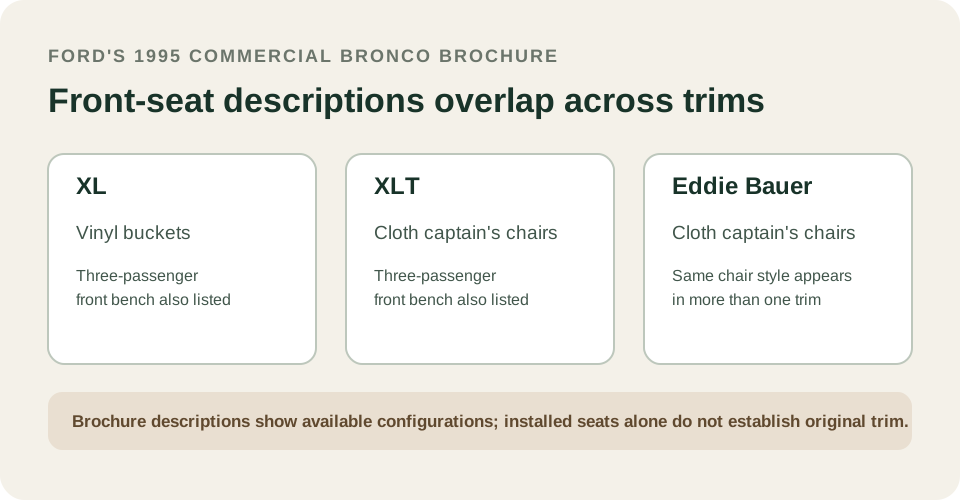
For 1992 the 4.9L six was standard in Custom and XLT, the 5.0L V8 was standard in Eddie Bauer and Nite, and the 5.8L V8 was optional. Ford's 1993 brochure lists only the two V8s. The 5.0 was rated 185 hp at first; Ford's 1994 brochure gives it 205 hp with the manual, and the 5.8 went from 200 hp to 210. The M5OD five-speed manual was standard and the E4OD automatic optional, standard on Eddie Bauer from 1993. Trims settled into XL, XLT and Eddie Bauer, with the XLT Sport package in Bright Red or Oxford White for 1995 and 1996. Both V8s were OBD II for 1996.
Blue Oval Trucks and Bronco Corral count 25,516 for 1992, 32,281 for 1993, 33,083 for 1994, 37,693 for 1995 and 34,130 for 1996, a total of 162,703. Ford-Trucks.com puts 1996 sales at more than 28,000. A white 1993 XLT driven by Al Cowlings, with O.J. Simpson aboard, was the Bronco in the June 17, 1994 chase. Ford has said that had nothing to do with ending the Bronco. Two-door, two-row SUVs were already fading, and the four-door Expedition replaced it for 1997.
On one today, watch the airbag and ABS lamps run their start-up check, and make sure the steering wheel is the right one. Ask whether the cruise-control switch recall was done. Check the parking brake, bumper mounts and signs of collision repair. On an XLT Sport, look for the body-color bumpers, grille and cab steps, running boards and deep-dish wheels, because a repaint can copy the look. On a 1996, pull the OBD II codes.


Highlights
-
Safety gear arrived a year at a time: rear three-point belts for 1992, four-wheel ABS for 1993 and a driver airbag for 1994.
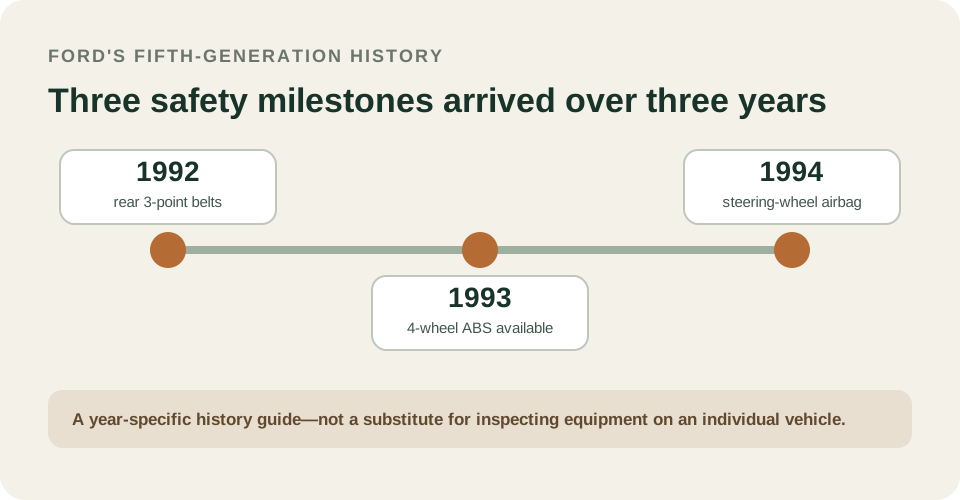
Ford dates rear three-point belts to 1992, four-wheel anti-lock brakes to 1993, and a steering-wheel airbag to 1994. Original BroncoFacts timeline based on Ford’s fifth-generation history. Source: Ford -
Three engines for 1992, the 4.9L six, 5.0L V8 and 5.8L V8. Ford's 1993 brochure lists only the V8s.
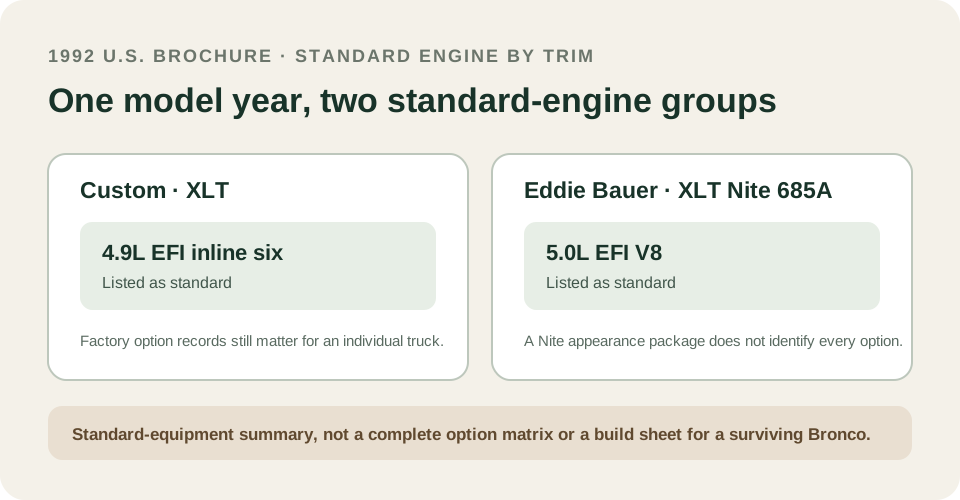
Ford's 1992 brochure lists the 4.9L EFI six as standard in Custom and XLT and the 5.0L EFI V8 in Eddie Bauer and Nite. Original BroncoFacts diagram based on Ford’s 1992 Bronco brochure. Source: xr793.com -
Production ended June 12, 1996, at the Michigan Truck Plant, and the four-door Expedition took the Bronco's place for 1997.
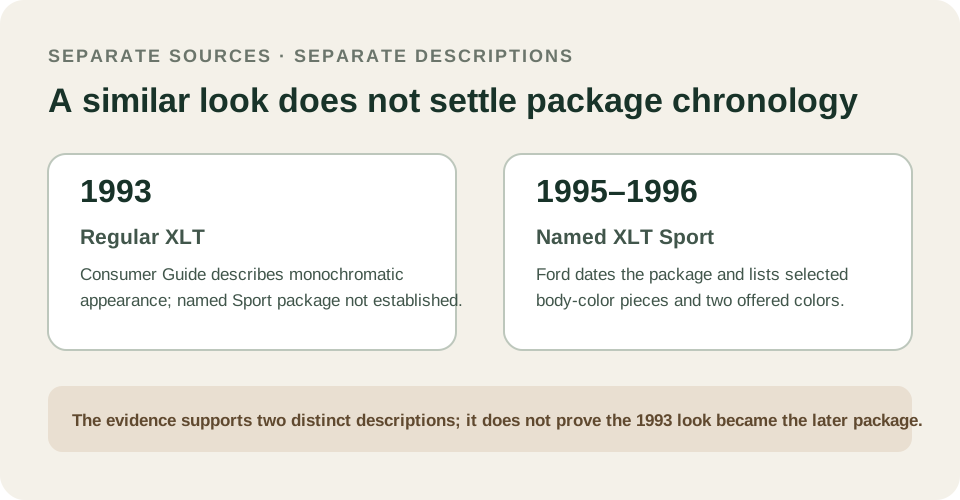
Consumer Guide describes a monochromatic regular XLT in 1993; Ford dates the named XLT Sport package to 1995–1996. Original BroncoFacts chronology comparing two published descriptions. Sources: consumerguide.com · Ford 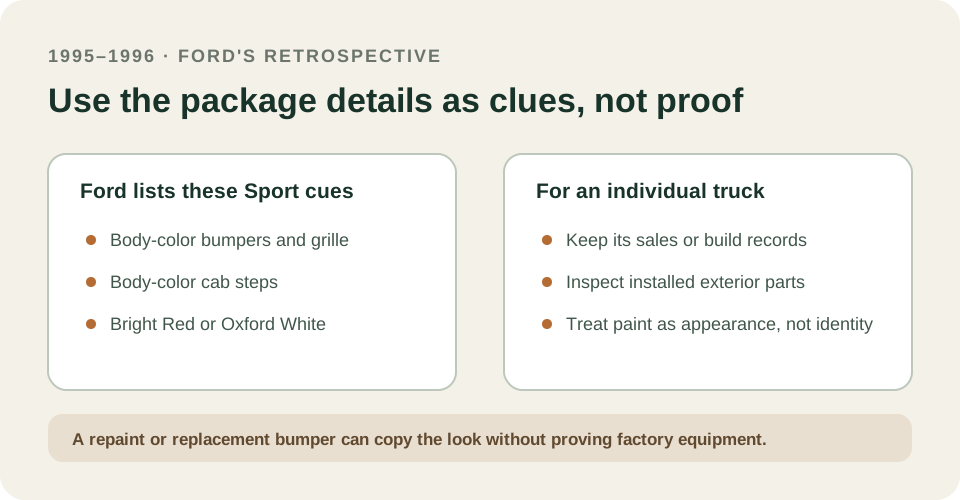
Ford lists body-color bumpers, grille, and cab steps for XLT Sport in Bright Red and Oxford White. Original BroncoFacts owner-reference diagram based on Ford’s fifth-generation history. Source: Ford - 1995 was the generation's biggest year at 37,693 built.
- The XLT Sport package came in Bright Red or Oxford White for 1995 and 1996, with body-color bumpers, grille and cab steps.




Generation sources
- Ford — Fifth Generation Bronco historyManufacturer history and factory brochures
- Ford Motor Company — The Ford BroncoManufacturer archive history
- Wikipedia — Ford BroncoEncyclopedia entry with production table
- Blue Oval Trucks — Bronco production figuresEnthusiast production table
- Ford 1993 Bronco sales brochureU.S. factory brochure
- Consumer Guide — 1990–96 Ford BroncoUsed-vehicle buyer's guide
- Ford-Trucks.com — End of an era: a look back at the 1996 Ford BroncoEnthusiast retrospective
- SlashGear — Why the Ford Bronco was discontinued after the O.J. Simpson trialAutomotive history article quoting Ford
- Wikipedia — White Bronco chaseEncyclopedia entry
Year by year
| Year | Production | Engines | Output | Trims |
|---|---|---|---|---|
| 1992 | 25,516 1 | 4.9L EFI six (standard in Custom and XLT); 5.0L EFI V8 (standard in Eddie Bauer and Nite); 5.8L EFI V8 | 4.9L six: 145 hp, 265 lb-ft; 5.0L V8: 185 hp, 270 lb-ft; 5.8L V8: 200 hp, 300 lb-ft (SAE net) 2 | Custom, XLT, XLT Nite, Eddie Bauer |
| 1993 | 32,281 1 | 5.0L EFI V8 (standard); 5.8L EFI V8 (optional) | 5.0L V8: 185 hp, 270 lb-ft; 5.8L V8: 200 hp, 300 lb-ft 3 | Custom, XLT, Eddie Bauer |
| 1994 | 33,083 1 | 5.0L EFI V8 (standard); 5.8L EFI V8 (optional) | 5.0L V8: 205 hp, 275 lb-ft; 5.8L V8: 210 hp, 325 lb-ft (Ford, SAE net). LMR lists 199 hp and 205 hp 4 | XL, XLT, Eddie Bauer |
| 1995 | 37,693 5 | 5.0L EFI V8 (standard); 5.8L EFI V8 (optional) | 5.0L V8: 205 hp with manual, 195 hp with automatic, 275 lb-ft; 5.8L V8: 210 hp, 325 lb-ft (Ford). LMR lists 199 hp, 270 lb-ft and 205 hp, 328 lb-ft 6 | XL, XLT, XLT with Exterior Sport Package, Eddie Bauer |
| 1996 | 34,130 built; more than 28,000 sold 7 | 5.0L EFI V8 (standard); 5.8L EFI V8 (optional) | 5.0L V8: 199 hp at 4,200 rpm, 270 lb-ft at 2,400 rpm; 5.8L V8: 205 hp at 3,500 rpm, 328 lb-ft at 2,200 rpm (Ford) 8 | XL, XLT, Eddie Bauer; Sport package on XLT |
- Blue Oval Trucks' count, matched by Bronco Corral. Neither names the Ford record it came from.
- LMR's and Automobile Catalog's figures. HighLine Classics prints 203 hp for the 5.8; 203 metric horsepower works out to 200 hp.
- Horsepower comes from Road & Track's 1993 buyer's guide and LMR's table. Ford's brochure prints the 5.0's 270 lb-ft at 2,400 rpm.
- Ford's 1994 brochure rates the 5.0 with the manual transmission. LMR's lower figures come from one table covering 1992 through 1996.
- Blue Oval Trucks' count, the largest in its 1992–1996 section, matched by Bronco Corral. Neither names the Ford record it came from.
- Ford's 1995 brochure against LMR's single table for 1992 through 1996. The two have never been squared up.
- The build count is Blue Oval Trucks' and Bronco Corral's. Ford-Trucks.com gives the sales figure, and sales for the calendar year need not match the model-year build.
- Ford's 1996 brochure figures. One specialist table gives the 5.0 198 hp.
More for these years: dimensions and gearboxes, factory colors, recalls, or compare two years.
Model years
Each produced model year has its own page with cited facts and context.