BRONCOFACTS Trail guide · 1966–present

Model year · Ford Bronco II

1984 Bronco II

Ford's compact Bronco II arrives

The 1984 Bronco II was Ford's new Ranger-based compact 4x4: 94-inch wheelbase, 115-hp 2.8-liter V6, built in Louisville, Kentucky.

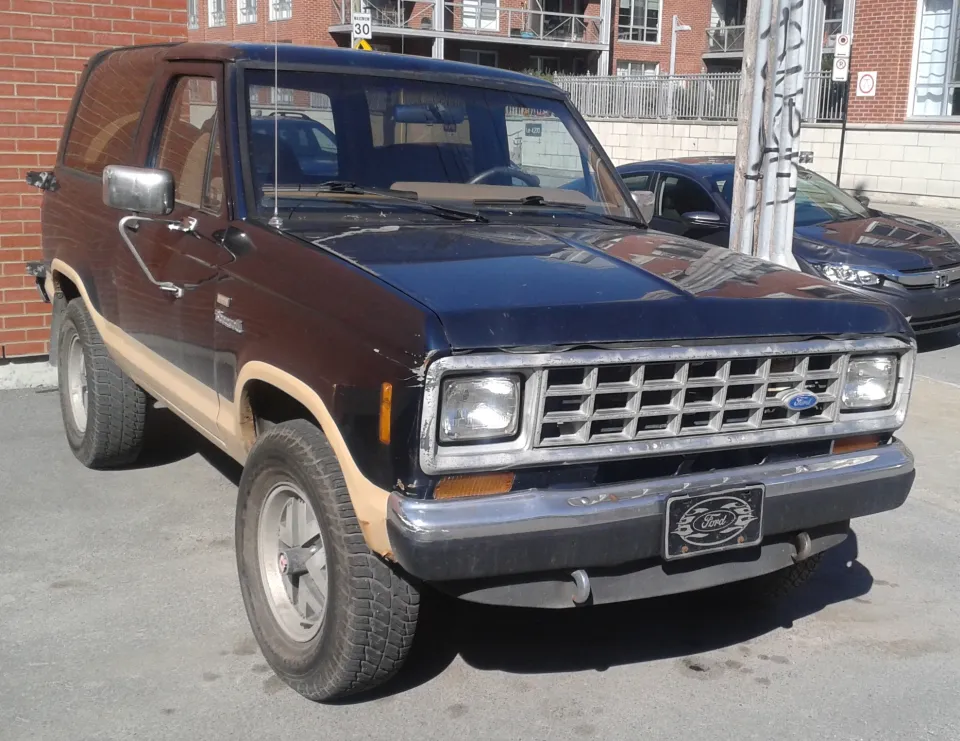
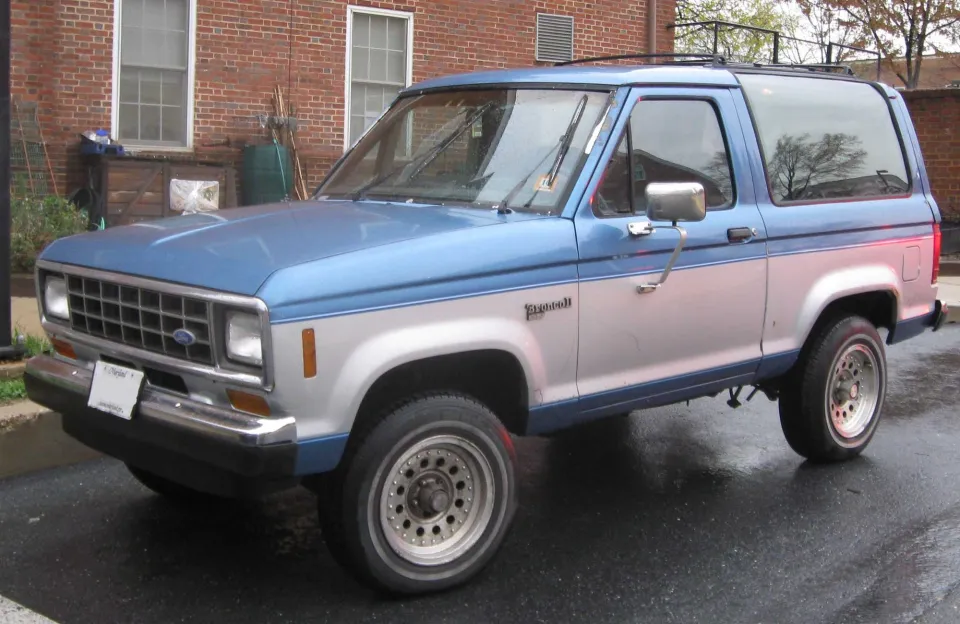
Blue-and-silver early Bronco II, front-left view; exact model year not established
Blue-and-silver early Bronco II, front-left view; exact model year not established Photo by IFCAR, public domain, via Wikimedia Commons Source: Wikimedia Commons

Published by BroncoFacts / 1031 Productions. How we evaluate sources.

The Bronco II was Ford's new compact SUV, a three-door wagon on a shortened Ranger pickup chassis. Ford's launch material set the introduction for March 1983 and the production start for January at Louisville Assembly Plant in Kentucky, all as a 1984 model. It shared a name with the full-size Bronco and little else. The wheelbase was 94 inches, more than 10 inches shorter than the big truck's, and overall length was 158.4 inches.

Every 1984 was four-wheel drive. The only engine was a carbureted 2.8-liter V6, rated by The Ranger Station at 115 hp and 150 lb-ft. A four-speed manual was standard, with a five-speed manual or a three-speed automatic optional, all with a part-time two-speed transfer case. Properly equipped, it could tow 4,500 lb.

Ford's brochure lists four versions: Standard, XLS, XLT and Eddie Bauer, in 12 exterior colors. Bronco II Corral's production table starts at 1985 with 106,554, and that figure may include the 1984 trucks.

Sources for this account: [1] [2] [5] [8] [9]

1984 Bronco II at a glance
Body styles Three-door wagon, 4x4 only [1] [2]
Wheelbase 94 inches [1] [8]
Overall length 158.4 inches [8]
Curb weight 3,270 lb (Eddie Bauer, V6, as tested) [10] a
Engines 2.8-liter V6, two-barrel carburetor [1] [8]
Output 115 hp at 4,600 rpm; 150 lb-ft at 2,600 rpm [3] [9] b
Transmissions 4-speed manual standard; 5-speed manual or 3-speed automatic optional [8]
Transfer case Part-time 2-speed (Borg-Warner 1350); manual locking hubs, automatic optional [8] [9]
Axles Dana 28 Twin-Traction Beam front (2,750 lb); Ford 7.5-inch rear (2,500 lb) [8] [9]
Fuel capacity 23 gallons [8]
Towing capacity Up to 4,500 lb with 3.73 axle [8]
Trims Standard, XLS, XLT, Eddie Bauer [8]
Exterior colors Raven Black, Polar White, Light Charcoal Metallic, Dark Canyon Red, Light Blue, Medium Blue Metallic, Midnight Blue Metallic, Medium Desert Tan, Walnut Metallic, Light Desert Tan, Bright Bittersweet, Bright Copper Glow [8]
Assembly plant Louisville Assembly Plant, Louisville, Kentucky [1]
  1. Consumer Reports' test weight.
  2. Ford's 1984 brochure prints no output. These are The Ranger Station's figures, and Automobile Catalog agrees on the 115 hp.

Every year in one table: production · engines and specs · trims and colors · compare this year with another

Why it matters

The Bronco II was Ford's entry in the new compact-SUV market, and it wore the Eddie Bauer name before the full-size Bronco did.

Body styles and market

Market: U.S.-market Bronco II, a separate compact truck from the full-size Bronco

Body styles: Three-door compact wagon, 4x4 only

1987–1988 Ford Bronco II, pre-1989-restyle, dark red/maroon
This 1987–1988 Bronco II shows the square-grille body used before the 1989 restyle. Photo by Bull-Doser, public domain, via Wikimedia Commons Source: Wikimedia Commons

What changed for this year

On sale in March 1983 as a 1984 model
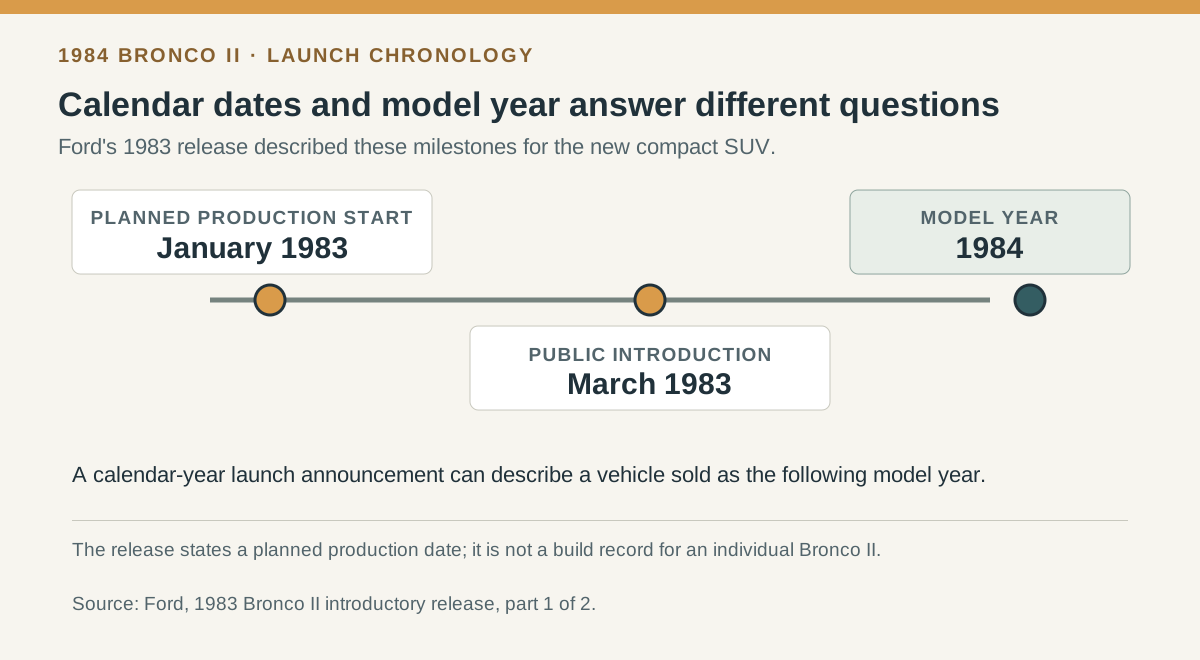
Ford's launch material set the Bronco II introduction for March 1983, with production starting that January at Louisville Assembly Plant. It was a 1984 model from the start. [1]
A shortened Ranger underneath
The Bronco II rode a shortened Ranger pickup chassis with a 94-inch wheelbase. It was body-on-frame like the full-size Bronco, on a frame of its own. [1] [2]
Ford's 1983 Bronco II production plan, public introduction and 1984 model-year designation
Ford's 1983 release placed planned production in January and public introduction in March for a vehicle sold as a 1984 model. Original BroncoFacts timeline based on Ford's 1983 Bronco II launch release. Source: Ford Media Center

Models and trims

Four versions
Ford's 1984 brochure lists Standard, XLS, XLT and Eddie Bauer. [8]
Eddie Bauer
MotoGallery describes the Bronco II as the first Ford to carry the Eddie Bauer name, starting in 1984 as a premium package built on the XLT. [4] [8]

Engines and transmissions

2.8-liter V6
The only engine was a 2.8-liter V6 with a two-barrel carburetor. The Ranger Station rates it at 115 hp at 4,600 rpm and 150 lb-ft at 2,600 rpm; Automobile Catalog agrees on the 115 hp. [1] [3] [8] [9]
Three transmissions
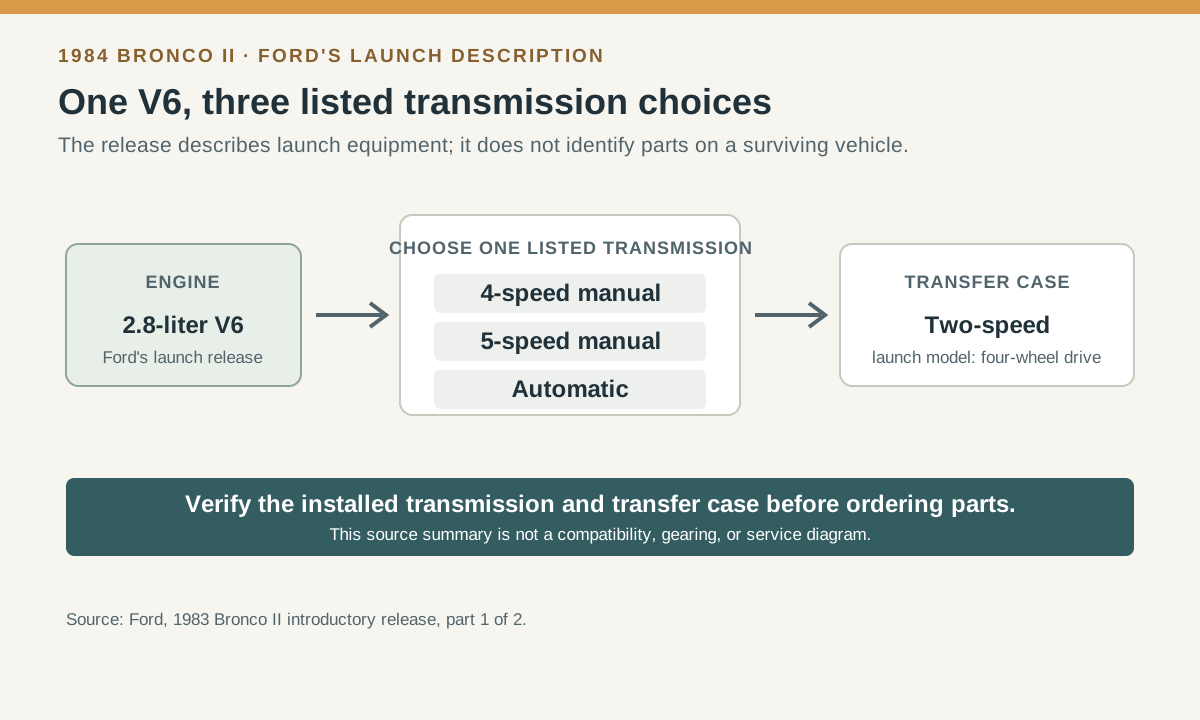
A four-speed manual was standard. A five-speed manual and a three-speed automatic were optional. [8]
Four-wheel drive on every truck
Every 1984 had a part-time two-speed transfer case, the Borg-Warner 1350. Manual locking hubs were standard and automatic hubs optional. The front axle was a Dana 28 Twin-Traction Beam rated at 2,750 lb; the rear was a Ford 7.5-inch rated at 2,500 lb. [1] [2] [8] [9]
Ford's launch-listed 1984 Bronco II V6, three transmission choices and two-speed transfer case
Ford's launch release lists a 2.8-liter V6, four-speed manual, five-speed manual or automatic transmission, and a two-speed transfer case. Original BroncoFacts diagram based on Ford's 1983 Bronco II launch release. Source: Ford Media Center
Ford brochure illustration labeled standard 2.8-liter V6; period image only
Ford’s 1984 brochure labels this as the standard 2.8-liter V6. Image courtesy Ford Motor Company; 1984 Bronco II sales brochure; via XR793. Source: xr793.com

Capability and specifications

94-inch wheelbase, 158.4 inches long
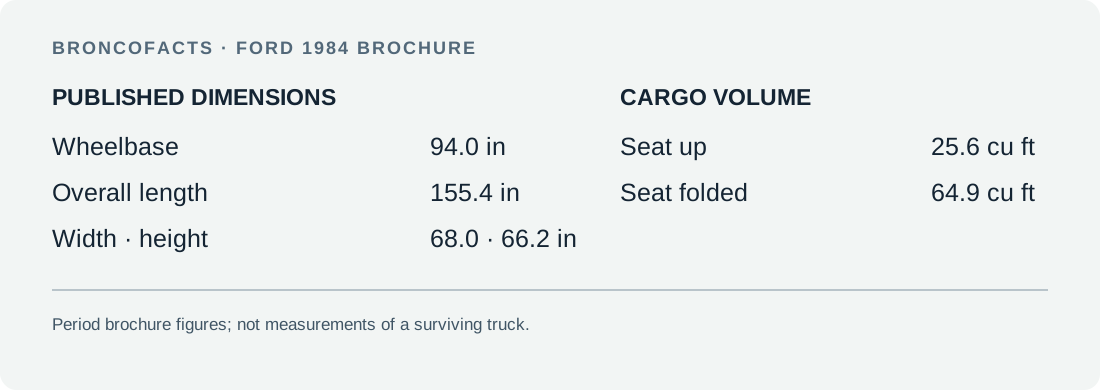
Ford gives a 94-inch wheelbase, more than 10 inches shorter than the full-size Bronco's, and an overall length of 158.4 inches. The fuel tank holds 23 gallons. [1] [8]
Production
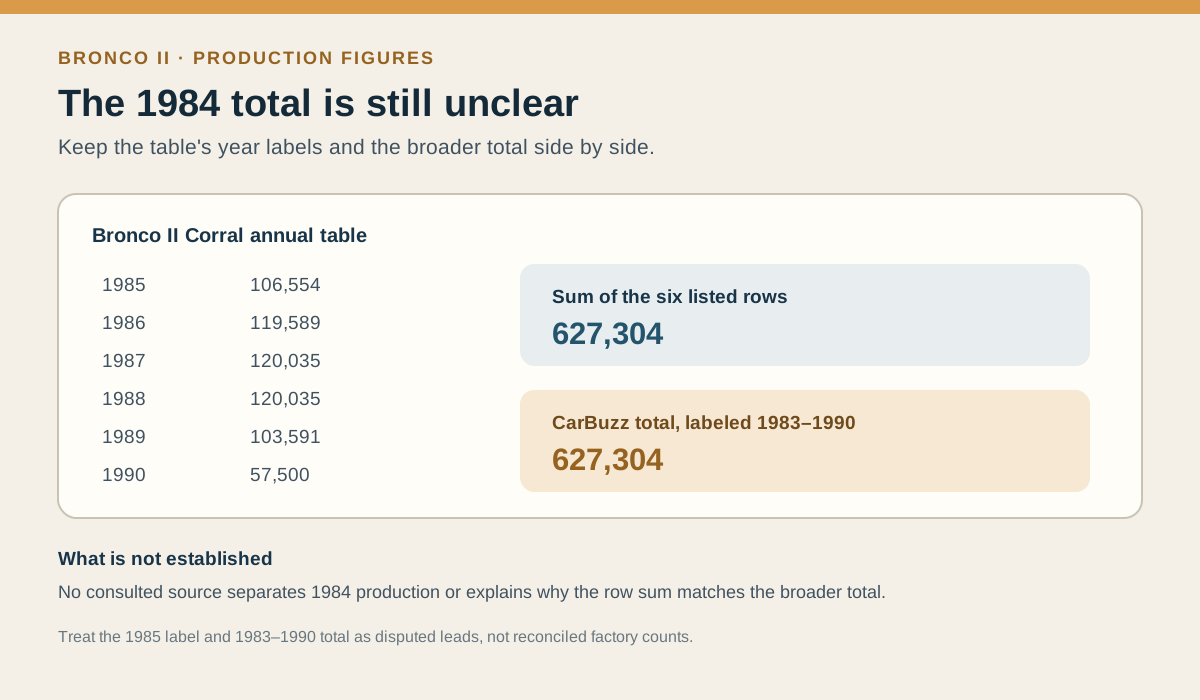
Bronco II Corral's table starts at 1985 with 106,554. CarBuzz prints 627,304 for 1983 through 1990. The 1984 trucks may be counted in the Corral's 1985 figure. [5] [6]
Towing: up to 4,500 lb
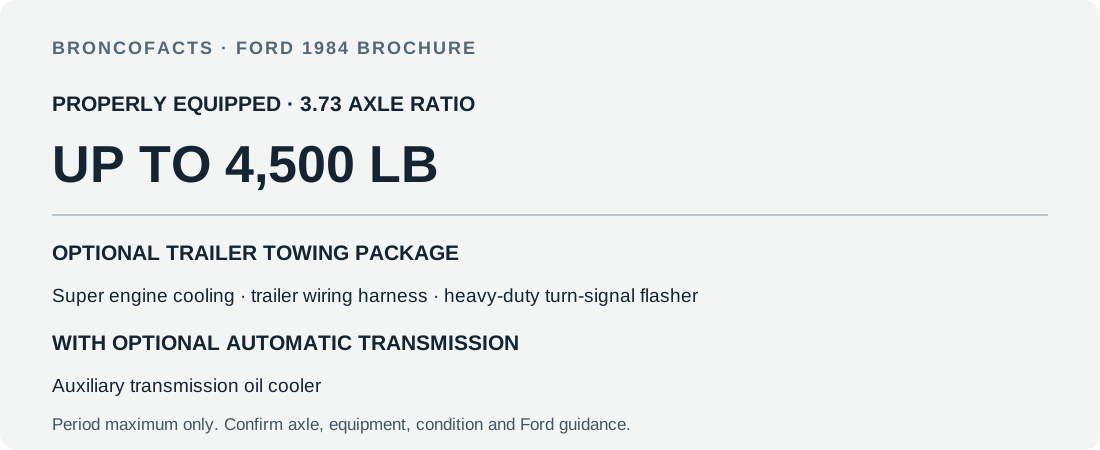
Ford's brochure rates a properly equipped Bronco II at up to 4,500 lb with the 3.73 axle. The optional Trailer Towing Package added super engine cooling, a trailer wiring harness and a heavy-duty turn-signal flasher, plus an auxiliary transmission oil cooler with the automatic. Ford also recommended the heavy-duty battery and the gauge package for towing. [8]
Diagram compares the 1985–1990 table rows, which sum to 627,304, with a separately reported 1983–1990 total of 627,304; no separate 1984 count is established
Bronco II Corral's listed 1985–1990 rows sum to 627,304, the same figure CarBuzz gives for 1983–1990. Original BroncoFacts diagram comparing the cited production claims. Sources: broncoiicorral.com · carbuzz.com
Ford’s published 1984 Bronco II dimensions and rear-seat cargo volumes
Ford’s U.S. brochure lists the 94-inch wheelbase and cargo volumes of 25.6 cubic feet with the rear seat up or 64.9 with it folded. Original BroncoFacts dimensions reference based on Ford’s 1984 Bronco II brochure, p. 13. Source: xr793.com
Ford’s 1984 Bronco II advertised towing maximum and Trailer Towing Package contents
Ford listed trailer towing up to 4,500 pounds with a 3.73 axle ratio when properly equipped with the optional package. Original BroncoFacts towing reference based on Ford’s 1984 Bronco II brochure, p. 12. Source: xr793.com

Colors and interiors

12 exterior colors
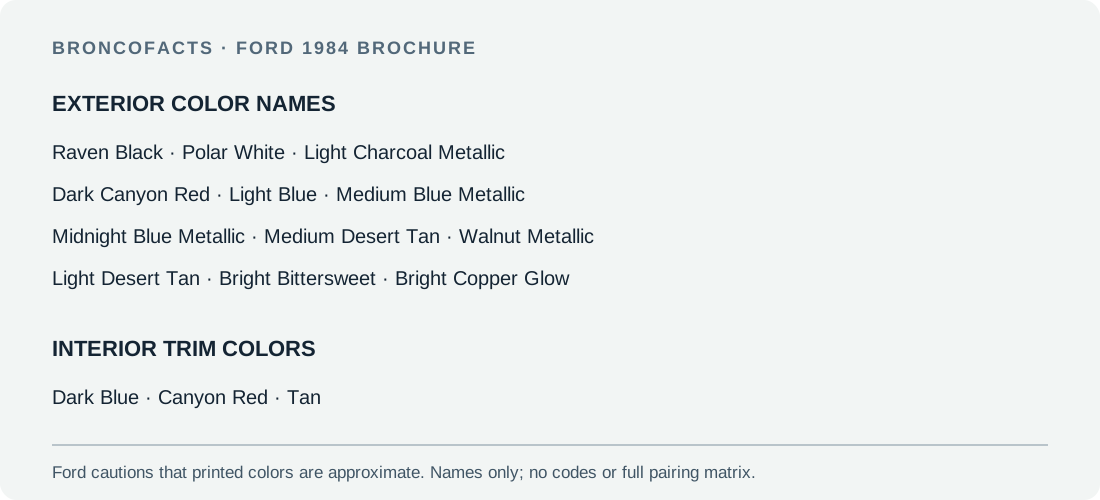
Raven Black, Polar White, Light Charcoal Metallic, Dark Canyon Red, Light Blue, Medium Blue Metallic, Midnight Blue Metallic, Medium Desert Tan, Walnut Metallic, Light Desert Tan, Bright Bittersweet and Bright Copper Glow. [8]
Three interior colors
Interior trim came in Dark Blue, Canyon Red or Tan. [8]
Ford brochure view of the standard Bronco II bucket seats, dashboard and cabin
Ford’s brochure shows the standard Bronco II cabin with reclining bucket seats and a pewter-tone instrument panel. Image courtesy Ford Motor Company; 1984 Bronco II sales brochure; via XR793. Source: xr793.com
Ford’s 1984 brochure exterior and interior color names
Ford’s brochure lists these exterior and interior color names and notes that printed colors are approximate. Original BroncoFacts color-name reference based on Ford’s 1984 Bronco II brochure, p. 14. Source: xr793.com
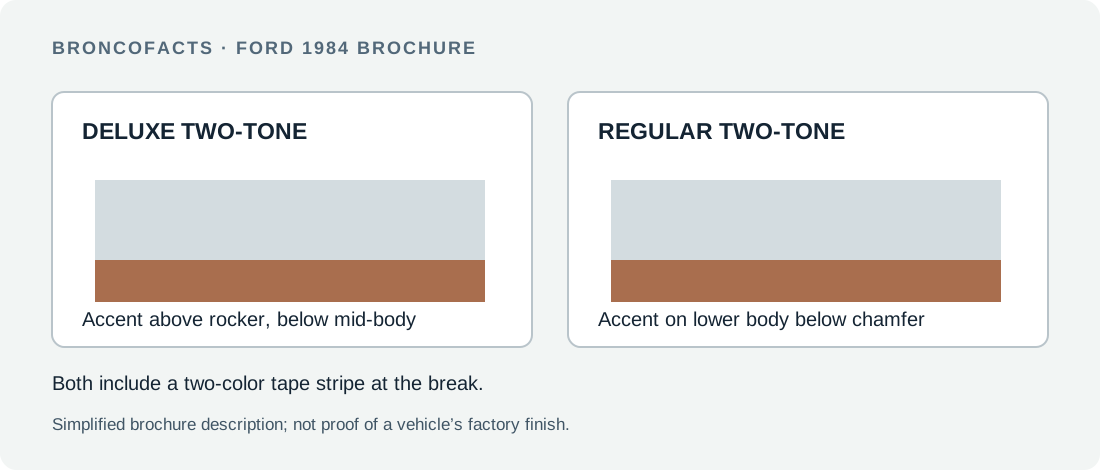
Original summary of Ford’s Deluxe and Regular two-tone accent placement descriptions
Ford describes Deluxe and Regular two-tone accent locations and a two-color stripe. Original BroncoFacts two-tone reference based on Ford’s 1984 Bronco II brochure, p. 15. Source: xr793.com

Options and packages

Transmissions, hubs and towing
The main mechanical options were the five-speed manual, the three-speed automatic, automatic locking hubs and the Trailer Towing Package. [8]

Safety and recalls

Rollover record
The Bronco II is remembered for its rollover record. NHTSA opened a rollover investigation in 1989, and that May Consumer Reports rated the truck "Avoid" after wheels lifted in its emergency-maneuver test. [2] [7]

Owner and buyer notes

Full-size Bronco parts do not carry over
The Bronco II is a shortened Ranger with its own frame, axles and capacities. Full-size Bronco parts and specifications do not carry over. [1] [2]
What to look at
Engines get swapped and Eddie Bauer two-tone paint gets added later, so check the VIN, certification label and drivetrain tags against the truck. Rust, steering, suspension, brakes, wheel bearings, driveline and the fuel system all deserve a look on a truck this age. Run the VIN for open recalls. [2] [4]

Stories from this year

A 1984 built in January 1983
The first Bronco IIs were scheduled off the Louisville line in January 1983, with the introduction set for March. A truck with an early-1983 build date is still a 1984. [1]
627,304, to the unit
The lifetime total CarBuzz prints, 627,304, matches Bronco II Corral's 1985 through 1990 rows exactly: 106,554, 119,589, 120,035, 120,035, 103,591 and 57,500. [5] [6]
Planning a viewing? Start with the buyer guide, take the printable inspection worksheet, and compare records with the VIN and warranty-plate tools.

Sources and footnotes

Bracketed references beside a fact lead to the document that supports it.

  1. Ford 1983 Bronco II press releases, part 1 Ford 1983 Bronco II press kit, part 1; introductory release
  2. Bronco II Corral model history Bronco II Corral model history
  3. Automobile Catalog 1984 Bronco II specifications Automobile Catalog 1984 Bronco II specifications
  4. MotoGallery Bronco II Eddie Bauer history MotoGallery article on the Bronco II Eddie Bauer
  5. Bronco II Corral production numbers Bronco II Corral production table by year and drive type
  6. CarBuzz Bronco II retrospective CarBuzz Bronco II retrospective with a lifetime production total
  7. Washington Post archive on Bronco II handling criticism Washington Post, May 18, 1989: Consumer Reports on Bronco II handling
  8. Ford 1984 Bronco II sales brochure Ford 1984 Bronco II brochure, XR793 scan
  9. The Ranger Station, Bronco II Specifications & Facts The Ranger Station Bronco II specification table
  10. Consumer Reports: Ford Bronco history through the years Consumer Reports history article; its 1984 Bronco II Eddie Bauer test entry

See something missing or wrong? Send a correction or source.