The 1985 Bronco II was the launch truck for a second year. Bronco II Corral and Wikipedia both describe it as a carryover: a three-door wagon on a 94-inch wheelbase, four-wheel drive only, with the carbureted 2.8-liter V6. The Ranger Station rates that engine at 115 hp and 150 lb-ft.
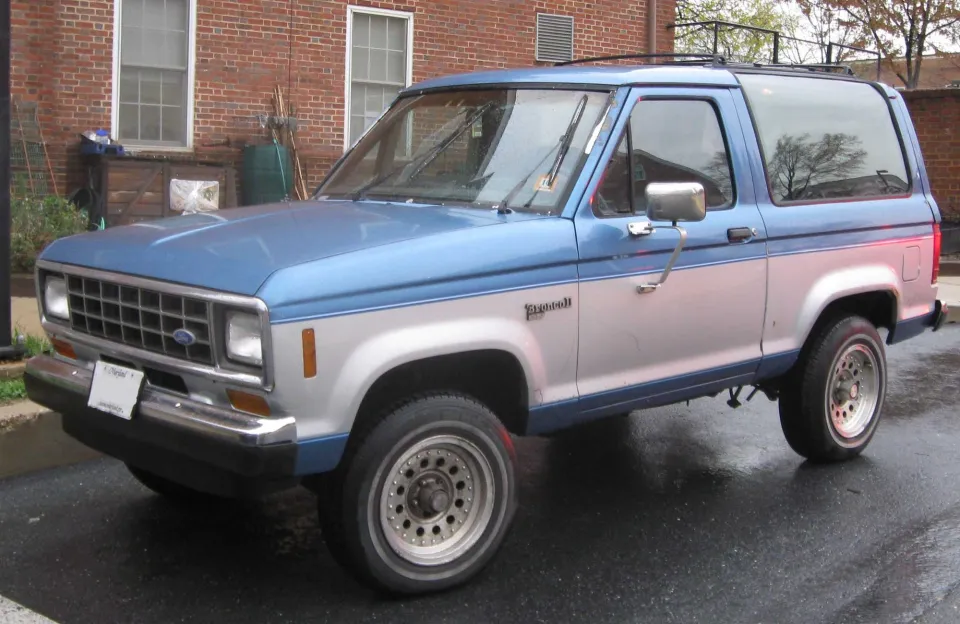
The photographer identifies this as a 1985 Bronco II, photographed in Christchurch, New Zealand.Photo by Riley / NZ Car Freak, CC BY 2.0, via Wikimedia Commons; plate characters obscured by BroncoFactsSource: Wikimedia Commons
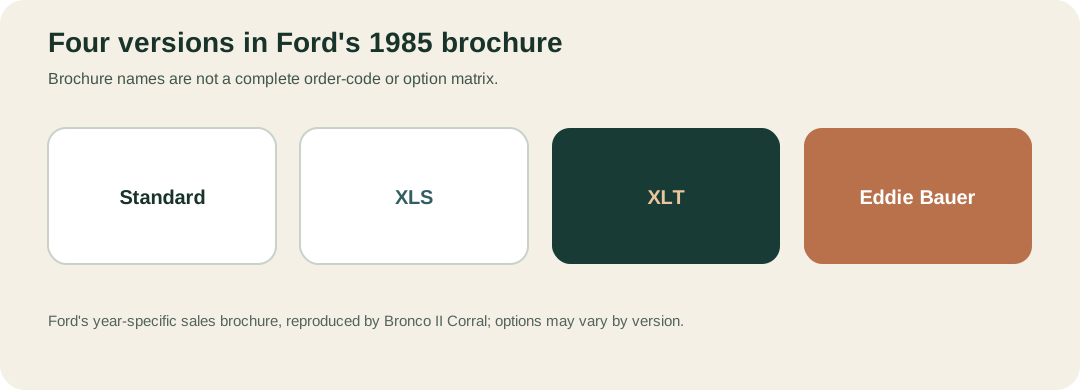
Ford's brochure lists a five-speed manual overdrive as standard and an automatic overdrive as optional, with a part-time two-speed transfer case on every truck. There were four versions: Standard, XLS, XLT and Eddie Bauer. The brochure shows 12 exterior colors, with Dark Spruce Metallic kept for the Eddie Bauer.
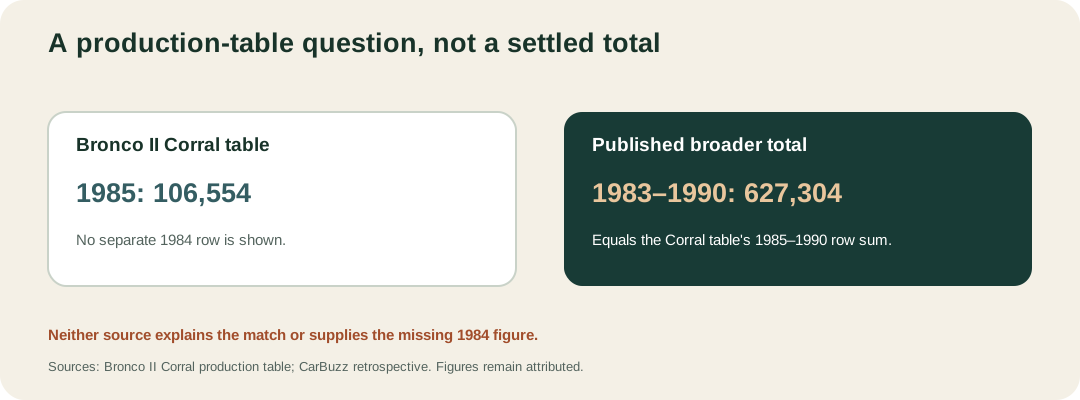
Bronco II Corral counts 106,554 built, all 4x4. Its table starts at 1985, so that number may include 1984 trucks. For 1986 Ford brought a fuel-injected 2.9-liter V6 and a rear-drive model, which makes 1985 the last of the original setup.
Bronco II Corral's count. Its table has no 1984 line, and the 627,304 lifetime total CarBuzz prints is exactly 1985 through 1990 added up, so this figure may include 1984 trucks.
Wikipedia's figure for 1984-1988 trucks. Ford's brochures print 158.4 inches for 1984 and 158.2 for 1986.
Ford's 1985 brochure prints no output. The torque figure is The Ranger Station's; Wikipedia gives the same 115 hp.
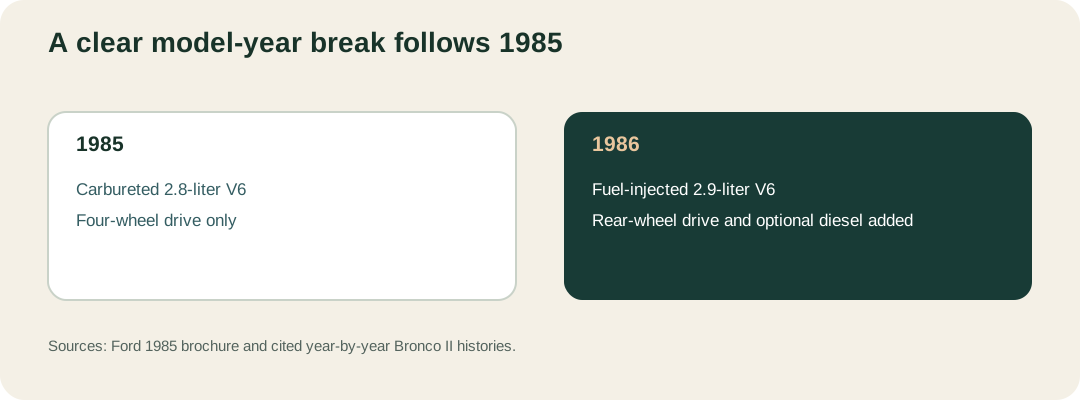
1985 was the last year of the launch setup, before fuel injection, rear-wheel drive and a diesel option arrived for 1986.
Body styles and market
Market: U.S.-market Bronco II, a separate compact truck from the full-size Bronco
Body styles: Three-door compact wagon, 4x4 only
This undated photo shows the early Bronco II body shared across 1984–1988.Photo by IFCAR, public domain, via Wikimedia CommonsSource: Wikimedia Commons
What changed for this year
Carryover year
Bronco II Corral and Wikipedia describe 1985 as a carryover from the launch year.
[1][2]
Still 4x4 only
Every 1985 was four-wheel drive. The rear-drive Bronco II arrived for 1986.
[1][2]
Models and trims
Four versions
Ford's 1985 brochure lists Standard, XLS, XLT and Eddie Bauer.
[8]
Eddie Bauer
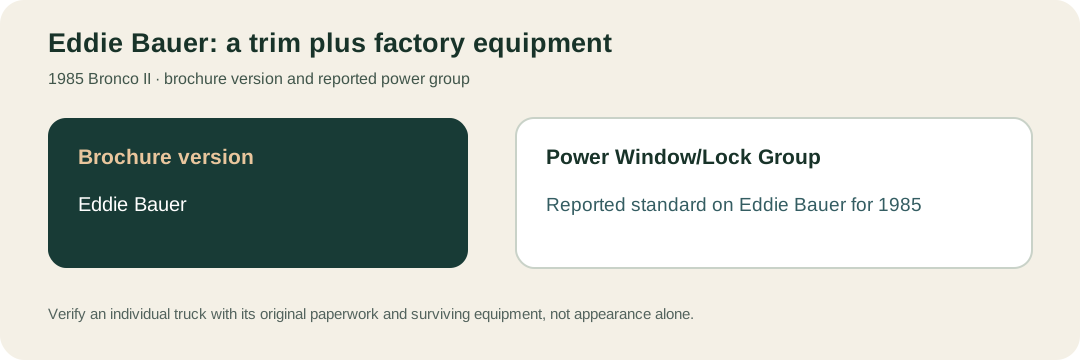
Eddie Bauer was a separate version in the 1985 brochure, with Dark Spruce Metallic paint reserved for it.
[8]
Ford's 1985 brochure shows four versions: Standard, XLS, XLT and Eddie Bauer.Original BroncoFacts diagram based on Ford's brochure.Source: broncoiicorral.comBronco II histories report that the Power Window/Lock Group was standard on the Eddie Bauer version for 1985.Original BroncoFacts comparison based on Ford's brochure and cited histories.Sources: broncoiicorral.com · broncoiicorral.com (2) · motogallery.com
Engines and transmissions
Carbureted 2.8-liter V6
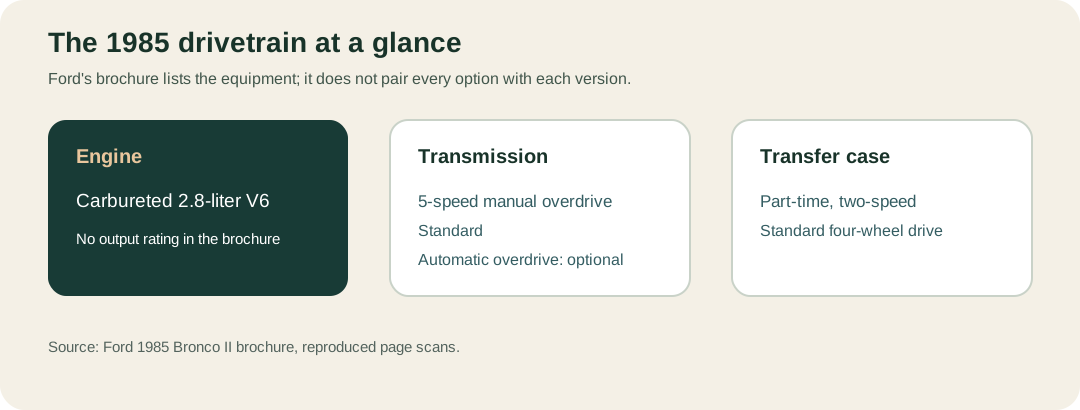
The 2.8-liter V6 was the only engine. The Ranger Station rates it at 115 hp at 4,600 rpm and 150 lb-ft at 2,600 rpm; Wikipedia gives the same 115 hp.
[2][8][10]
Five-speed standard, automatic optional
Ford's 1985 specification table lists a five-speed manual overdrive as standard and an automatic overdrive as optional.
[8]
Transfer case and axles
A part-time two-speed transfer case, the Borg-Warner 1350, was standard, with manual locking hubs and optional automatic hubs. The front axle was a Dana 28 Twin-Traction Beam rated at 2,750 lb; the rear was a Ford 7.5-inch rated at 2,640 lb.
[8][10]
Ford lists the carbureted 2.8-liter, standard five-speed manual and part-time two-speed transfer case, with automatic overdrive optional.Original BroncoFacts drivetrain diagram based on Ford's brochure.Source: broncoiicorral.com
Capability and specifications
94-inch wheelbase
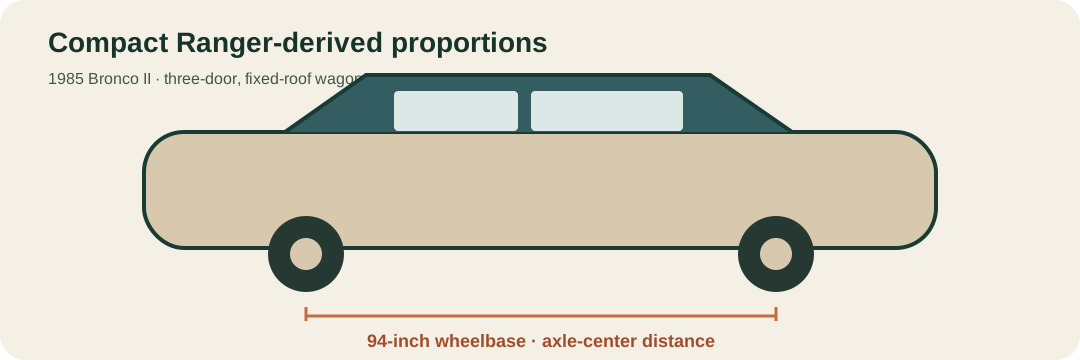
The wheelbase was 94 inches. Wikipedia gives 158.3 inches overall for 1984 through 1988; Ford's brochures print 158.4 for 1984 and 158.2 for 1986. The fuel tank holds 23 gallons.
[2][4][8]
The Ranger-derived three-door Bronco II uses a 94-inch wheelbase, measured between the axle centers.Original BroncoFacts diagram based on Ford's launch material and cited model history.Sources: Ford Media Center · broncoiicorral.comA published 1985 count and a broader 1983–1990 total share the same table sum.Original BroncoFacts comparison of attributed production figures.Sources: broncoiicorral.com · carbuzz.com
Colors and interiors
12 exterior colors
Raven Black, Silver Metallic, Light Canyon Red, Midnight Blue Metallic, Light Regatta Blue, Dark Canyon Red, Bright Regatta Blue, Wimbledon White, Light Desert Tan, Dark Charcoal Metallic, Walnut Metallic and, on the Eddie Bauer only, Dark Spruce Metallic.
[8]
Options and packages
Automatic overdrive and automatic hubs
Ford sold the 1985 in four versions, Standard through Eddie Bauer. The automatic overdrive transmission and automatic locking hubs were optional.
[8][10]
Safety and recalls
Rollover record
The Bronco II is remembered for its rollover record. NHTSA opened a rollover investigation in 1989, and that May Consumer Reports rated the truck "Avoid" after wheels lifted in its emergency-maneuver test.
[1][2][7]
Owner and buyer notes
Full-size Bronco parts do not carry over
The Bronco II is a shortened Ranger with its own frame, axles and capacities. Full-size Bronco parts and specifications do not carry over.
[1][4]
Eddie Bauer trucks
Two-tone paint, badges and upgraded seats can all be added later. Check the paint and trim codes on the certification label.
[3]
What to look at
Rust, steering, suspension, brakes, wheel bearings, driveline and the fuel system all deserve a look on a truck this age. Run the VIN for open recalls.
[1]
Stories from this year
Last of the original setup
For 1986 Ford moved to a fuel-injected 2.9-liter V6 and added a rear-drive model. That makes 1985 the last carbureted, 4x4-only Bronco II.
[1][2]
One number, maybe two years
The lifetime total CarBuzz prints, 627,304, is exactly Bronco II Corral's 1985 through 1990 rows added up. If CarBuzz's 1983 start is right, the Corral's 106,554 covers 1984 as well.
[5][6]
Ford's year-by-year sources separate the carbureted, 4x4-only 1985 model from the 1986 engine and drivetrain changes.Original BroncoFacts timeline based on the cited brochure and model history.Sources: broncoiicorral.com · broncoiicorral.com (2)