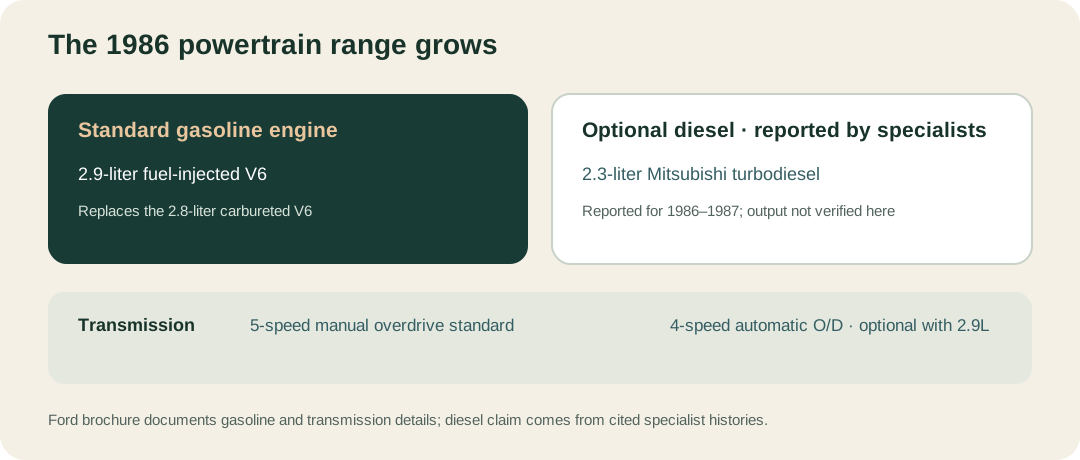
1986 was the Bronco II's biggest mechanical change. A fuel-injected 2.9-liter V6 replaced the carbureted 2.8 as the standard engine. The Ranger Station rates it at 140 hp and 170 lb-ft, and Ford's later brochures print the same numbers.
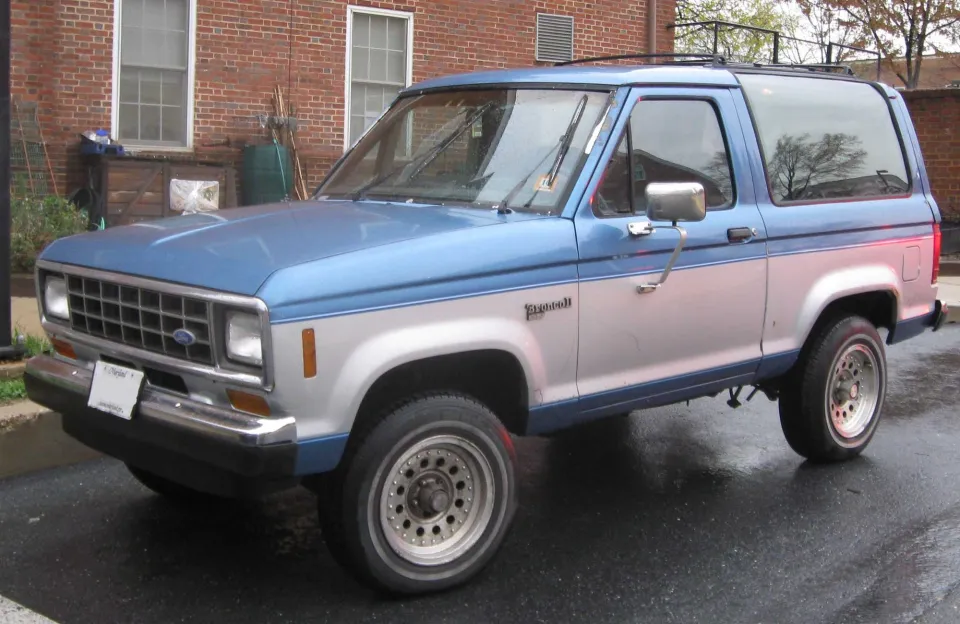
This undated photo shows the early Bronco II body shared across 1984–1988.Photo by IFCAR, public domain, via Wikimedia CommonsSource: Wikimedia Commons
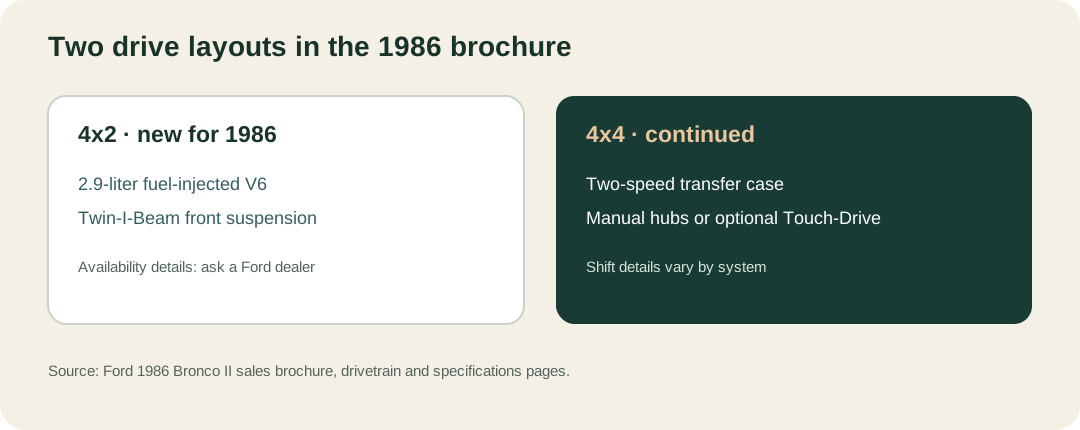
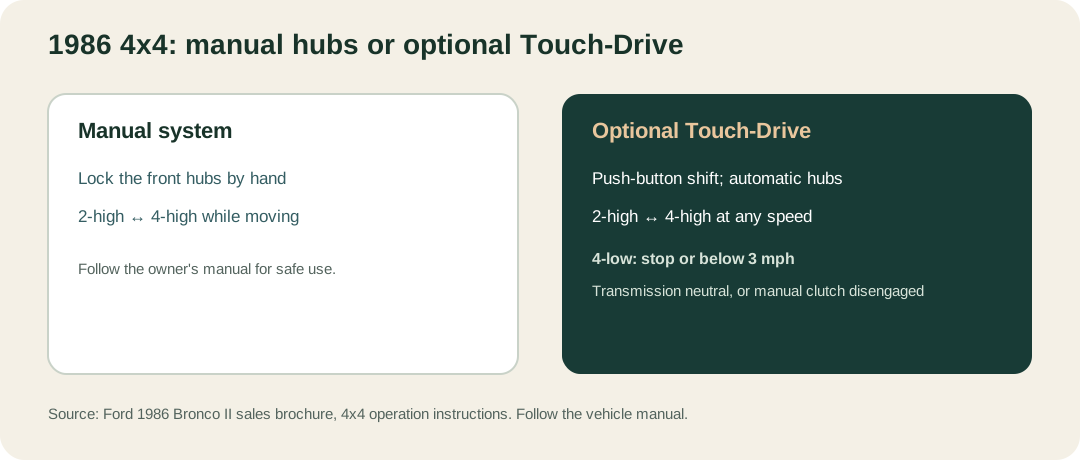
Ford's brochure also calls the 4x2 new for the year, with Twin-I-Beam front suspension in place of the 4x4's Twin-Traction Beam. On the 4x4, the standard manual-shift transfer case could go between 2-high and 4-high on the move, and Touch-Drive push-button shifting was optional. A five-speed manual overdrive was standard and a four-speed automatic overdrive optional. Bronco II Corral and Wikipedia also list a Mitsubishi 2.3-liter turbodiesel four as a 1986 option and say few were ordered.
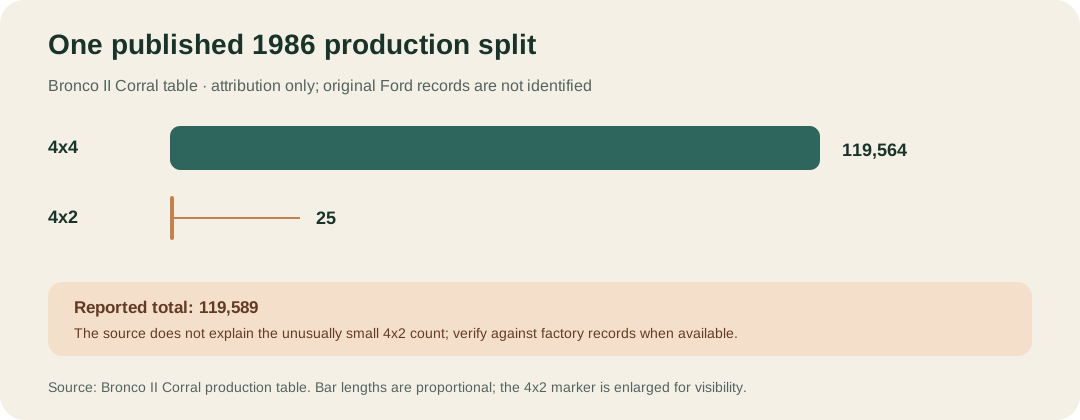
The brochure lists three versions, Standard, XLT and Eddie Bauer, and 12 colors. Bronco II Corral counts 119,589 built: 119,564 4x4 and just 25 4x2.
Raven Black, Dark Grey Metallic, Medium Silver Metallic, Bright Canyon Red, Dark Canyon Red, Light Regatta Blue, Dark Shadow Blue Metallic, Colonial White, Dark Walnut Metallic, Light Desert Tan, Desert Tan Metallic, Dark Spruce Metallic (Eddie Bauer only)
[7]
Bronco II Corral's count, which it says was compiled from Ford records without reproducing them. The 25 rear-drive trucks are its number for the 4x2's first year.
The turbodiesel is not in Ford's 1986 sales brochure. Bronco II Corral and Wikipedia both list it as a 1986 option and say few were ordered.
The 1986 brochure prints no output. These are The Ranger Station's figures, and Ford's later Bronco II brochures give the same numbers for this engine.
Ford's 1986 brochure gives the 4x2 front axle 2,500 lb. The 1987 and 1988 brochures give 2,200 lb.
1986 turned the Bronco II from a carbureted, 4x4-only truck into a line with fuel injection, rear-wheel drive and a diesel option.
Body styles and market
Market: U.S.-market Bronco II, a separate compact truck from the full-size Bronco
Body styles: Three-door compact wagon, 4x2 or 4x4
What changed for this year
2.9-liter EFI V6 replaces the 2.8
Ford's 1986 brochure makes the electronically fuel-injected 2.9-liter V6 the new standard engine on both 4x2 and 4x4, in place of the 2.8-liter two-barrel V6.
[7]
Rear-wheel drive arrives
Ford's brochure calls the 4x2 new for 1986. It came with the 2.9 EFI V6 and Twin-I-Beam independent front suspension. Bronco II Corral and Wikipedia give the body codes as 21E for the 4x2 and 21I or 211 for the 4x4.
[1][2][7]
Two 4x4 shift systems
The standard 4x4 has manual locking hubs and shifts between 2-high and 4-high on the move. Optional Touch-Drive swaps the floor lever for push buttons and adds automatic locking hubs. It shifts between 2-high and 4-high at any speed; 4-low needs a stop or under 3 mph, with the transmission in neutral or the clutch in.
[7]
Ford calls the 4x2 new for 1986 and pairs it with the 2.9-liter V6 and Twin-I-Beam suspension. The brochure sends buyers to dealers for availability.Original BroncoFacts diagram based on Ford's 1986 brochure.Source: therangerstation.comFord describes manual locking hubs and optional push-button Touch-Drive, with different 4-low engagement conditions.Original BroncoFacts 4x4 operation diagram based on Ford's brochure.Source: therangerstation.com
Models and trims
Three versions
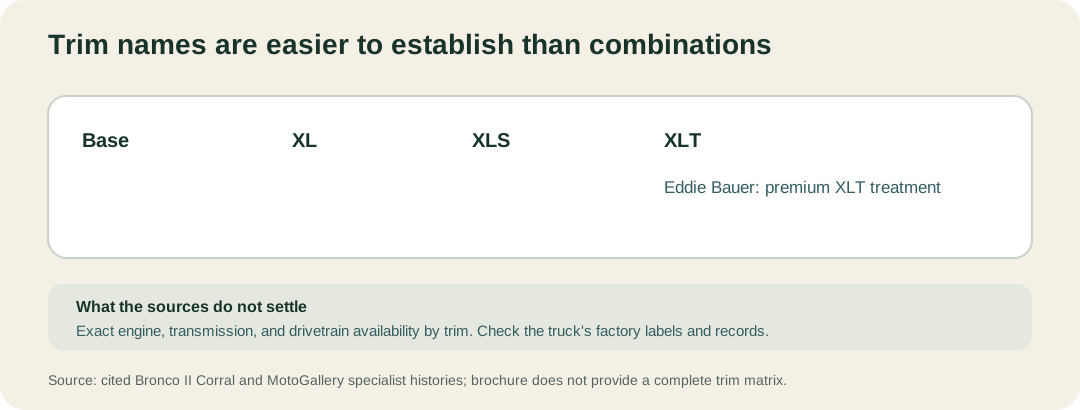
Ford's 1986 brochure lists Standard, XLT and Eddie Bauer.
[7]
Specialist histories list Base, XL, XLS and XLT, with Eddie Bauer as a premium XLT treatment.Original BroncoFacts diagram based on cited specialist histories.Sources: broncoiicorral.com · motogallery.com
Engines and transmissions
2.9-liter fuel-injected V6
The Ranger Station rates the 2.9 at 140 hp at 4,600 rpm and 170 lb-ft at 2,600 rpm. Ford's later Bronco II brochures give the same numbers.
[4][7][9]
Optional 2.3-liter turbodiesel
Bronco II Corral and Wikipedia list a Mitsubishi 2.3-liter turbodiesel four as an option for 1986 and 1987, and both say few were ordered. Ford's 1986 sales brochure leaves it out.
[1][2][7]
Transmissions and transfer case
A five-speed manual overdrive was standard and a four-speed automatic overdrive optional with the 2.9 V6. The 4x4 had a part-time two-speed transfer case with manual shift; Touch-Drive electric shift was optional.
[7]
The photographer identifies this as a 2.9-liter V6 in a 1986 Bronco II.Photo by Redelback49, CC BY-SA 4.0, via Wikimedia Commons; resized by BroncoFactsSource: Wikimedia CommonsFord's brochure lists the standard 2.9-liter V6 and gasoline-engine transmission choices. Specialist histories report an optional diesel.Original BroncoFacts powertrain diagram based on Ford's brochure and specialist histories.Sources: therangerstation.com · broncoiicorral.com · therangerstation.com (2)
Capability and specifications
Dimensions
Ford's brochure gives a 94-inch wheelbase, 158.2 inches overall and a 23-gallon fuel tank.
[7]
Axles
The 4x4 used a Dana 28 Twin-Traction Beam front axle rated at 2,750 lb. The 4x2 used a Twin-I-Beam front rated at 2,500 lb. Both had a Ford 7.5-inch rear rated at 2,640 lb.
[7][9]
Bronco II Corral reports 119,564 4x4 and 25 4x2 units, an unusually small rear-drive figure.Original BroncoFacts chart based on Bronco II Corral's published table.Source: broncoiicorral.com
Colors and interiors
12 exterior colors
Raven Black, Dark Grey Metallic, Medium Silver Metallic, Bright Canyon Red, Dark Canyon Red, Light Regatta Blue, Dark Shadow Blue Metallic, Colonial White, Dark Walnut Metallic, Light Desert Tan, Desert Tan Metallic and, on the Eddie Bauer only, Dark Spruce Metallic.
[7]
Options and packages
Touch-Drive, automatic and diesel
Touch-Drive electric shift and the four-speed automatic overdrive were the main mechanical options. The turbodiesel and the new 4x2 widened the choices further.
[1][2][7]
Safety and recalls
Rollover record
The Bronco II is remembered for its rollover record. NHTSA opened a rollover investigation in 1989, and that May Consumer Reports rated the truck "Avoid" after wheels lifted in its emergency-maneuver test.
[2][6]
Owner and buyer notes
4x2 or 4x4
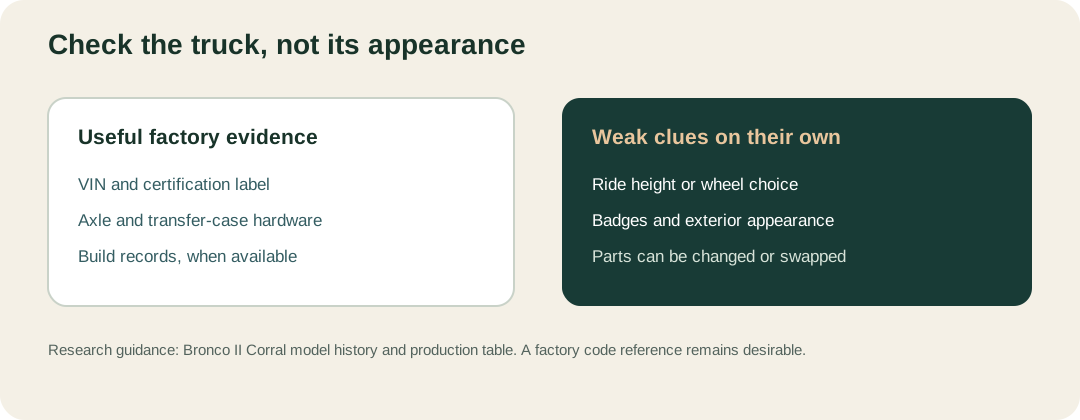
A 4x2 has the Twin-I-Beam front axle; a 4x4 has the Dana 28 and a transfer case. Check the VIN and certification label as well. With 25 listed for the year, a real 1986 4x2 is a rare truck.
[1][5][7]
Engines get swapped
Diesel swaps and later 2.9 repairs happen. Check the engine, transfer case, axles and emissions equipment against the VIN and labels, and run the VIN for open recalls.
[1][4]
Full-size Bronco parts do not carry over
The 1986 full-size Bronco had a different chassis and engine range. Its parts and specifications are its own.
[1][2]
Tell a 4x2 from a 4x4 by its VIN, factory labels and drivetrain hardware. Badges and stance can be changed.Original BroncoFacts identification guide based on cited model histories.Sources: broncoiicorral.com · broncoiicorral.com (2)
Stories from this year
Twenty-five rear-drive trucks
Bronco II Corral lists 25 4x2s for 1986 against 119,564 4x4s. Ford's brochure called the 4x2 new and sent buyers to the dealer for availability. The Corral's 4x2 count for 1987 is 23,958.
[5][7]
The two-year diesel
The Mitsubishi turbodiesel came for 1986 and was gone after 1987. Few were ordered, and reviewers found it weak.
[1][2]