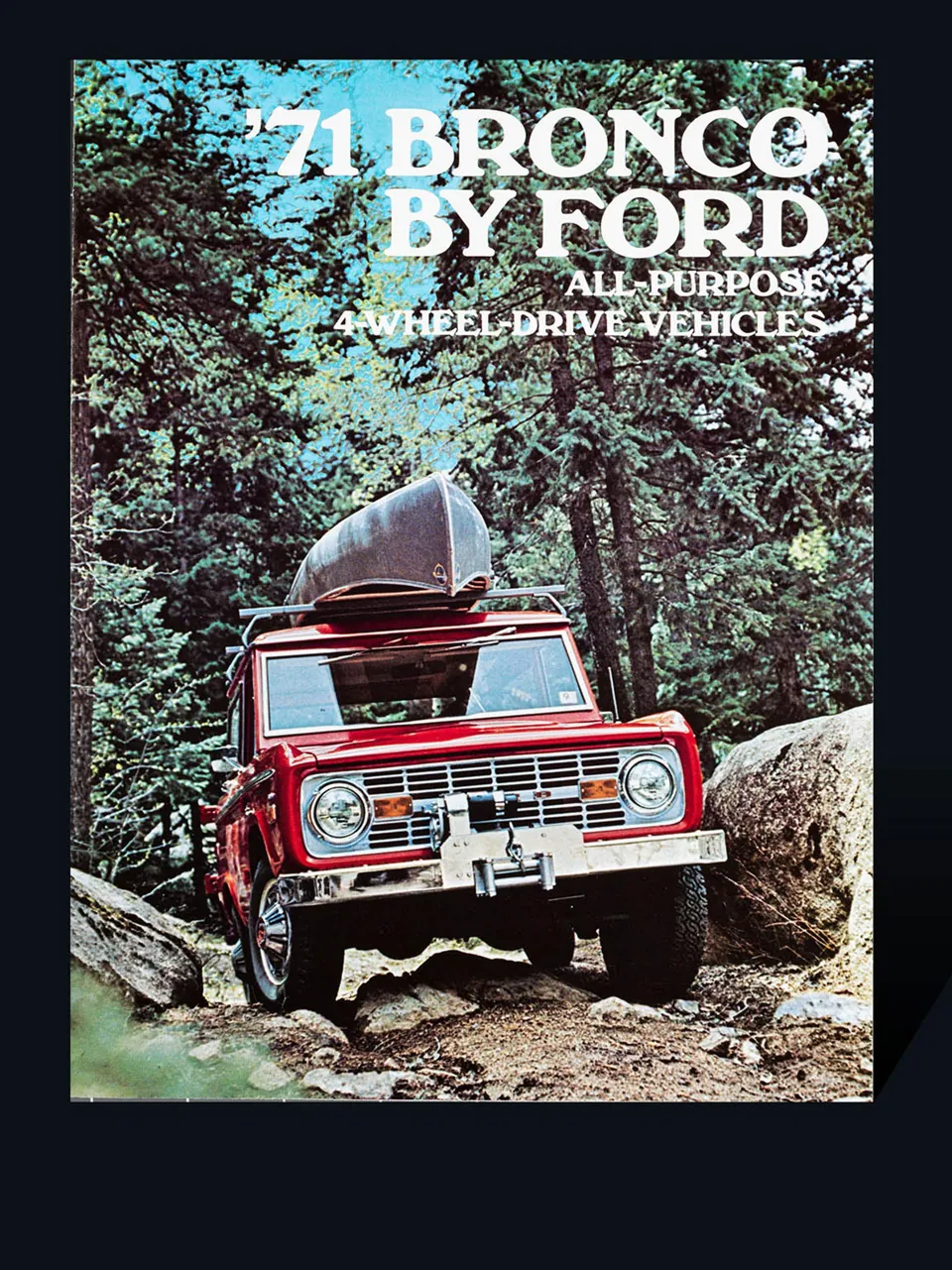
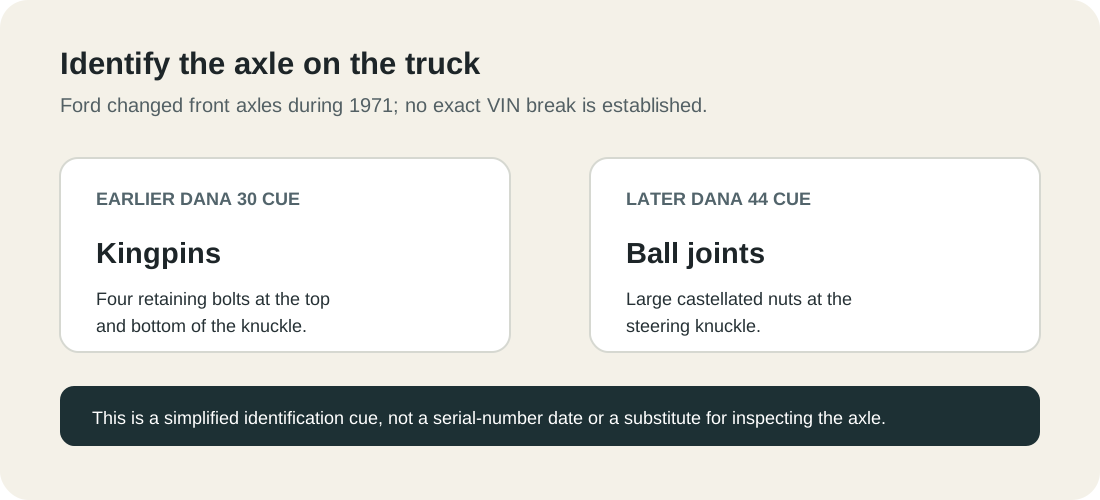
The 1971 Bronco came as a U14 Pickup or U15 Wagon with the 170 six or the optional 302 V8. The big mechanical news came late. Ford's product information calls the Dana 44 front axle a late-1971 introduction, and parts specialists call it a midyear change from the Dana 30. A Dana 30 has kingpins in its steering knuckles. A Dana 44 has ball joints held by castle nuts.
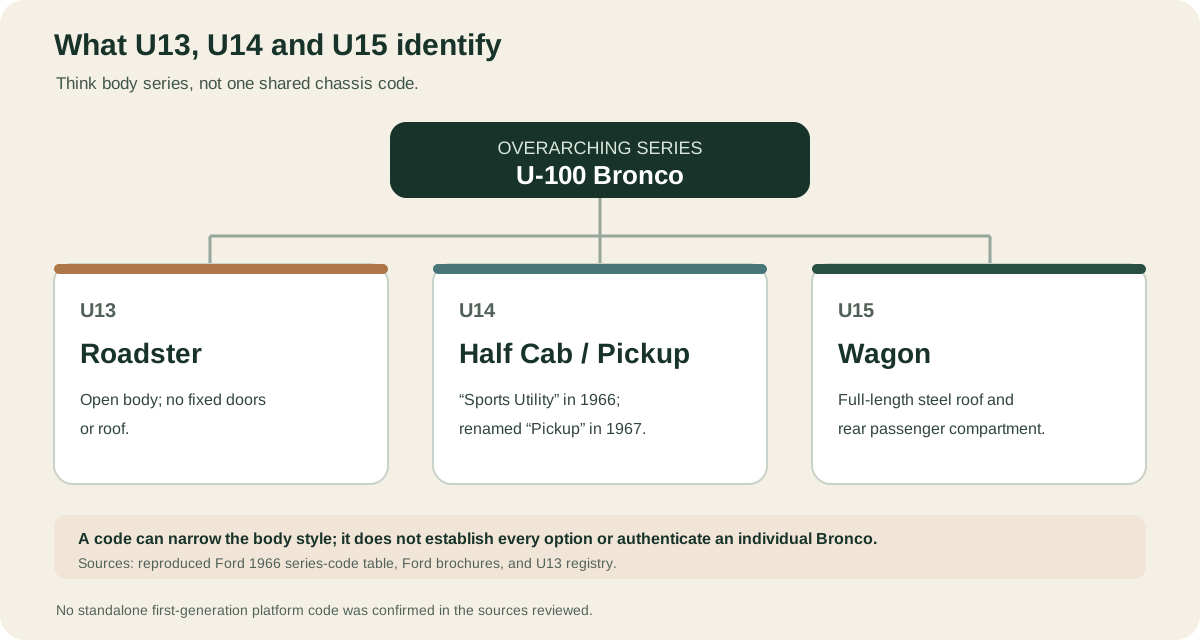
The diagram includes U13 for comparison; Ford’s 1971 product information lists the Bronco Pickup and Wagon, U14 and U15 here. The codes identify body styles.Original BroncoFacts series-code explainer with links to the cited references.Sources: cjponyparts.com · roadsteru13.com · FordThese simplified steering-knuckle cues tell Dana 30 kingpins from Dana 44 ball joints. The axle changed during 1971, without an exact VIN cutoff.Original BroncoFacts axle-identification guide based on the linked technical source.Source: therangerstation.com
The Baja Bronco arrived the same year. Andrew Norton dates Ford's announcement to January 28, 1971. Bill Stroppe's shop converted the trucks, and Norton says the automatic and power steering were ordered equipment, so some Bajas kept the manual.
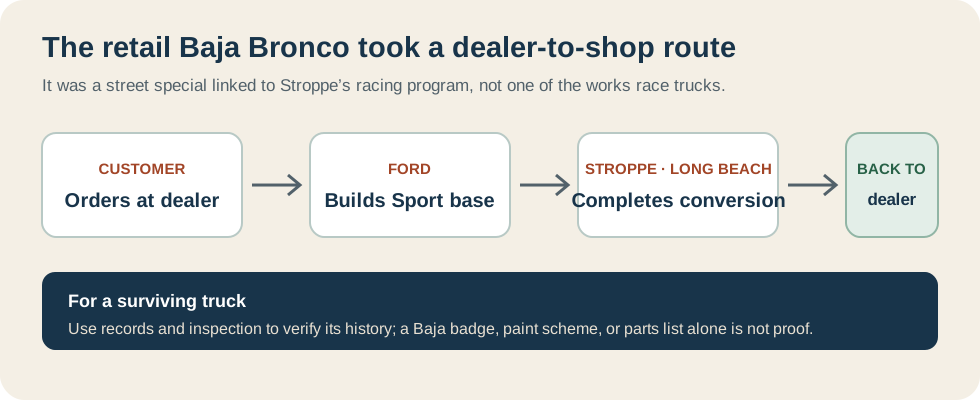
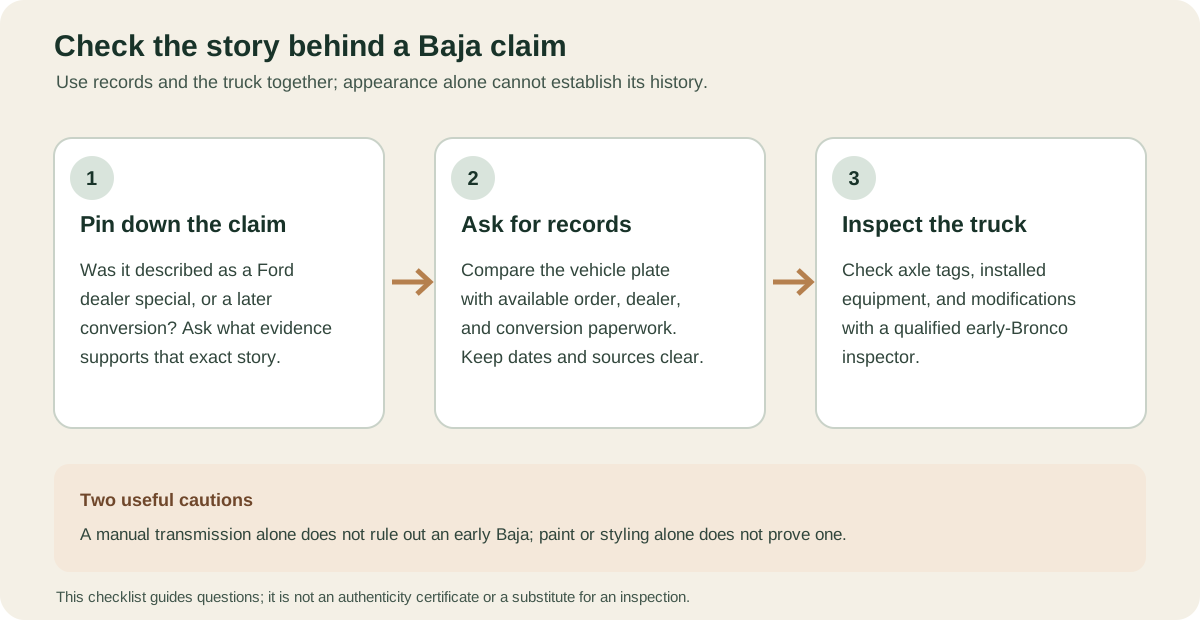
The retail special’s reported path ran from a Ford dealer to the factory, then to Stroppe’s Long Beach shop and back to the dealer.Original BroncoFacts diagram based on the cited Baja Bronco and Stroppe histories.Sources: bajabronco.com · ormhof.orgA buyer's checklist for a Baja claim: the seller's exact claim, period paperwork, then the installed parts. A manual transmission alone does not rule out an early Baja.Original BroncoFacts inspection aid; sources are linked on the page.Sources: bajabronco.com · mattstonecars.com
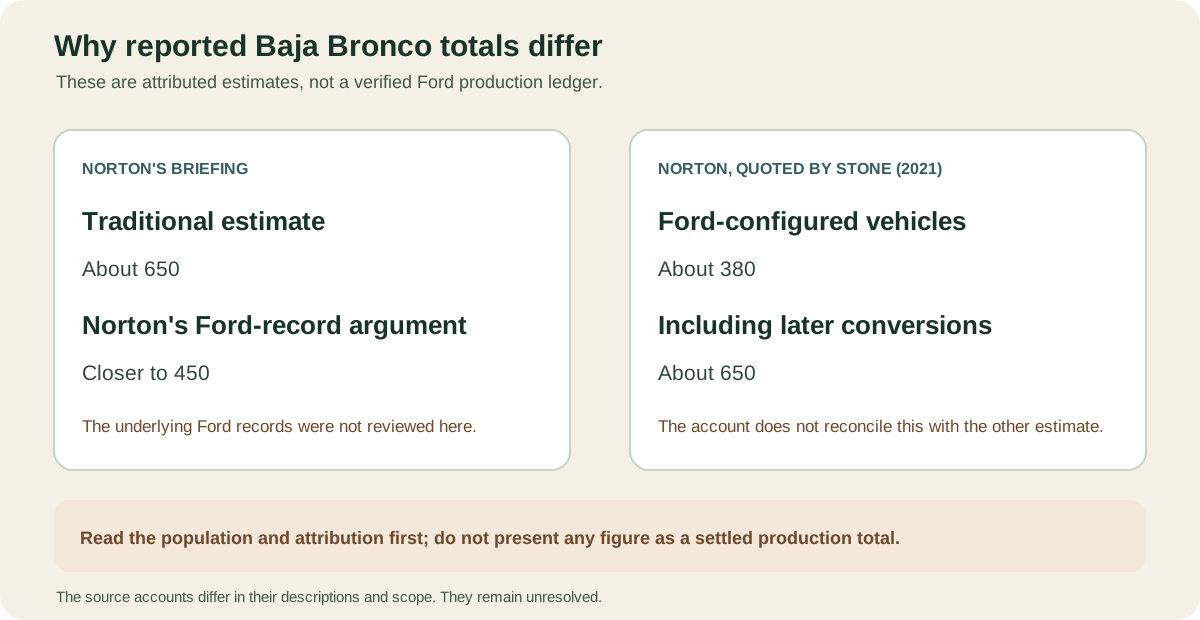
How many were built depends on who is counted. Norton cites the long-used figure of about 650 and argues Ford records support about 450. In Matt Stone's May 2021 account, Norton counts about 380 trucks specially configured by Ford and about 650 once later customer and dealer conversions are included.
Norton argues that Ford records support a figure near 450 instead of the traditional estimate near 650. Stone's 2021 article quotes Norton separating about 380 Ford-configured vehicles from about 650 including later conversions.Original BroncoFacts diagram; linked accounts provide the attributed estimates.Sources: bajabronco.com · mattstonecars.com
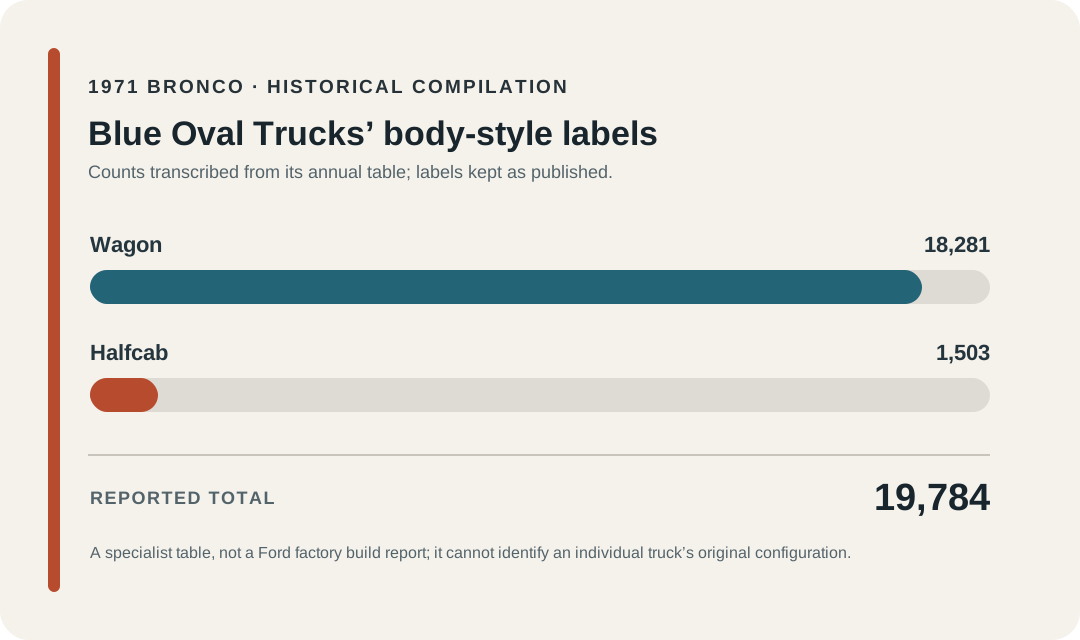
Blue Oval Trucks lists 19,784 Broncos for 1971: 18,281 Wagons and 1,503 Pickups. Parnelli Jones and Bill Stroppe won that year's Baja 1000 overall in Big Oly.
1971 brought the heavier Dana 44 front axle and the Baja Bronco to the showroom, and Big Oly won the Baja 1000 overall.
Body styles and market
Market: U.S.-market first-generation Bronco
Body styles: U14 Pickup; U15 Wagon
What changed for this year
Dana 44 front axle
Ford's 1971 product information calls the Dana 44 a late-1971 introduction. The Ranger Station and Wild Horses describe it as a midyear change.
[10][1][2][9]
Baja Bronco launch
Andrew Norton's Baja Bronco briefing dates Ford's announcement to January 28, 1971.
[4]
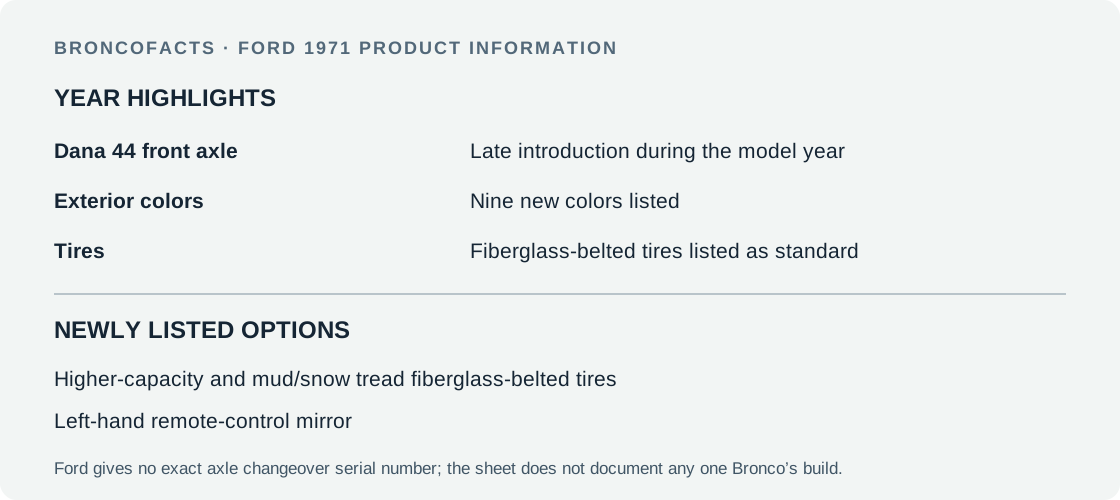
Ford’s 1971 product information calls the Dana 44 a late introduction, lists nine new exterior colors and standard fiberglass-belted tires, and names new tire and mirror options.Original BroncoFacts summary based on Ford’s 1971 Product Information, PDF p. 14.Source: xr793.com
Models and trims
Sport and Baja Bronco
Sport was the regular trim package. The Baja Bronco was a limited dealer special converted by Stroppe.
[1][3]
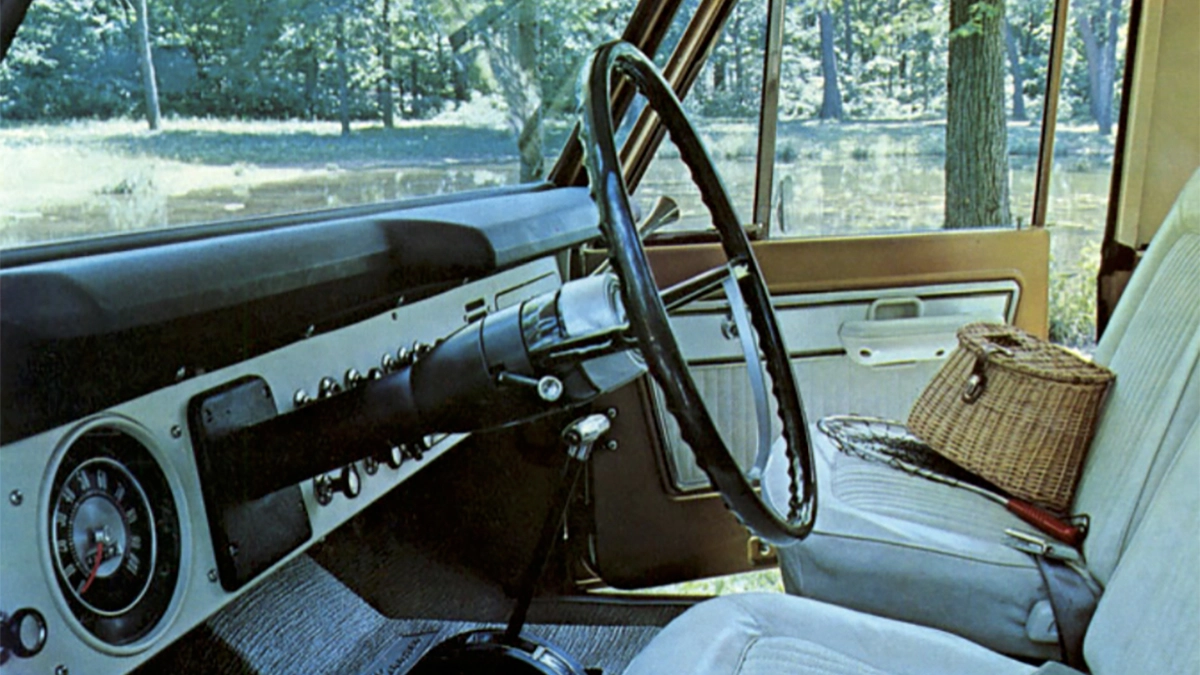
Car Back Catalogue indexes this as a Ford 1971 U.S. brochure Sport interior.Image courtesy Ford Motor Company; 1971 Bronco sales brochure image, accessed via Car Back Catalogue.Sources: carbackcatalogue.com · carbackcatalogue.com (2) · Ford Canada
Engines and transmissions
170 inline six
Standard. 100 gross hp and 148 gross lb-ft.
[1][5][12]
302 V8
Optional, with a two-barrel carburetor. 205 gross hp and 300 gross lb-ft.
[1][3][12]
Driveline
Fully synchronized three-speed manual and Dana 20 two-speed transfer case. On Baja Broncos, Norton says the automatic and power steering were ordered conversions.
[12][4]
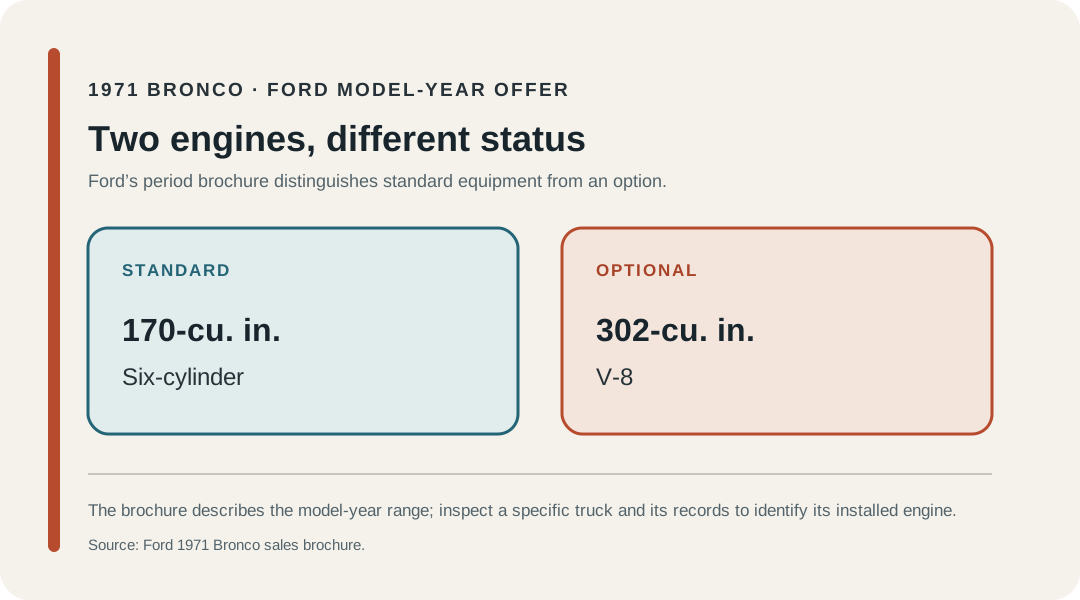
Ford's 1971 brochure lists the 170-cu. in. Six as standard and the 302-cu. in. V-8 as optional.Original BroncoFacts diagram based on Ford’s 1971 brochure.Sources: Ford Canada · xr793.com
Capability and specifications
Front axle identification
Dana 30 steering knuckles use kingpins. Dana 44 knuckles use ball joints secured by castle nuts. A 1971 can have either.
[2]
Dimensions and capacities
92-inch wheelbase, 152.1 inches overall. The Dana 30 front axle was rated at 2,500 lb and the rear at 2,780 lb with 4.11:1 standard. The tank held 12.7 gallons, with a 10.3-gallon auxiliary tank optional. GVWR was 3,900 lb, or 4,700 lb with the GVW package.
[12]
Blue Oval's table lists a 'Wagon' row (18,281) and a 'Halfcab' row (1,503), for a reported total of 19,784.Original BroncoFacts chart based on Blue Oval Trucks’ published 1971 table.Source: blueovaltrucks.com
Norton's briefing sets the traditional figure of about 650 against about 450 from Ford records. In Matt Stone's 2021 account, Norton gives 380 Ford-configured trucks and about 650 with later Stroppe conversions.
[4][7]
Limited-slip identification
A Dana 44 housing is no sign of a limited-slip differential. Read the axle tag and check what is inside.
[2]
Safety and recalls
Period safety
The 1971 Bronco predates airbags and crash-test ratings.
[5]
Owner and buyer notes
Axle and Baja checks
Look at the front knuckles: kingpins mean Dana 30, ball joints with castle nuts mean Dana 44. On a claimed Baja Bronco, ask for the plate, the order and the Stroppe conversion paperwork. A manual gearbox is correct on some early Bajas.
[2][4]
Stories from this year
Big Oly and the showroom echo
Parnelli Jones and Bill Stroppe won the 1971 Baja 1000 overall in Big Oly. The Baja Bronco was the limited showroom echo of that program.
[8]
Big Oly won the 1971 Baja 1000. This photo shows the race truck on display at the Petersen Automotive Museum in 2018.Photo by zombieite, CC BY 2.0, via Wikimedia CommonsSource: Wikimedia Commons