BRONCOFACTS Trail guide · 1966–present

Model year · First Generation

1973 Bronco

Wagon only, with an automatic at last

The 1973 Ford Bronco was Wagon-only and added the 200 six, the Ranger package and a V8-only automatic and power steering. 21,894 were built.

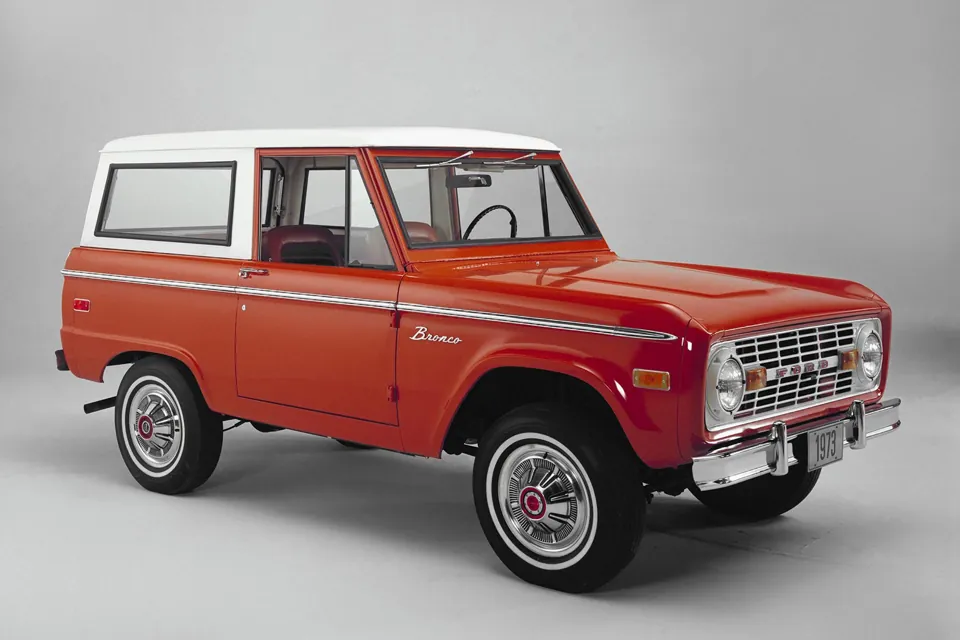
Ford's 1973 Bronco Ranger studio image, with white roof, side stripe, and Ranger spare-tire cover
Ford's 1973 Bronco Ranger studio image, with white roof, side stripe, and Ranger spare-tire cover Image courtesy Ford Motor Company Source: Ford

Published by BroncoFacts / 1031 Productions. How we evaluate sources.

With the Pickup gone, the 1973 Bronco was a U15 Wagon and nothing else. The standard engine was now a 200-cubic-inch six. The 302 V8 was optional, and it could be ordered with two new options: the SelectShift Cruise-O-Matic automatic and power steering. Both were V8-only.

Ford's 1973 Bronco brochure-cover photograph of a Wagon on a wooded road
Ford's 1973 model-year brochure cover. Image courtesy Ford Motor Company Source: Ford

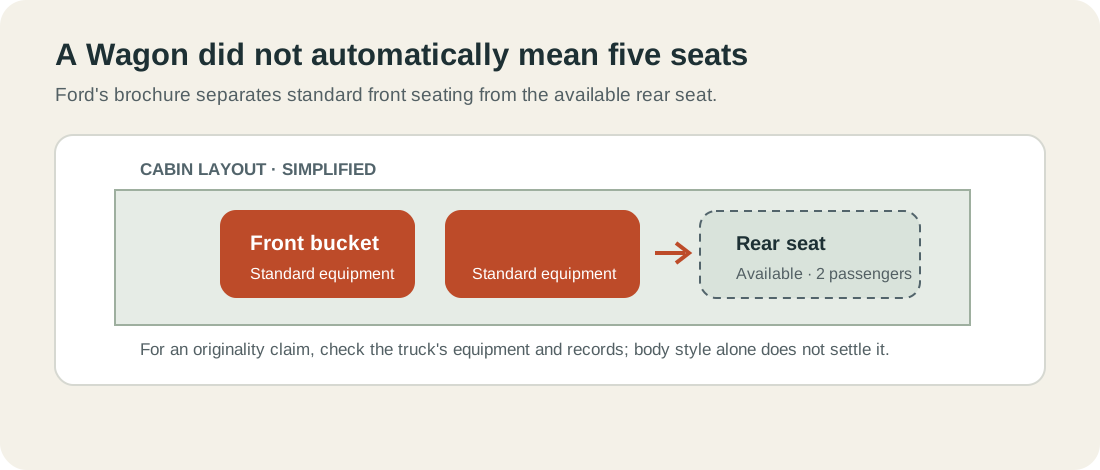
Front bucket seats were standard. A two-passenger rear seat was an option, so a Wagon was a two-seater unless the buyer ordered more.

Ford's brochure calls the Ranger package new for 1973: color-keyed carpeting, woodtone-accented door trim and cloth-and-vinyl seats, plus its exterior treatment. An older Bronco reference dates Ranger to 1972, and the brochure itself was printed in July 1972. Explorer and Sport continued.
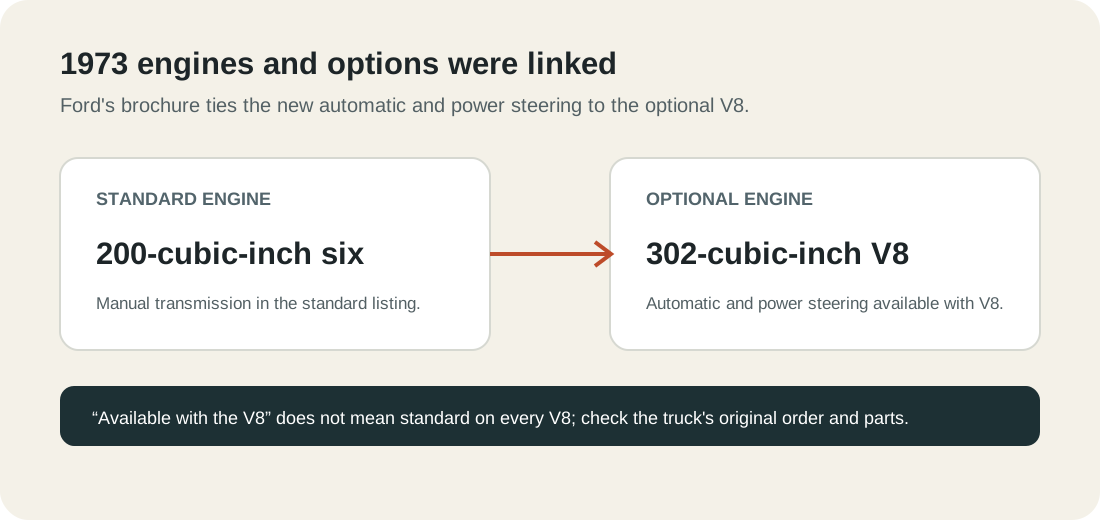
Original diagram of Ford's 1973 standard 200 six, optional 302 V8, and V8-only automatic/power-steering availability
Ford listed the 200 six as standard and the 302 V8 as optional. Its brochure made the automatic and power steering available with the V8. Original BroncoFacts diagram based on Ford's 1973 brochure. Source: Ford

For towing, Ford's recreation brochure rated a Bronco with the 302, power steering, extra cooling and the 4,500-lb GVW package for a 2,000-lb trailer. Blue Oval Trucks counts 21,894 Wagons for the year.
Sources for this account: [1] [2] [3] [4] [5] [6]

1973 Bronco at a glance
Production 21,894 Wagons [4] a
Base price $3,636 (Wagon) [9] b
Body styles Wagon (U15) [1] [2]
Assembly plant Michigan Truck Plant, Wayne, Michigan [8] c
Wheelbase 92 inches [1] [6]
Overall length 152.1 inches [6]
Curb weight 3,090 lb shipping weight (Wagon) [9] d
Engines 200 cu in six; 302 cu in V8 optional [1] [6]
Output Six: 84 hp, 151 lb-ft. V8: 138 hp, 234 lb-ft [7] e
Transmissions 3-speed manual; automatic optional with V8 [1] [6]
Transfer case Dana 20, 2-speed [6]
Axles Front 3,000-lb rating; rear 2,780-lb rating, 4.11:1 (3.50:1 with V8) [6]
Fuel capacity 12.2 gallons, plus optional 7.5-gallon auxiliary tank [6]
Towing capacity 2,000 lb with Ford's Class I setup: 302 V8, 4,500-lb GVW package, power steering, extra cooling [5]
GVWR 4,300 lb standard; 4,450, 4,500 or 4,900 lb packages [1] [6]
Trims Base, Sport, Explorer and new Ranger [1] [2]
Exterior colors 17: Wimbledon White, Candyapple Red, Royal Maroon, Wind Blue, Bahama Blue, Midnight Blue Metallic, Seapine Green Metallic, Bright Lime, Winter Green, Limestone Green Metallic, Mallard Green, Sequoia Brown Metallic, Hot Ginger Metallic, Durango Tan, Tampico Yellow, Chrome Yellow, Raven Black [6]
  1. Blue Oval Trucks' count. Ford has not published a year-by-year tally to check it against.
  2. OldRide's factory-price figure; it does not name its source.
  3. Ford says the plant built the Bronco from 1965 until June 12, 1996.
  4. OldRide's shipping-weight figure; it does not name its source.
  5. From the ClassicBroncos engine table, which does not say whether the figures are gross or net.

Every year in one table: production · engines and specs · trims and colors · compare this year with another

1973 Bronco specifications in detail

Engines

Advertised figures from the ClassicBroncos engine table, a club specialist's compilation. It does not say whether they are gross or net ratings.

1973 Bronco: engines [7]
Engine Bore × stroke Compression Carburetor Advertised horsepower Advertised torque Oil pressure
200 cu in inline six 3.683 × 3.126 in 8.3:1 1-barrel 84 at 3,600 rpm 151 lb-ft at 1,800 rpm 35 to 55 psi
302 cu in V8 4.000 × 3.000 in 8.3:1 2-barrel 138 at 4,200 rpm 234 lb-ft at 2,200 rpm 40 to 60 psi

Why it matters

1973 turned the Bronco into a Wagon-only truck with the options everyday drivers wanted: a bigger six, an automatic and power steering.

Body styles and market

Market: U.S.-market first-generation Bronco

Body styles: U15 Wagon, the only body

What changed for this year

Wagon only
The Pickup was discontinued. The Wagon was the only 1973 body. [1] [2]
200 six, automatic and power steering
The 200-cubic-inch six became the standard engine. The 302 V8 was optional, and the automatic and power steering were offered only with it. [1]
Ranger introduced
Ford's 1973 brochure, printed July 1972, calls the Ranger package new, and Ford's history dates it to 1973. An older Bronco reference says 1972. [1] [3] [2]
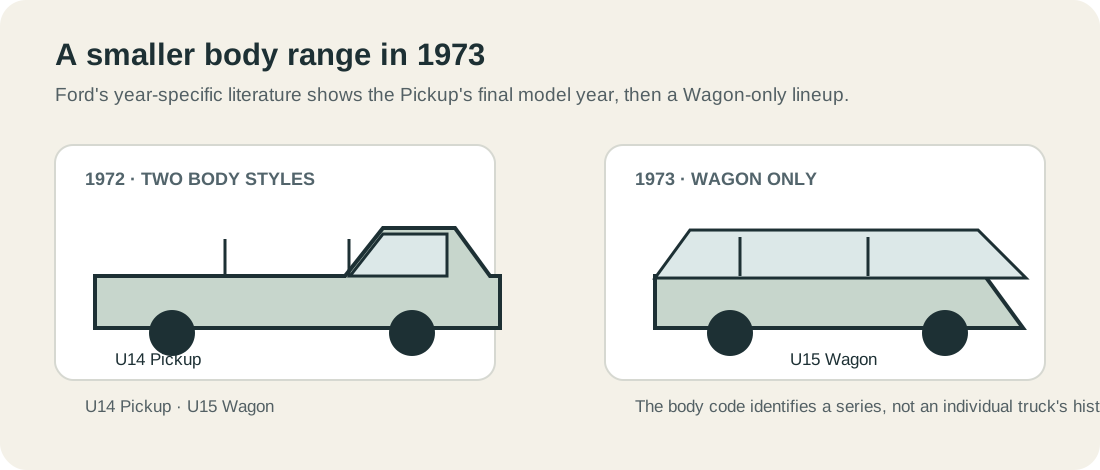
Original comparison of the 1972 U14 Pickup/U15 Wagon range and the 1973 Wagon-only offering
Ford's year-specific literature shows the U14 Pickup and U15 Wagon in 1972, then the U15 Wagon alone in 1973. Original BroncoFacts diagram based on Ford's cited model-year literature. Sources: Ford · Ford (2)
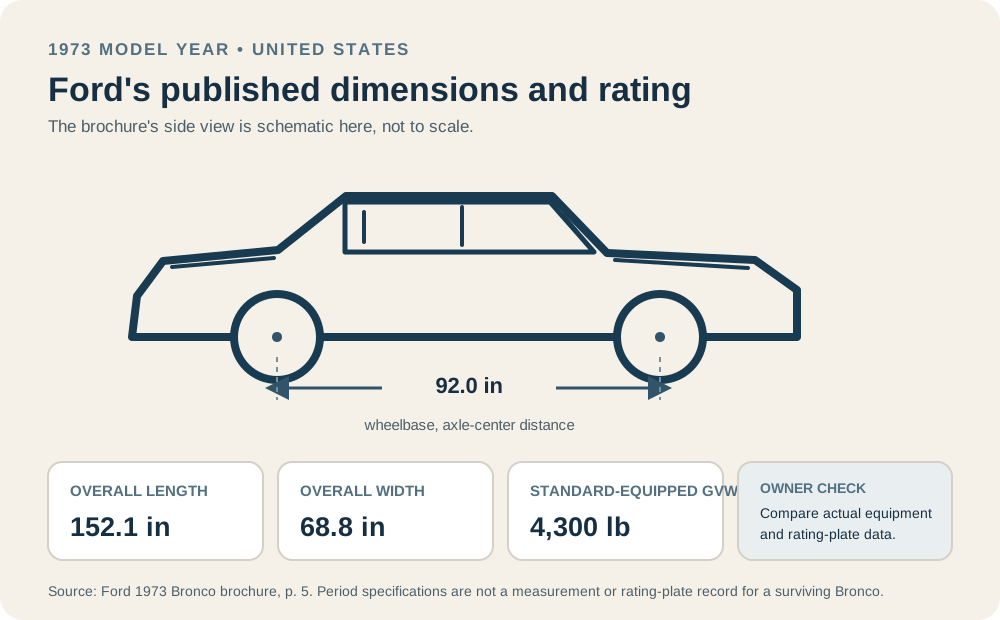
Original diagram of 1973 Ford Bronco published dimensions and standard-equipped gross vehicle weight rating
Ford’s 1973 brochure gives a 92.0-inch wheelbase, 152.1-inch overall length, 68.8-inch overall width, and a 4,300-lb gross vehicle weight rating with standard equipment. Original BroncoFacts diagram based on Ford’s 1973 Bronco brochure, p. 5. Sources: Ford · xr793.com
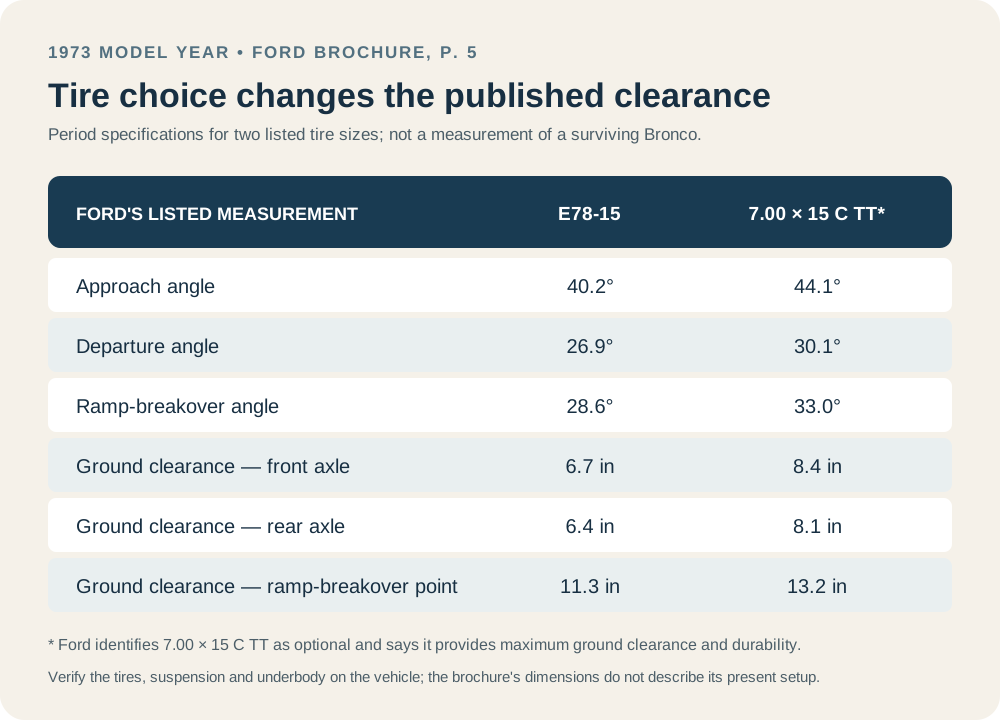
Ford's tire-specific 1973 approach/departure angles and ground-clearance figures
Ford’s 1973 brochure compares E78-15 and optional 7.00 × 15 C TT tires, with separate approach, departure, breakover, and axle-clearance figures. Original BroncoFacts comparison based on Ford's 1973 Bronco brochure, p. 5. Sources: Ford · xr793.com

Models and trims

Ranger
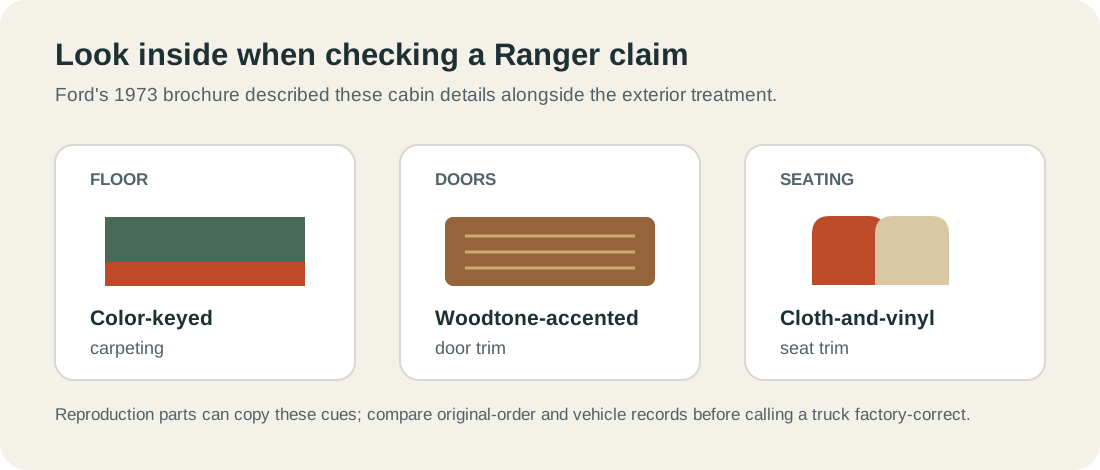
New for 1973, with color-keyed carpeting, woodtone-accented door trim, cloth-and-vinyl seating and its own exterior treatment. [1] [2]
Explorer and Sport
Both packages continued. [2]
Original diagram of Ranger carpeting, woodtone-accented door trim and cloth-and-vinyl seating
Ford's brochure describes Ranger carpeting, woodtone-accented door trim and cloth-and-vinyl seating. Original BroncoFacts diagram based on Ford's 1973 brochure. Source: Ford
1973 Bronco Ranger cabin with patterned cloth-and-vinyl bucket seats and woodtone-accented door trim
Ford's 1973 brochure labels this cabin as a Bronco with the optional Ranger Package, with patterned seats and woodtone-accented door trim. Image courtesy Ford Motor Company; 1973 Bronco brochure Sources: Ford · xr793.com
Ford brochure photo labeled “Sport Bronco interior,” showing a light-colored bucket-seat cabin and contrasting door trim
Ford labels this a Sport Bronco interior, a period example of the cabin. Image courtesy Ford Motor Company; 1973 Bronco brochure Sources: Ford · xr793.com
Gold-and-white Ford Bronco Explorer-package studio image, with a rear display card reading 1972
Ford’s history gallery calls this a 1973 Explorer; the rear display card reads 1972. Image courtesy Ford Motor Company Sources: Ford · Ford (2)

Engines and transmissions

200 inline six
Standard. ClassicBroncos lists 84 hp and 151 lb-ft. [1] [7]
302 V8
Optional. ClassicBroncos lists 138 hp and 234 lb-ft. The C4 automatic and power steering were available only with the V8. [1] [7]
Driveline
Three-speed manual standard, with a Dana 20 two-speed transfer case. [1] [6]

Capability and specifications

GVW and wheelbase
92-inch wheelbase and 152.1 inches overall. GVWR was 4,300 lb standard, with 4,450-, 4,500- and 4,900-lb packages. OldRide lists the Wagon at $3,636 with a 3,090-lb shipping weight. [1] [6] [9]
Axles and fuel
Front axle rated at 3,000 lb. Rear axle rated at 2,780 lb with a 4.11:1 ratio, or 3.50:1 with the V8. The tank held 12.2 gallons, with a 7.5-gallon auxiliary tank optional. [6]

Colors and interiors

Factory colors
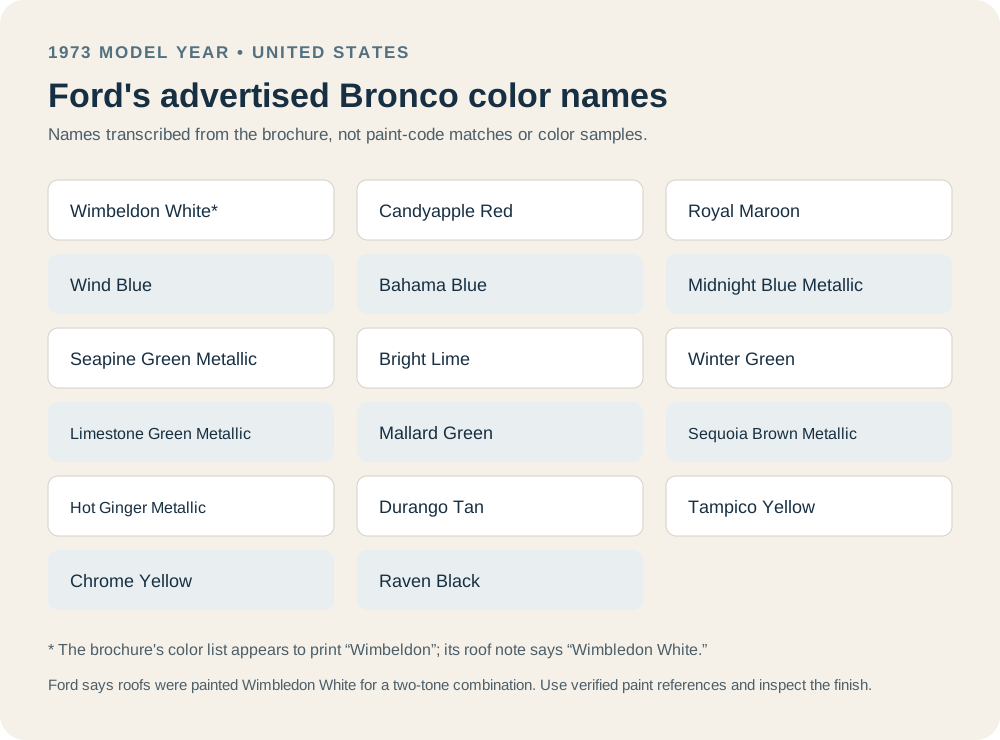
Seventeen colors: Wimbledon White, Candyapple Red, Royal Maroon, Wind Blue, Bahama Blue, Midnight Blue Metallic, Seapine Green Metallic, Bright Lime, Winter Green, Limestone Green Metallic, Mallard Green, Sequoia Brown Metallic, Hot Ginger Metallic, Durango Tan, Tampico Yellow, Chrome Yellow and Raven Black. [6]
Rear seat was an option
Front bucket seats were standard. A two-passenger rear seat was available as an option. [1]
Original cabin-layout diagram separating standard front buckets from the available two-passenger rear seat
Ford lists front bucket seats as standard and a two-passenger rear seat as available. Original BroncoFacts diagram based on Ford's 1973 brochure. Source: Ford
Text-only reference to 17 color names in Ford's 1973 Bronco brochure
Ford’s 1973 brochure lists 17 color names; its list spells “Wimbeldon” while its roof note says “Wimbledon White.” Original BroncoFacts color-name list based on Ford's 1973 Bronco brochure, p. 5. Sources: Ford · xr793.com

Options and packages

Automatic and power steering
Both were V8-only options in Ford's Bronco brochure and in its 1973 Vehicles for Recreation brochure. [1] [5]
Class I towing setup
Ford's recreation brochure specifies the 4,500-lb GVW package, 302 V8, power steering, G78-15D tires or equivalent, extra cooling and a weight-carrying hitch. So equipped, the Bronco was rated for a 2,000-lb loaded trailer with under 25 sq. ft. of frontal area and up to 200 lb on the hitch, 10 to 15 percent of trailer weight. That was Ford's 1973 rating for a new truck. [5]

Safety and recalls

Period safety
The 1973 Bronco predates airbags and crash-test ratings. [1]

Owner and buyer notes

Checking a Ranger
Stripes get replaced, so look at the cabin too. A Ranger should have the color-keyed carpet, woodtone door trim and cloth-and-vinyl seats the brochure describes. [1]

Stories from this year

The Bronco grows up without growing larger
1973 cut the Bronco to one body and made it easier to live with. An automatic transmission and power steering joined the option list. [1] [2]

Planning a viewing? Start with the buyer guide, take the printable inspection worksheet, and compare records with the VIN and warranty-plate tools.

Sources and footnotes

Bracketed references beside a fact lead to the document that supports it.

  1. Ford 1973 Bronco sales brochure Ford brochure printed July 1972; Ranger package on p. 4
  2. Ford first-generation Bronco history Ford's first-generation Bronco history page
  3. First-generation Bronco history, production, and trim Early Bronco Ads history of the Ranger package
  4. Blue Oval Trucks: Ford Bronco production numbers Specialist production table; 1973 Wagon count
  5. Ford 1973 Vehicles for Recreation Ford 1973 Vehicles for Recreation brochure, XR793 scan; Bronco towing on p. 9
  6. Ford 1973 Bronco sales brochure, XR793 scan XR793 scan of Ford's brochure; GVW selector in the centre spread, specs on the last page
  7. ClassicBroncos: 1966-1977 general engine specifications ClassicBroncos engine table dated December 23, 2015; output by year
  8. Ford: Bronco production returns to Michigan Assembly Plant Ford news release, June 15, 2021; plant history paragraph
  9. OldRide: 1973 Ford Bronco Classic-car site's model history; production, price and weight table

See something missing or wrong? Send a correction or source.