The 1978 Bronco moved to a shortened F-Series frame with a 104-inch wheelbase, a standard 351 V8 and a lift-off rear roof. Blue Oval Trucks lists 77,917.
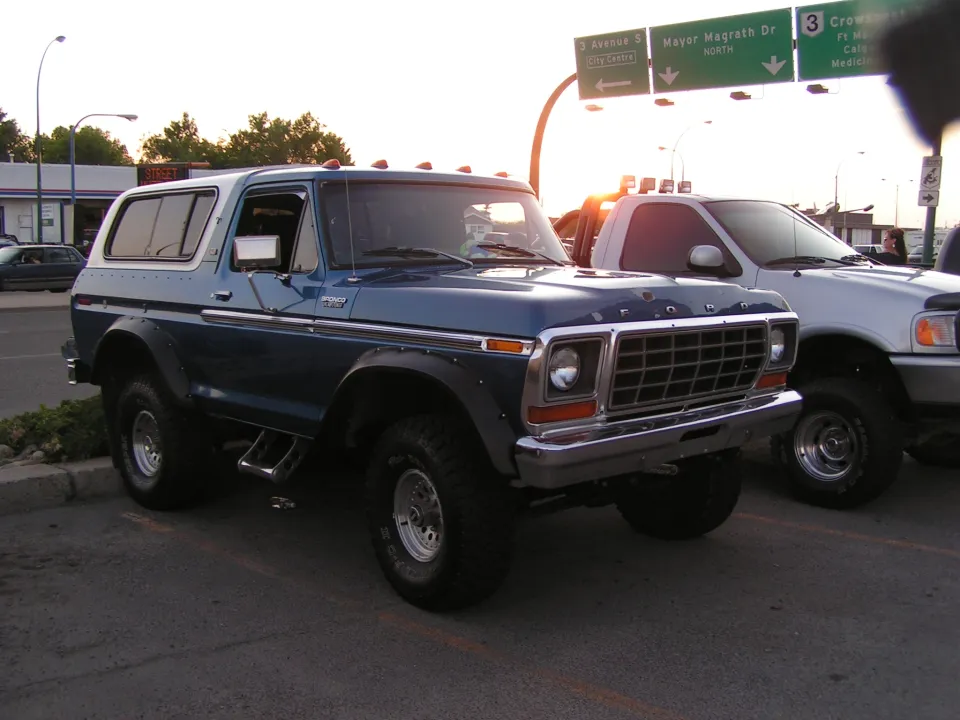
1978 Ford Bronco Custom, aftermarket wheels, street scene (Lethbridge, Canada)
Photo by dave_7, CC BY-SA 2.0, via Wikimedia CommonsSource: Wikimedia Commons
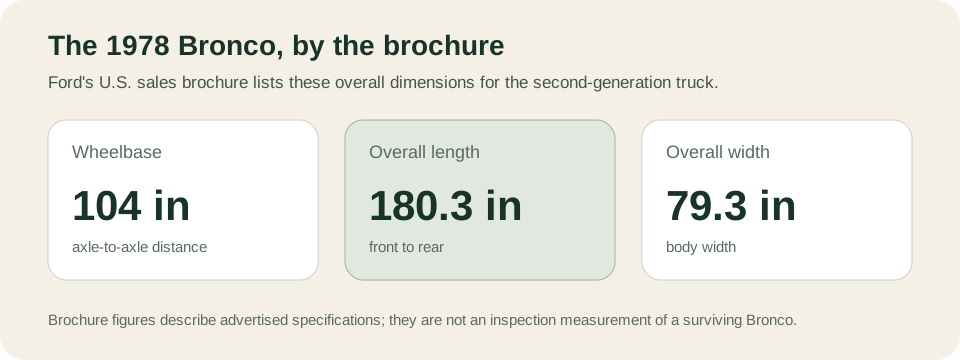
The 1978 Bronco was all new and a lot bigger. Ford put it on a shortened F-Series frame with a 104-inch wheelbase. It measured 180.3 inches long and 79.3 inches wide. The body was a two-door wagon with a removable fiberglass rear roof and a power window in the tailgate.
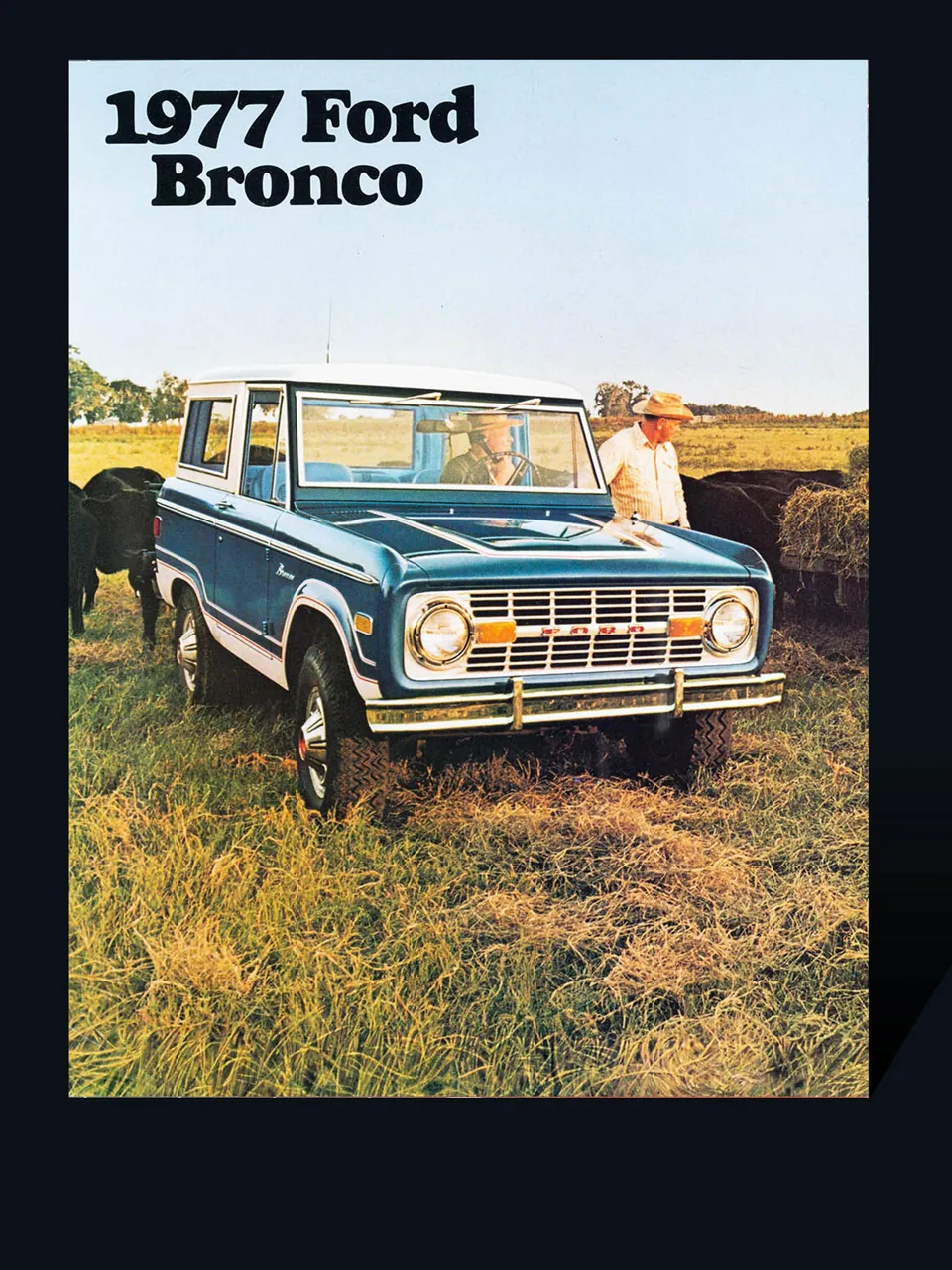
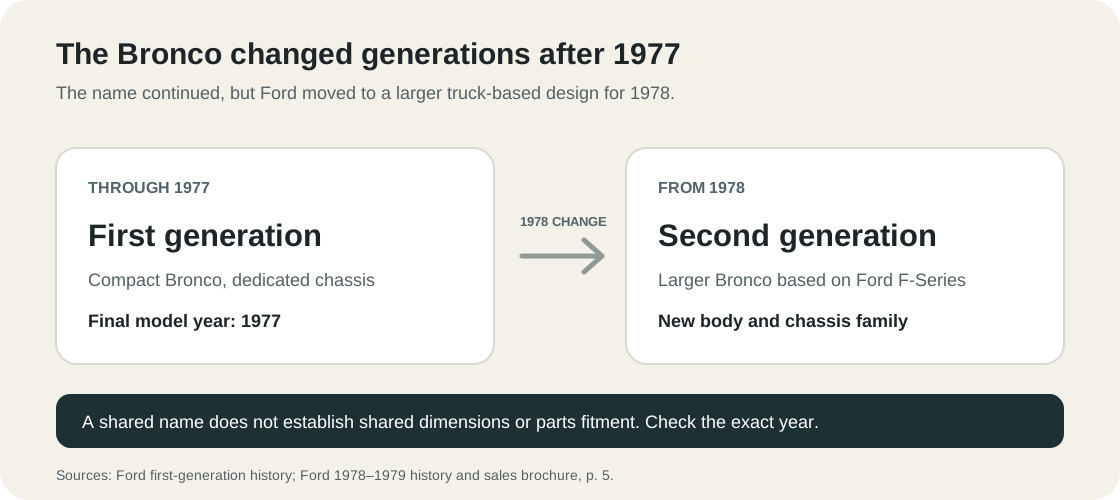
Ford's 1977 brochure cover shows the outgoing compact Bronco, for comparison with the 1978 redesign.Image courtesy Ford Motor CompanySource: FordFord's history and 1978 brochure mark the change from the compact first generation to the larger F-Series-based Bronco.Original BroncoFacts generation-boundary illustration based on linked Ford sourcesSources: Ford · Ford (2) · Ford (3)
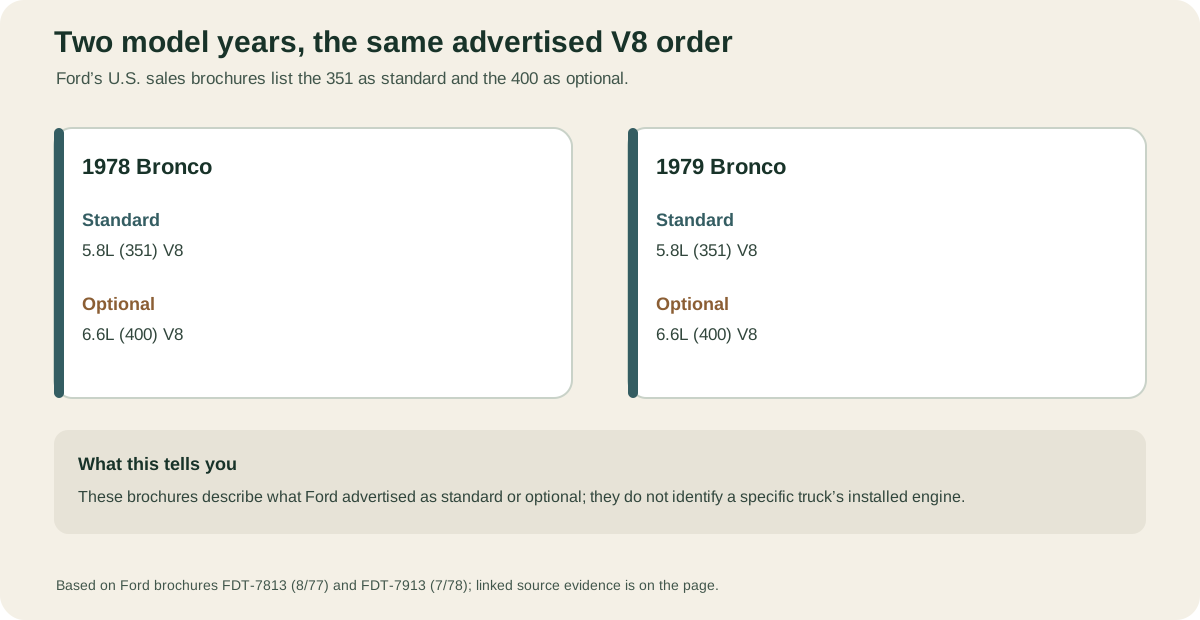
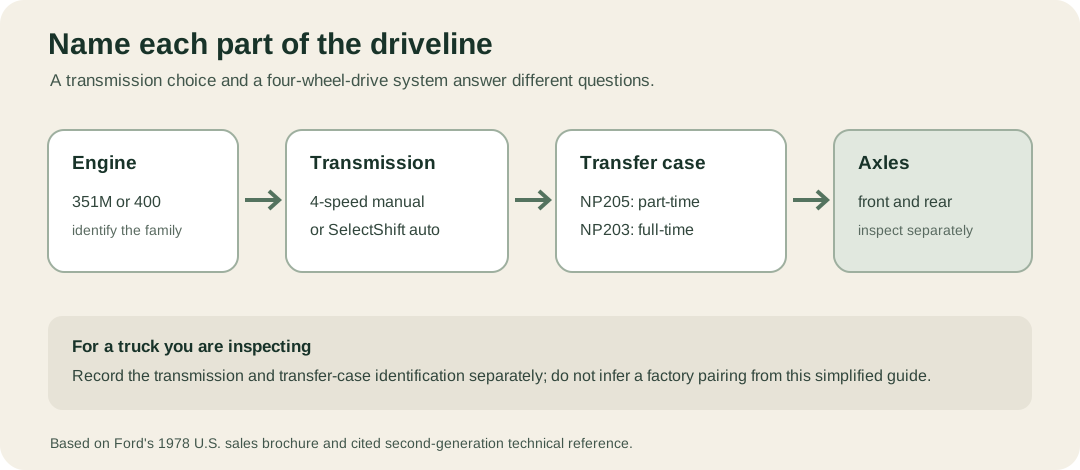
Every one was a V8 with four-wheel drive. Ford's brochure lists the 351 (5.8-liter) as standard and the 400 (6.6-liter) as the option. A four-speed manual was standard and the SelectShift automatic was optional. The NP205 part-time transfer case was standard, and automatic trucks could have NP203 full-time four-wheel drive. The front axle was a solid Dana 44 and the rear was a Ford 9-inch.
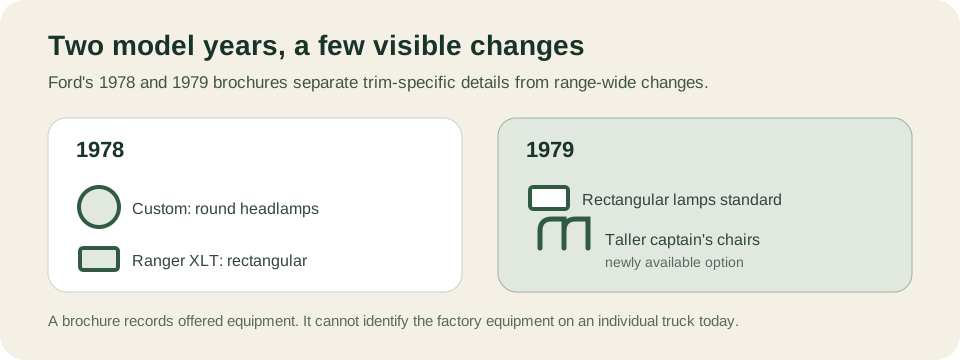
There were two trims, Custom and Ranger XLT, and 19 colors. Custom had round headlamps and Ranger XLT had rectangular ones. The Free Wheelin' package put tri-color stripes and styled wheels on either trim. Ford's history page says the truck was named 1978 Four Wheeler of the Year.
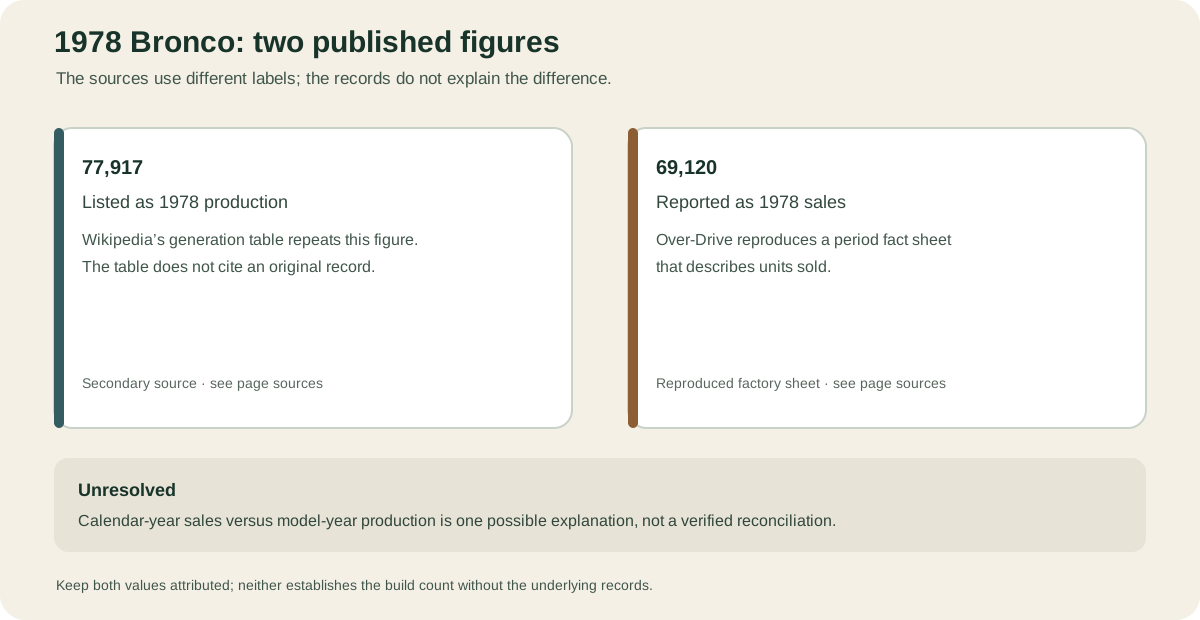
Blue Oval Trucks lists 77,917 built. A reproduced Ford fact sheet says 69,120 sold.
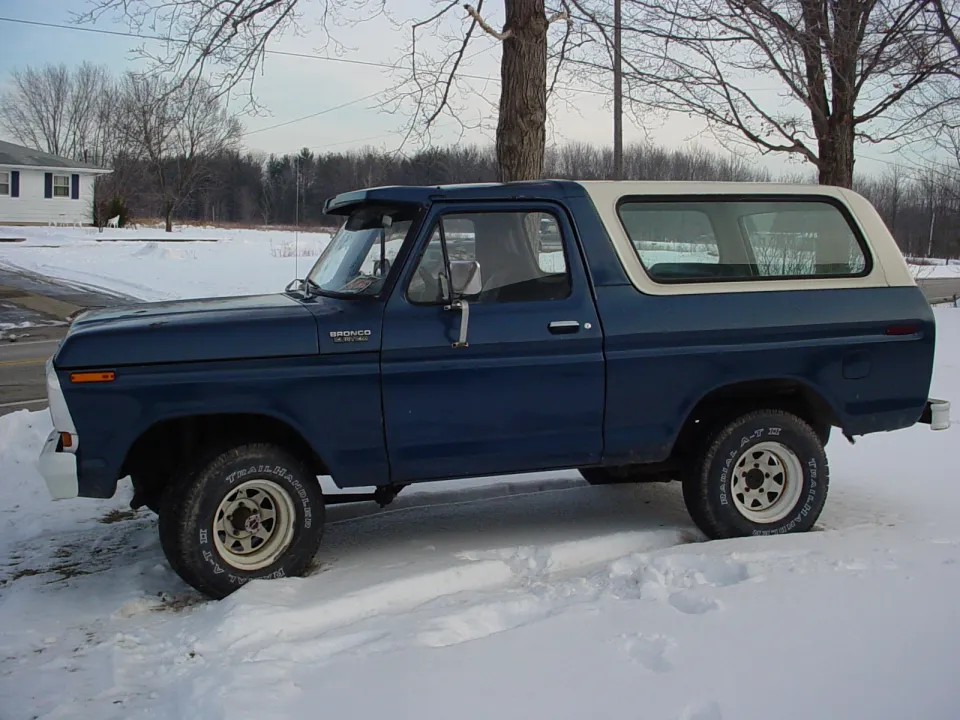
1978 Ford Bronco Custom, blue/white top, snow scenePhoto by Magley64, public domain, via Wikimedia Commons1978 Ford Bronco Ranger XLT soft top, "Free Wheeling" tribute decor, Cars & Coffee (Bridgehampton, NY)Photo by Mr.choppers, CC BY-SA 3.0, via Wikimedia Commons
Blue Oval Trucks lists 77,917 built. A reproduced Ford fact sheet says 69,120 sold, which may be a sales count rather than a build count.
Wikipedia's range, which it draws from Automobile Catalog listings rather than Ford literature.
Over-Drive Magazine's reproduced fact sheet gives the first pair for each engine as SAE net and says horsepower varied by application. Wikipedia gives the second pair.
Ford's brochure gives the ratings and ratio. The Dana 44 and Ford 9-inch names are Wikipedia's.
Project Shorthorn turned the Bronco from a compact 4x4 on its own chassis into a full-size truck built off the F-Series.
Body styles and market
Market: U.S.-market second-generation Bronco
Body styles: Two-door wagon with removable rear fiberglass roof
What changed for this year
Full-size redesign
The Bronco moved to a shortened F-Series frame. Wheelbase is 104 inches, length 180.3 inches and width 79.3 inches.
[1][2]
Removable rear roof
The rear section of the roof is fiberglass and lifts off. The tailgate glass is powered and works from the driver's seat or from the tailgate.
[1][2]
V8 only
The 351 V8 was standard and the 400 V8 was the option. Ford's brochure lists no six for 1978.
[1][7]
Ford's 1978 U.S. brochure lists a 104-inch wheelbase, 180.3-inch length and 79.3-inch width.Original BroncoFacts diagram based on Ford's 1978 sales brochure.Source: Ford
Models and trims
Custom
The base trim. It has round headlamps for 1978.
[1][2]
Ranger XLT
The upper trim. It has rectangular headlamps for 1978.
[1][2]
Ford's brochures show round headlamps on the 1978 Custom and rectangular lamps on the Ranger XLT, before rectangular lamps became standard in 1979.Original BroncoFacts diagram based on Ford's 1978 and 1979 sales brochures.Source: Ford
Engines and transmissions
351 V8
The 5.8-liter 351 was the standard engine in Ford's August 1977 brochure. It is the 351M, an M-block, and has nothing to do with the 351 Windsor. Over-Drive Magazine's reproduced fact sheet rates it at 152 hp and 278 lb-ft net. Wikipedia gives 156 hp and 262 lb-ft.
[1][2][4][8]Ford's history page says “two standard V8 engines” in one passage and calls the 351 the standard engine in another. The 1978 brochure lists the 400 as an option.
400 V8
The 6.6-liter 400 was optional and is also an M-block. The fact sheet rates it at 160 hp and 314 lb-ft net. Wikipedia gives 158 hp and 277 lb-ft.
[1][4][8]
Transmissions and transfer cases
A four-speed manual was standard and the SelectShift Cruise-O-Matic automatic was optional. The NP205 part-time transfer case was standard. NP203 full-time four-wheel drive was optional with the automatic.
[1][7][8]
Ford's 1978 and 1979 brochures both list the 351 V8 as standard and the 400 as optional.Original BroncoFacts diagram based on Ford's 1978 and 1979 sales brochures.Source: Ford
Capability and specifications
Size and weight
104-inch wheelbase, 180.3 inches long, 79.3 inches wide. Wikipedia puts curb weight at 4,663 to 4,718 lb.
[1][7][8]
Axles
Solid Dana 44 front axle and Ford 9-inch rear axle.
[8]
Fuel tank
25 gallons standard. A 32-gallon tank was optional.
[7]
Blue Oval lists 77,917 under its 1978 production heading; a reproduced period fact sheet reports 69,120 sales. The labels and scope differ.Original BroncoFacts diagram; sources and attributions are linked in the caption.Sources: Wikipedia · over-drive-magazine.com
Front bucket seats were standard. A full-width front bench was optional. The rear bench was optional too, and it folds down or comes out for cargo.
[1]
Options and packages
Free Wheelin'
Offered on Custom or Ranger XLT. It adds tri-color striping, dark exterior details, styled wheels and its own trim.
[1][4]
Northland Special
A cold-weather package with upgraded electrical equipment and block heaters.
[4]
Comfort and handling options
Air conditioning, tilt steering and five radio choices were on the list. So were an off-road handling package and quad front shocks.
[1][2]
Safety and recalls
What to check first
Steering, the solid front axle, brakes, fuel system, wiring and tires. Then look for rust.
[1]
Owner and buyer notes
Know which 351 it is
The 1978 351 and 400 are both M-block engines. Use M-block parts listings and service books, not 351 Windsor ones.
[1][8]
Gearbox and transfer case
A 1978 can have the four-speed with the NP205, or the automatic with either the NP205 or the full-time NP203. Know which pair is in the truck before ordering driveline parts.
[1][8]
Front clips get swapped
Round lamps mean Custom and rectangular lamps mean Ranger XLT, as long as the front clip is the one the truck left with. Clips get changed in restorations.
[1][2]
Roof, glass and stripes
Look at the rear roof, its seals and the power tailgate glass. Free Wheelin' stripes are easy to reproduce, so ask for paperwork on a package claim.
[1]
The 1978 brochure describes a four-speed manual and optional SelectShift automatic; a technical reference identifies the NP205 as part-time and the NP203 as full-time.Original BroncoFacts driveline guide based on Ford’s 1978 brochure and cited technical reference.Sources: Ford · classicbroncos.com
Stories from this year
Shorthorn started as a cut-down F-100
Ford engineer George Peterson wrote in 2014 that he coordinated the Shorthorn prototype with Carron & Co. He recalls a shortened 1973 F-100 wearing a Blazer roof to test the idea.
[6]
The tailgate changed on the way to production
Peterson says the prototype used a borrowed liftgate. The production Bronco got a tailgate with drop-down glass.
[6]
Four Wheeler of the Year
Ford's history page says the 1978 Bronco was named Four Wheeler of the Year. Ford's ads called it the “first 4-wheeler that puts it all together.”
[2]