The 1979 Bronco kept the 351 V8 and solid front axle, added captain's chairs and went to rectangular headlamps. Blue Oval Trucks lists 104,038 built.
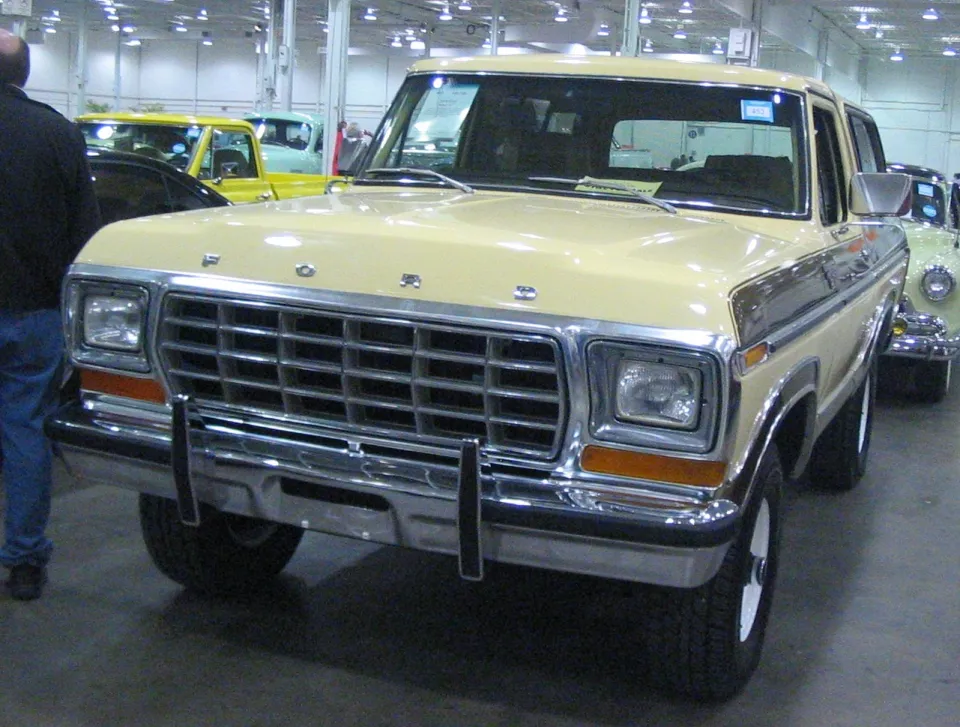
1979 Ford Bronco Ranger XLT, Toronto Spring '12 Classic Car Auction
Photo by Bull-Doser, public domain, via Wikimedia Commons (no attribution legally required)Source: Wikimedia Commons
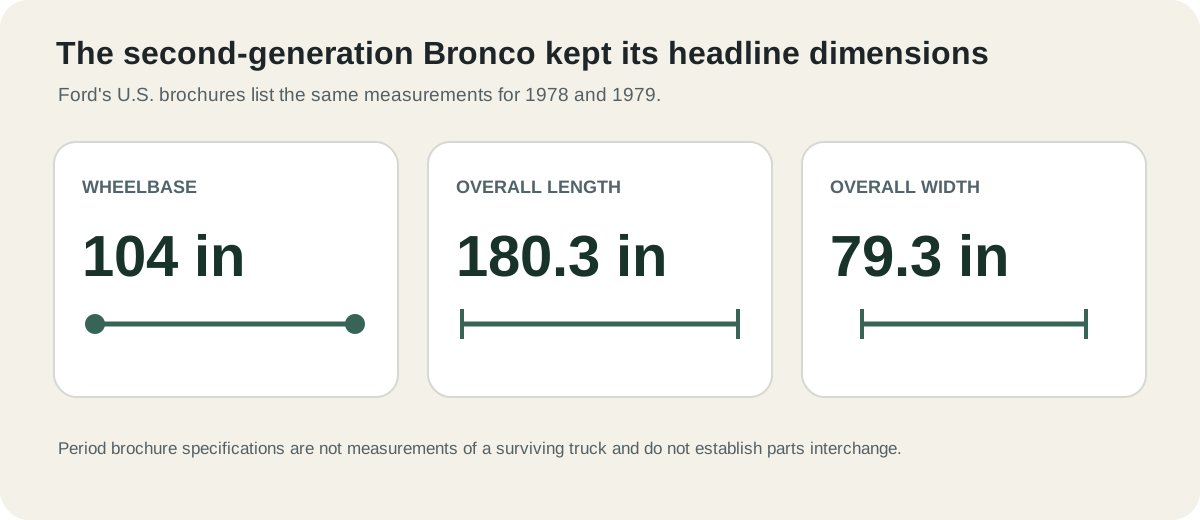
1979 was the second and last year of the big solid-axle Bronco. The truck stayed on its 104-inch wheelbase at 180.3 inches long and 79.3 inches wide, with the same removable fiberglass rear roof.
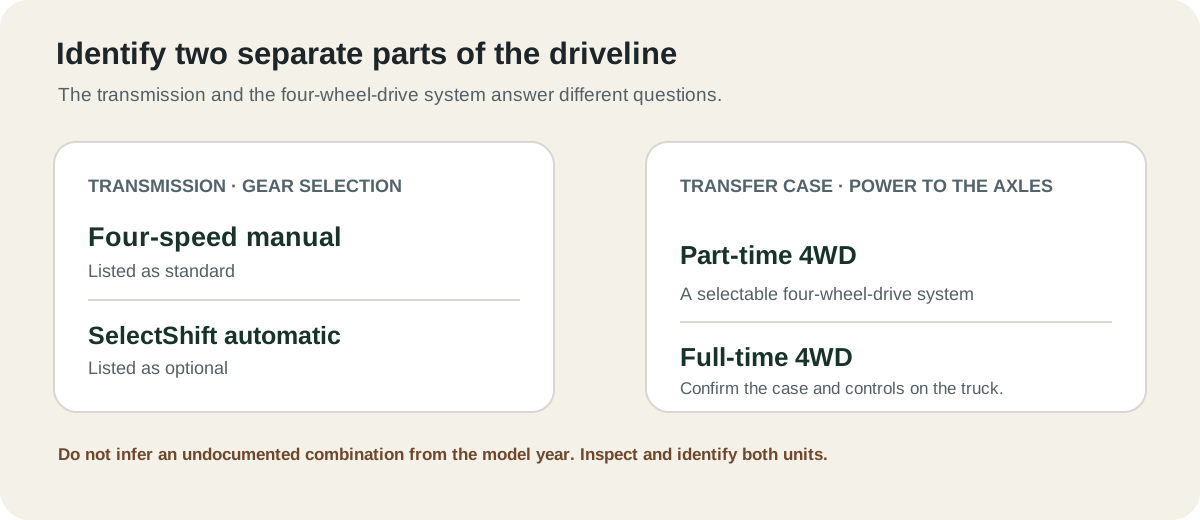
Changes were small. Rectangular headlamps, a Ranger XLT item in 1978, went on every 1979. Taller captain's chairs joined the front-seat choices. The 351 (5.8-liter) V8 stayed standard and the 400 (6.6-liter) stayed optional, in its last Bronco year. Wikipedia rates the 351 at 158 hp and 262 lb-ft and the 400 at 156 hp and 277 lb-ft. A four-speed manual was standard and SelectShift automatic was optional. Automatic trucks could have full-time four-wheel drive.
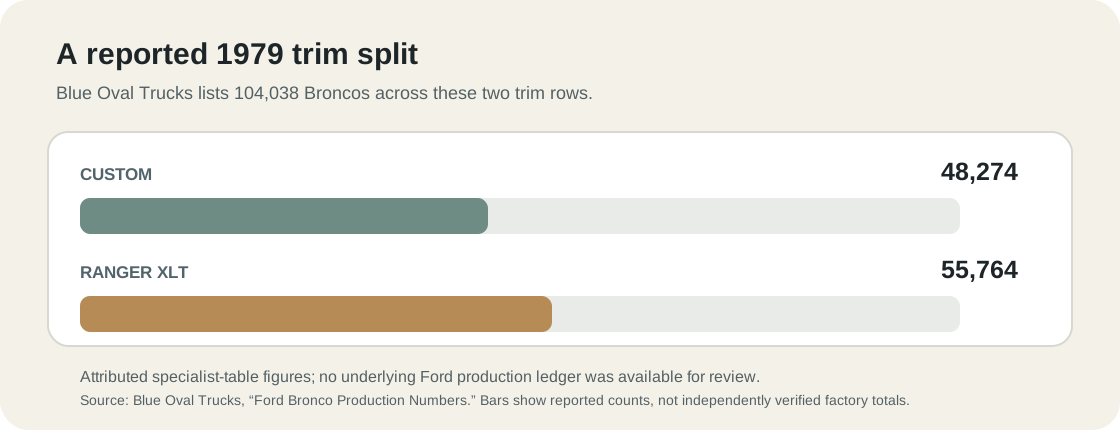
Trims were Custom and Ranger XLT, with 19 colors and the Free Wheelin' stripe package on either. Blue Oval Trucks lists 104,038 built: 48,274 Custom and 55,764 Ranger XLT. That made 1979 the high point of the two-year generation.
1979 was the sales high point and the last year of the solid-front-axle, F-Series-based second generation.
Body styles and market
Market: U.S.-market second-generation Bronco
Body styles: Two-door wagon with removable rear fiberglass roof
This 1978 Ranger XLT wears Free Wheeling tribute graphics.Photo by Mr.choppers, CC BY-SA 3.0, via Wikimedia CommonsSource: Wikimedia Commons
What changed for this year
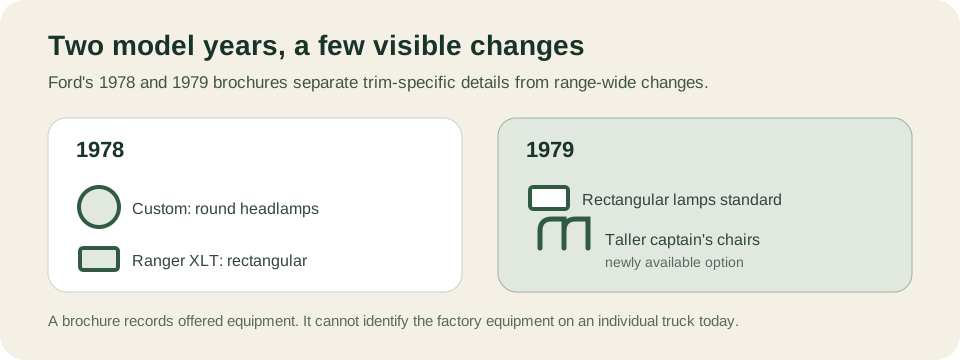
Rectangular headlamps
Every 1979 Bronco has rectangular headlamps. In 1978 only Ranger XLT had them; Custom used round lamps.
[1][2]
Captain's chairs
Taller front captain's chairs were new for 1979.
[1][2]
Last year for the 400
The 6.6-liter 400 V8 made its final Bronco appearance, and so did the solid Dana 44 front axle.
[1][9]
Ford's brochures show rectangular headlamps standard across the 1979 range and taller captain's chairs newly available.Original BroncoFacts diagram based on Ford's 1978 and 1979 sales brochures.Source: Ford
Models and trims
Custom
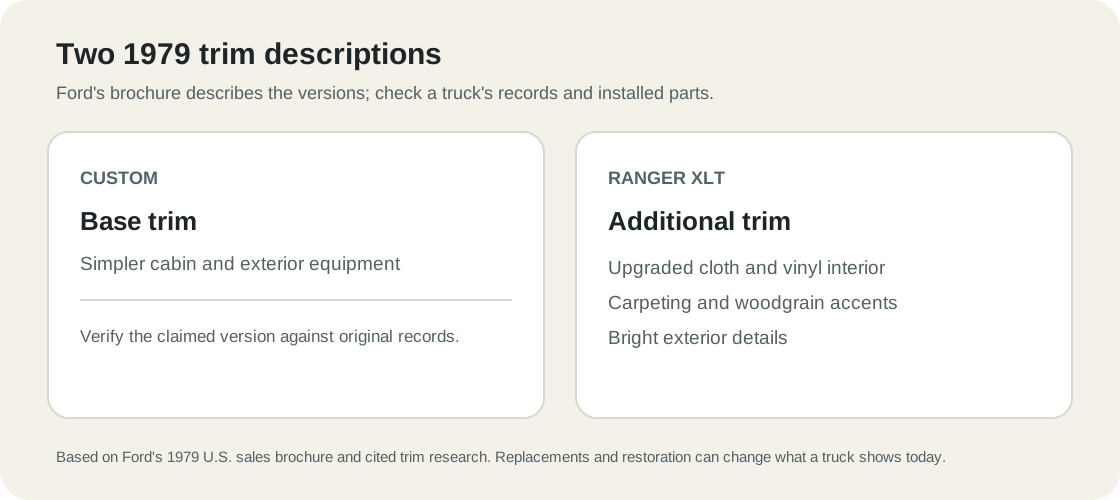
The base trim, with a simpler cabin and exterior. Blue Oval Trucks counts 48,274.
[1][3][6]
Ranger XLT
Cloth-and-vinyl upholstery, carpeting, woodgrain accents and bright exterior trim. Blue Oval Trucks counts 55,764.
[1][3][6]
Ford’s 1979 brochure and trim references describe Custom as the base version and Ranger XLT with upgraded cabin and exterior details.Original BroncoFacts comparison based on linked 1979 trim sources.Ford's history gallery identifies this as a 1979 Bronco interior.Image courtesy Ford Motor CompanySources: Ford · Ford (2)
Engines and transmissions
351M V8
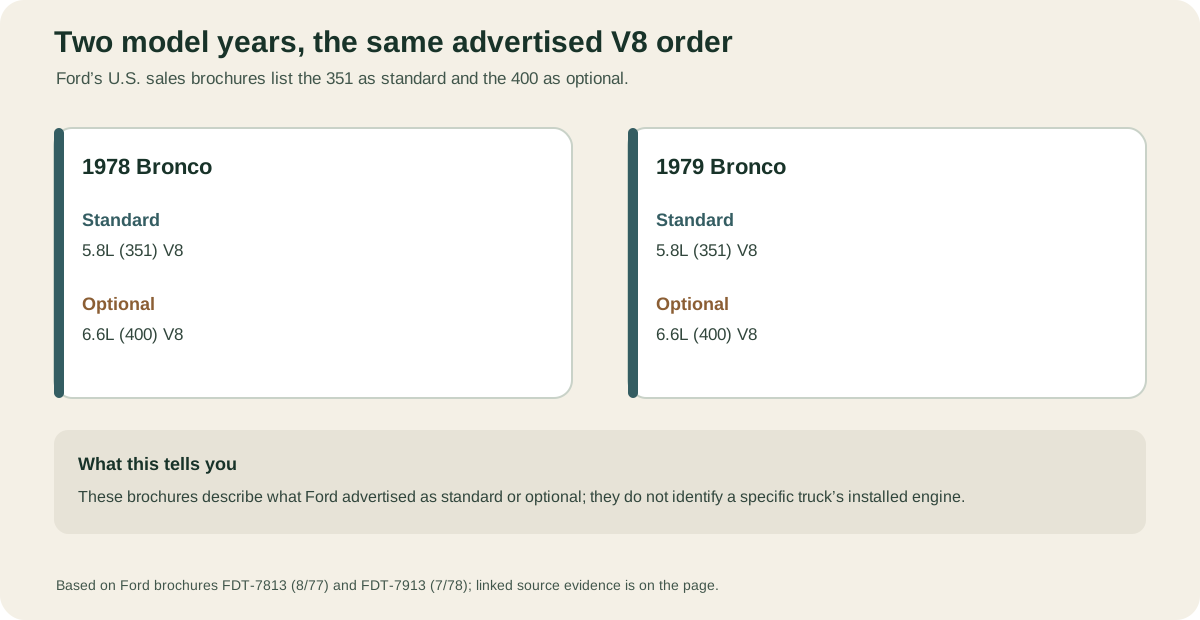
The 5.8-liter 351M was standard in Ford's July 1978 brochure. Wikipedia rates it at 158 hp and 262 lb-ft.
[1][9]
400 V8
The 6.6-liter 400 was optional, in its last Bronco year. Wikipedia rates it at 156 hp and 277 lb-ft.
[1][9]
Transmissions and four-wheel drive
A four-speed manual was standard and SelectShift automatic was optional. The two-speed transfer case was part-time. Full-time four-wheel drive was optional with the automatic.
[1][8]
Ford's 1978 and 1979 brochures both list the 351 V8 as standard and the 400 as optional.Original BroncoFacts diagram based on Ford's 1978 and 1979 sales brochures.Source: Ford
Capability and specifications
Size and weight
104-inch wheelbase, 180.3 inches long, 79.3 inches wide. Wikipedia puts curb weight at 4,663 to 4,718 lb.
[1][8][9]
Axles
Solid Dana 44 front axle and Ford 9-inch rear axle.
[9]
Fuel tank
25 gallons standard. A 32-gallon tank was optional.
[8]
Blue Oval's specialist compilation lists 48,274 Custom and 55,764 Ranger XLT Broncos, totaling 104,038 for 1979.Original BroncoFacts diagram; the provisional source is linked in the caption.Ford's 1978 and 1979 U.S. brochures list a 104-inch wheelbase, 180.3-inch length, and 79.3-inch width.Original BroncoFacts dimension reference based on Ford's 1978 and 1979 U.S. Bronco brochures, p. 5.Source: Ford
Colors and interiors
Paint
Ford's 1979 brochure offers 19 exterior colors. The paint and trim codes are on the certification label, and FORDification has the 1979 code list.
[8][5]
Cabin
Ranger XLT has cloth-and-vinyl seats, carpet and woodgrain. Ford's history page also describes a rear foot well for back-seat passengers.
[1][2][3]
Options and packages
Free Wheelin'
Tri-color or chromatic stripes with dark exterior trim, on Custom or Ranger XLT.
[1][3]
Handling and towing packages
Ford offered a handling package and a trailer-towing package.
[1]
Ford's history gallery shows a 1979 Bronco in a tri-color Free Wheeling setup.Image courtesy Ford Motor CompanySources: Ford · Ford (2)
Safety and recalls
What to check first
Steering, the solid front axle, brakes, fuel system, emissions equipment, wiring and tires. Then look for rust.
[1]
Owner and buyer notes
Know which 351 it is
The 1979 351 and 400 are both M-block engines. Use M-block parts listings and service books, not 351 Windsor ones.
[1][9]
Gearbox and transfer case
A 1979 can have the four-speed manual or SelectShift, with part-time or full-time four-wheel drive. Know which pair is in the truck before ordering driveline parts.
[1]
Telling a 1979 from a 1978
All 1979s left with rectangular lamps, so headlamps no longer separate the trims. Round lamps point to a 1978 Custom front clip.
[1][2]
Roof and stripes
Look at the rear roof, its seals and the tailgate glass. Free Wheelin' stripes are easy to reproduce, so ask for paperwork on a package claim.
[1]
Ford lists a standard four-speed manual and optional SelectShift automatic, alongside part-time and full-time four-wheel-drive choices.Original BroncoFacts driveline reference based on Ford's 1979 U.S. Bronco brochure, p. 5.Source: Ford
Stories from this year
Shorthorn had bigger siblings
George Peterson's 2014 account names Longhorn, Midhorn and Widehorn concepts alongside Shorthorn. The Bronco that reached showrooms was the two-door.
[7][1]
Comfort was part of the pitch
Ford's history page puts captain's chairs in 1979 and describes a rear foot well. The big Bronco was sold on passenger room as well as off-road hardware.
[2]