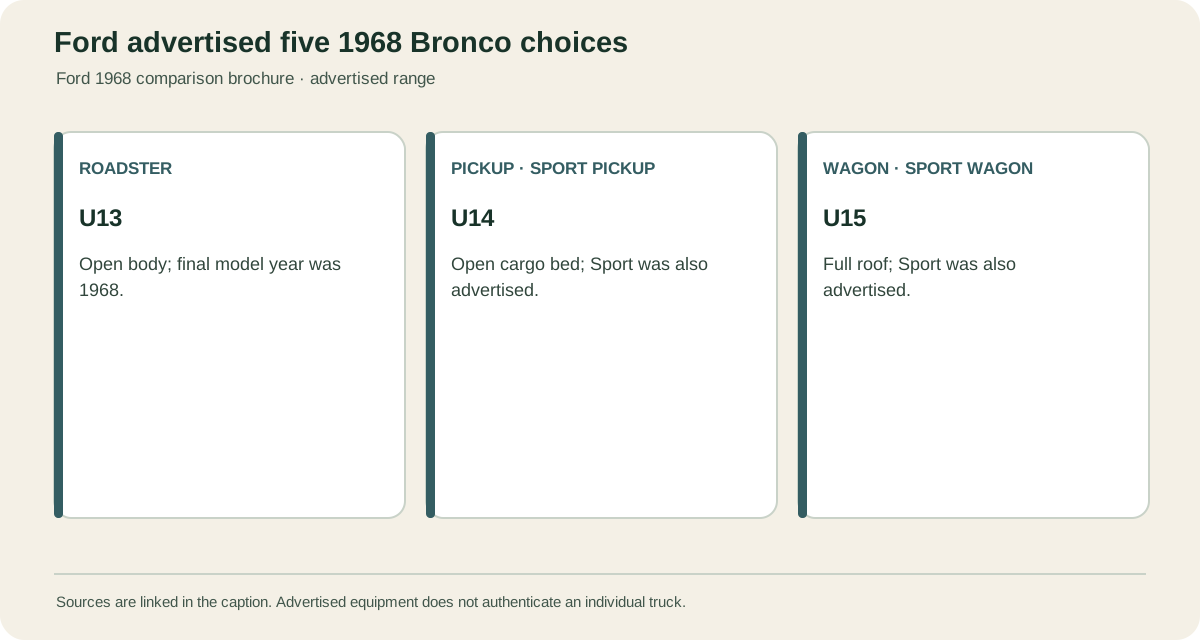
Ford offered five Broncos for 1968: Roadster, Pickup, Wagon, Sport Pickup and Sport Wagon. They were three bodies, and this was the last year for one of them. The open U13 Roadster ended after 1968 with 212 built.
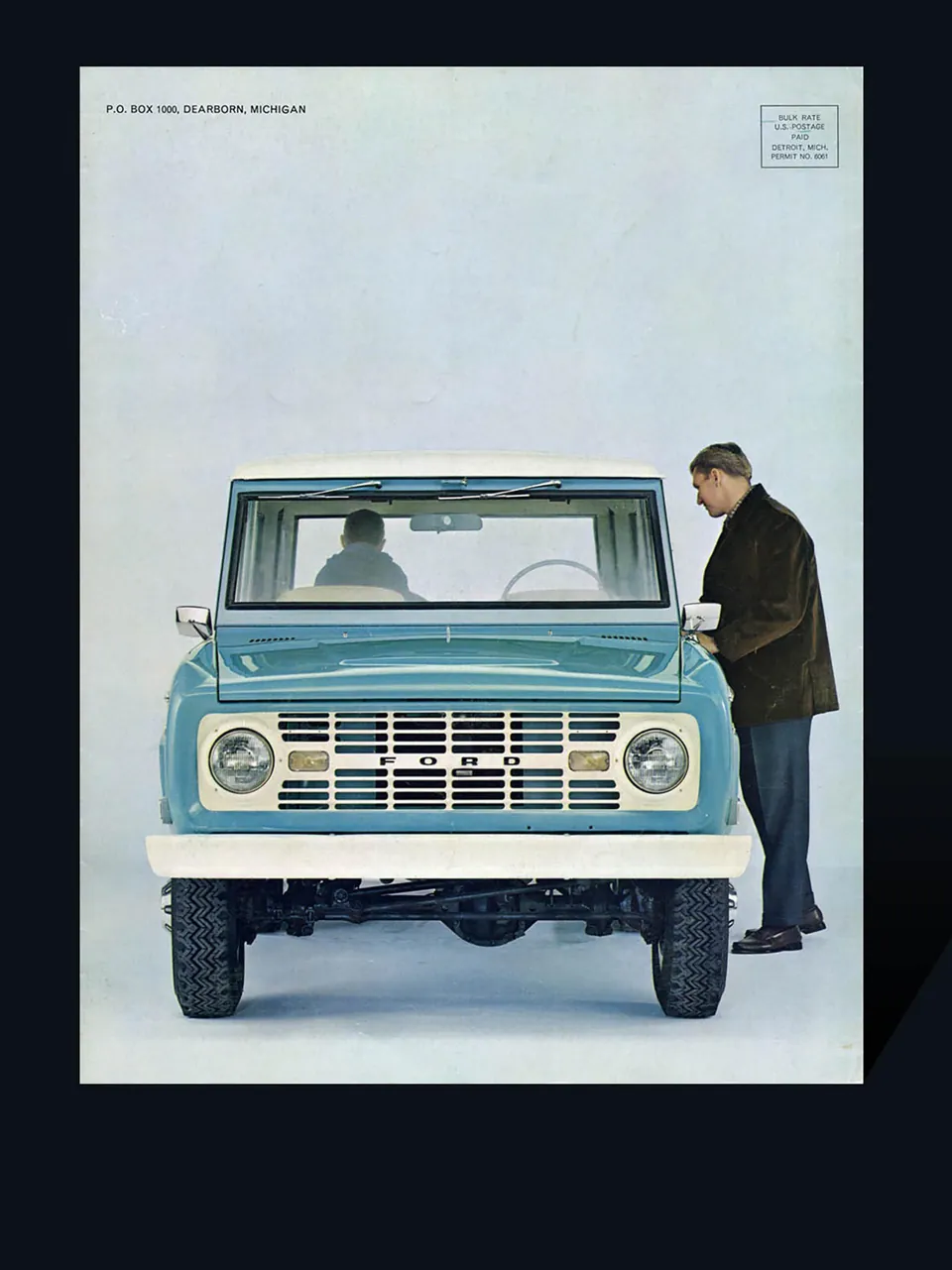
Ford’s 1966 brochure explains the original Roadster, Sports Utility, and Wagon arrangements, background to the Roadster’s final 1968 model year.Image courtesy Ford Motor Company; 1966 Bronco sales brochureSource: FordFord’s 1968 brochure listed Roadster, Pickup, Wagon, Sport Pickup, and Sport Wagon: five advertised model choices built around three body forms.Original BroncoFacts diagram; source documents are linked in the caption.Source: FordPhotographer Elise240SX identifies this as a 1968 Bronco Pickup at the 2023 St. Ignace Car Show Weekend.Photo by Elise240SX, CC BY-SA 4.0, via Wikimedia CommonsSource: Wikimedia Commons
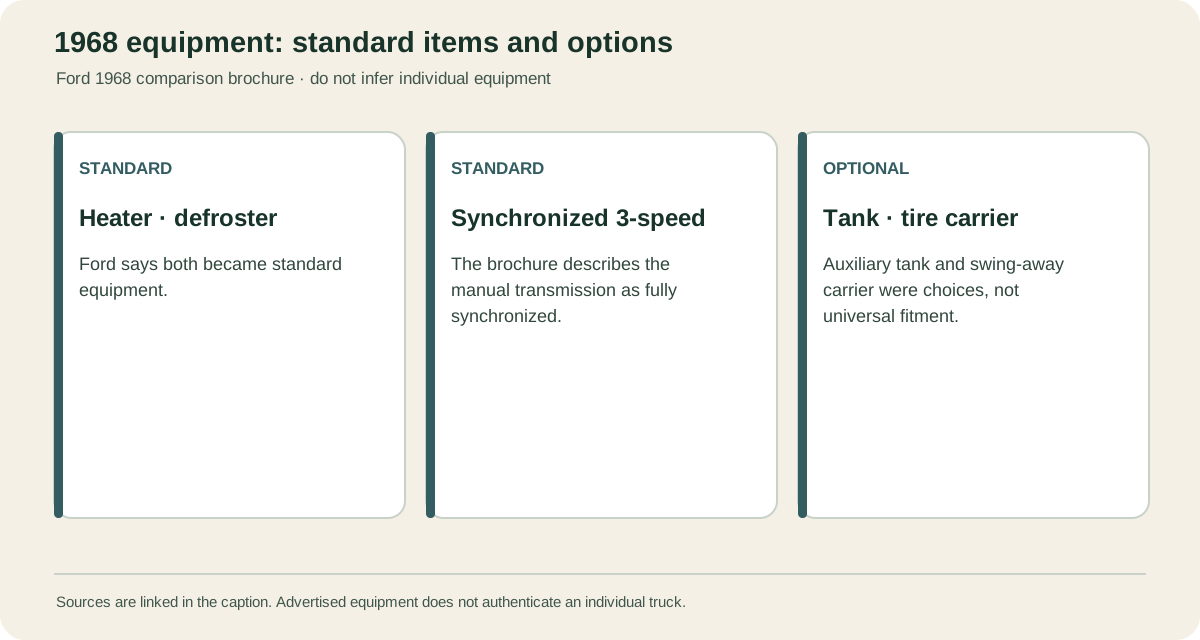
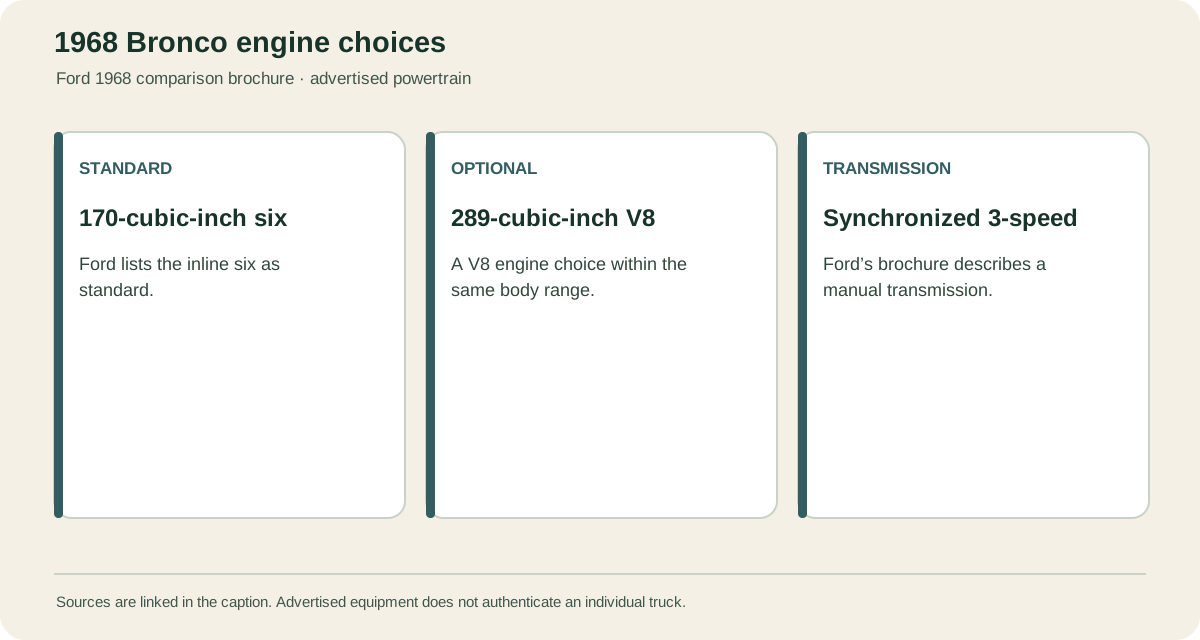
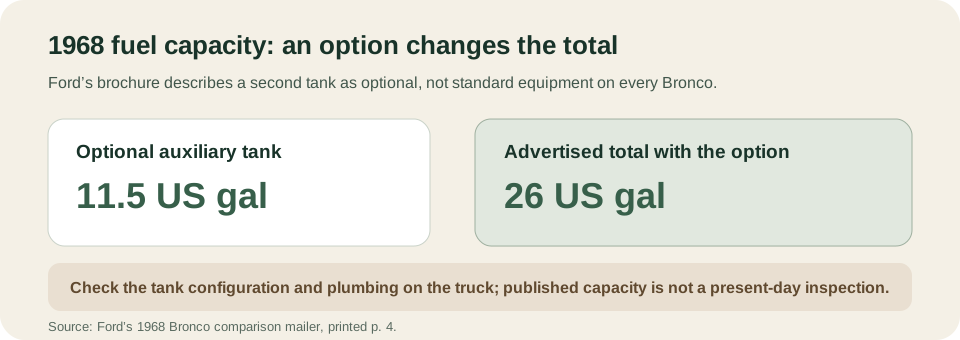
New for the year were a standard fresh-air heater and defroster, a fully synchronized three-speed manual, improved free-running hubs and an optional swing-away tire carrier. The optional 11.5-gallon auxiliary tank brought fuel capacity to 26 gallons. The 170 six was standard at 100 horsepower and the 289 V8 was optional at 195. No automatic was offered.
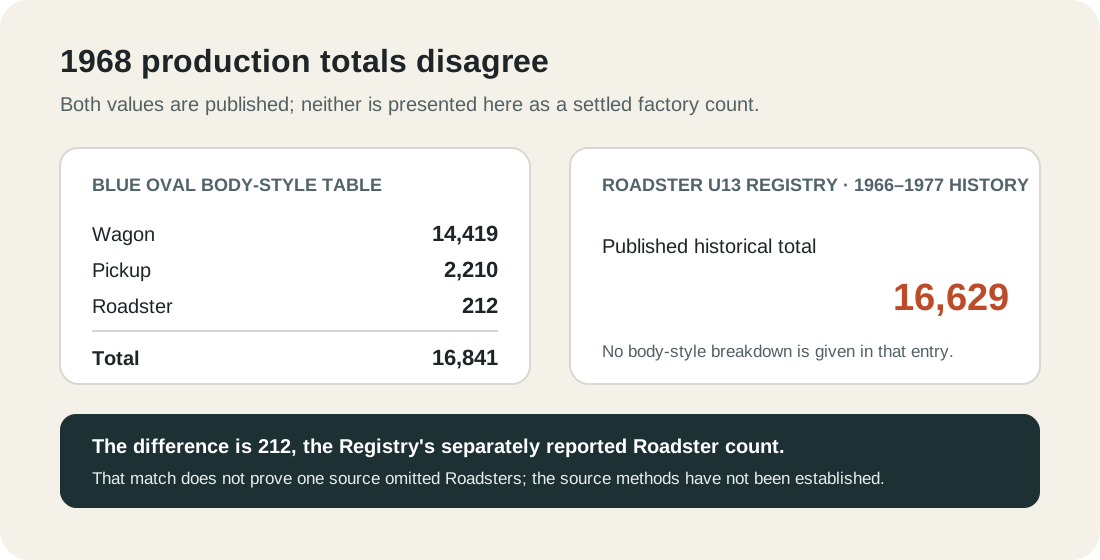
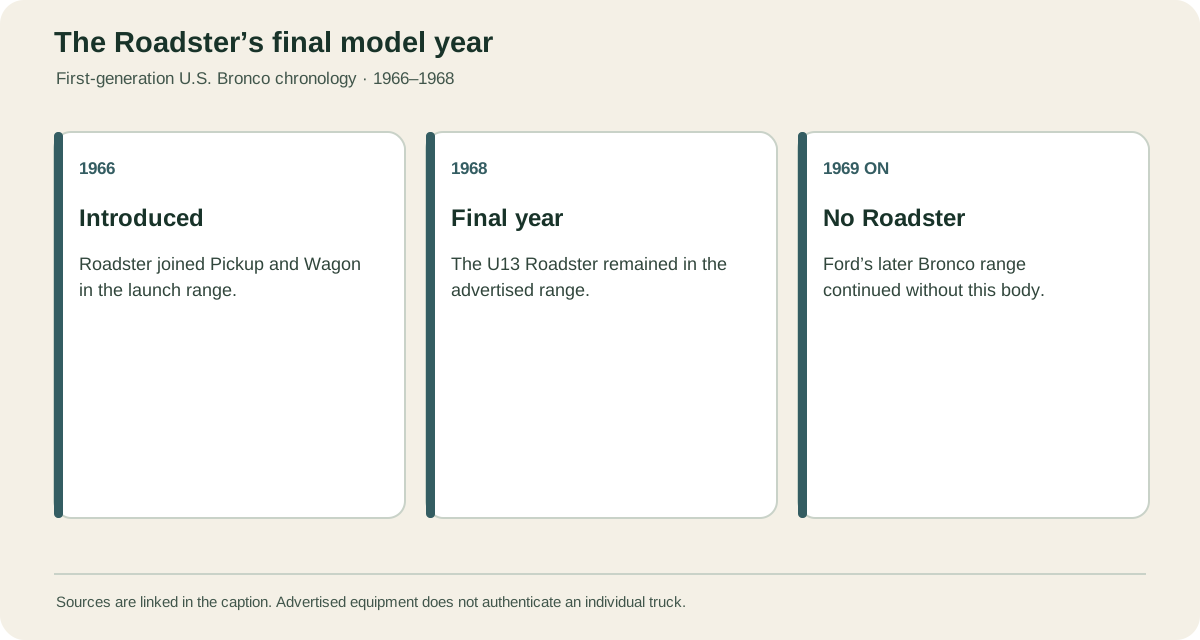
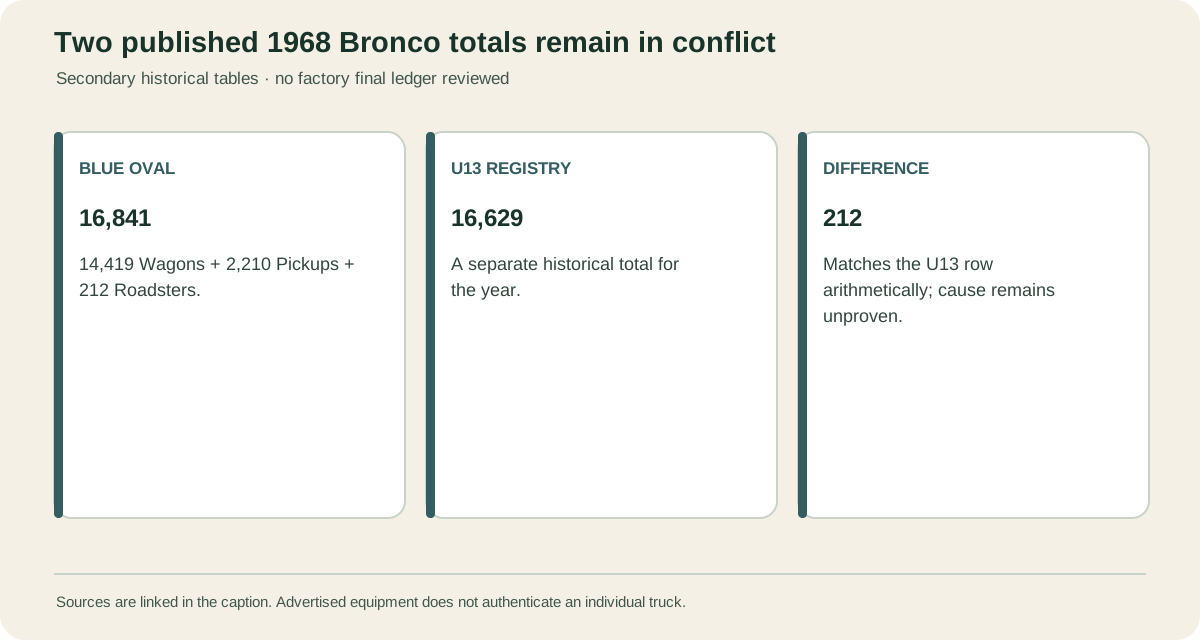
Blue Oval lists 16,841 Broncos; the Roadster U13 Registry reports a historical total of 16,629. The 212 difference matches the separately reported Roadster count.Original BroncoFacts diagram; underlying tables are linked in the caption and year-page sources.Source: blueovaltrucks.comFord’s history page and the U13 Registry place the Roadster in the early range and identify 1968 as its final year.Original BroncoFacts diagram; source documents are linked in the caption.Sources: Ford · roadsteru13.com
Production totals come two ways. Blue Oval Trucks lists 14,419 Wagons, 2,210 Pickups and 212 Roadsters for 16,841. The Roadster Registry's history gives 16,629, exactly 212 fewer.
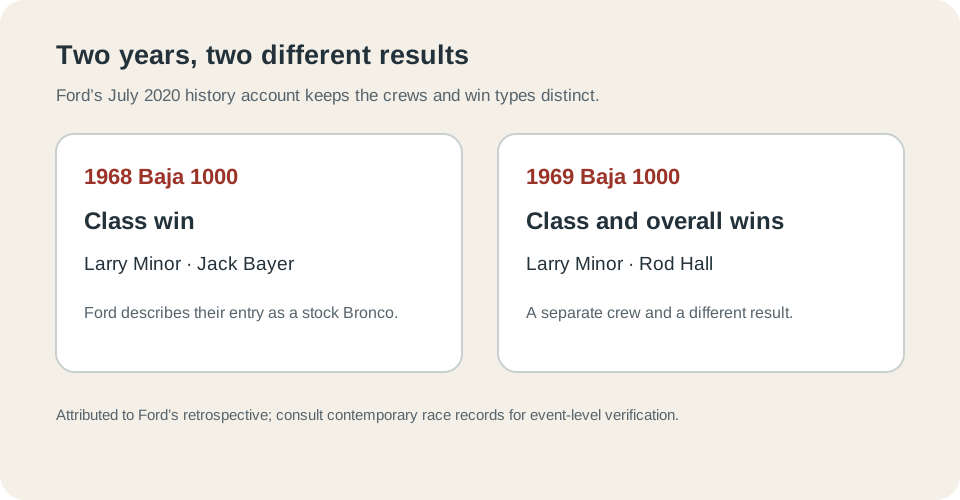
On the race course, Ford credits Larry Minor and Jack Bayer with a stock-Bronco class win at the 1968 Baja 1000. The overall win, by Minor and Rod Hall, came a year later.
Blue Oval Trucks adds up 14,419 Wagons, 2,210 Pickups and 212 Roadsters for 16,841. The Roadster Registry's history counts 212 U13 Roadsters but gives 16,629 for the year, exactly 212 fewer.
Ford says the plant built the Bronco from 1965 until June 12, 1996.
From Ford's 1968 comparison mailer, which does not say gross or net. ClassicBroncos lists the same 100 and 195 hp.
1968 was the last year of the three-body Bronco. After it the open Roadster was gone and the Wagon carried most of the sales.
Body styles and market
Market: U.S.-market first-generation Bronco
Body styles: U13 Roadster, final year; U14 Pickup; U15 Wagon
What changed for this year
Roadster final year
1968 was the last model year for the open U13 Roadster. From 1969 the Bronco came as a Pickup or Wagon.
[1][2]
Five models
Wagon, Pickup and Roadster, plus Sport Wagon and Sport Pickup.
[3]
Equipment updates
A fresh-air heater and defroster became standard. The three-speed manual was now fully synchronized, the free-running hubs were improved, and a swing-away tire carrier joined the options.
[3]
Ford’s brochure separates standard equipment from options: the heater/defroster and synchronized three-speed were standard; the auxiliary tank and swing-away tire carrier were options.Original BroncoFacts diagram; source documents are linked in the caption.Source: Ford
Models and trims
Base bodies
Roadster (U13), Pickup (U14) and Wagon (U15).
[1][2]
Sport
Sport trim was offered on the Wagon and the Pickup.
[3]
Engines and transmissions
170-cubic-inch inline six
Standard, at 100 hp in Ford's 1968 comparison mailer.
[3][7]
Fully synchronized three-speed manual. No automatic was offered.
[3][7]
Ford’s 1968 brochure lists the 170 six as standard, the 289 V8 as optional, and a fully synchronized three-speed manual.Original BroncoFacts diagram; source documents are linked in the caption.Source: Ford
Capability and specifications
Fuel capacity
26 gallons with the optional 11.5-gallon auxiliary tank.
[3]
Wheelbase and axles
92-inch wheelbase. Front axle rated at 2,500 lb and rear at 2,780 lb.
[3][7]
Blue Oval’s body-style table totals 16,841; the U13 Registry’s broader history reports 16,629. The 212-unit difference equals the listed Roadster count.Original BroncoFacts diagram; source documents are linked in the caption.Sources: blueovaltrucks.com · roadsteru13.comFord’s 1968 brochure lists an optional 11.5-gallon auxiliary tank, for 26 gallons total with the option.Original BroncoFacts diagram based on Ford’s 1968 comparison mailer.Sources: Ford · over-drive-magazine.com
Colors and interiors
Cabin equipment
A fresh-air heater and defroster were standard in every 1968 Bronco. Sport trim dressed up the Wagon and the Pickup.
[3]
Options and packages
Auxiliary tank and tire carrier
The 11.5-gallon auxiliary tank and the swing-away tire carrier were both options.
[3]
Sport
A factory trim package for the Wagon and the Pickup.
[3]
Safety and recalls
Period safety
The 1968 Bronco predates airbags and crash-test ratings. A fresh-air defroster was standard.
[3]
Owner and buyer notes
Confirming a Roadster
Any Bronco with the top off looks like a Roadster. A real one is a U13 on the data plate and frame, and only 212 were built for 1968.
[2]
Two production totals
16,841 comes from Blue Oval Trucks and 16,629 from the Roadster Registry.
[4][5]
Stories from this year
A class win before the overall win
Ford's history credits Larry Minor and Jack Bayer with a stock-Bronco class win at the 1968 Baja 1000. Minor won overall with Rod Hall in 1969.
[6]
Ford identifies this number 56, 1968-model-year Bronco as driven by Larry Minor and Rodney Hall in the 1969 Mexican 1000. SCORE confirms Minor and Rod Hall’s overall win; the photo also shows competition equipment.Image courtesy Ford Motor Company, first-generation Bronco history gallerySources: Ford · Ford (2) · Ford CanadaFord’s 2020 history credits Minor and Bayer with a 1968 class win, then Minor and Hall with the 1969 class and overall wins.Original BroncoFacts comparison; Ford retrospective linked in captionSource: Ford corporate